
Salesforce Financial Services Cloud: Complete 2026 Guide for Banking, Insurance, and Wealth Management
Data model, Actionable Intelligence, compliance tools, and Agentforce integration. Everything FSC practitioners need to know in 2026.

A relationship banker pulls up a client to prep for a 9 a.m. call. The checking and savings balances live in the core banking system. The mortgage sits in a separate lending platform. The client's spouse, who actually makes the investment decisions, is a contact on a different account entirely. The banker spends the first ten minutes of the call apologizing for not knowing things the bank already knows. This is the exact gap Financial Services Cloud was built to close, and whether it closes it for you depends almost entirely on how you set it up.
This guide covers what FSC actually is in 2026, the data model you will be living inside, what changes per industry vertical, and where the product genuinely struggles. No marketing gloss. Just what a practitioner needs before they commit.
What is Salesforce Financial Services Cloud
Financial Services Cloud is an industry application built on top of the Salesforce platform. It ships as a [managed package](/terms/managed-package) (the FinServ namespace) layered over standard Sales Cloud and Service Cloud, plus a set of prebuilt Lightning components, page layouts, and data structures tuned for banks, insurers, and wealth managers.
The key distinction from plain Sales Cloud is the data model. Sales Cloud thinks in Accounts, Contacts, and Opportunities. That model assumes you are selling to a company. Financial services does not work that way. You sell to a person, that person belongs to a household, the household holds financial accounts, and the relationships between people matter as much as the people themselves. A trust, a joint mortgage, a beneficiary designation: these are relationships, and a generic CRM has nowhere to put them.
FSC adds the objects and relationship structures to model all of that natively, so you are not bolting custom objects onto Sales Cloud and hoping the reporting holds together. It also brings vertical features: financial goals, referral tracking, interaction summaries, and a rules engine called Actionable Intelligence that we will cover later.
One thing to set straight early. FSC is a license and a managed package, not a magic data integration layer. It gives you the destination schema. Getting the core banking, policy admin, and custodial data into that schema is your integration project, and it is usually the larger half of the work.
The FSC Data Model
This is where FSC implementations live or die. Get the model wrong and every report, every list view, and every automation you build later inherits the mistake.
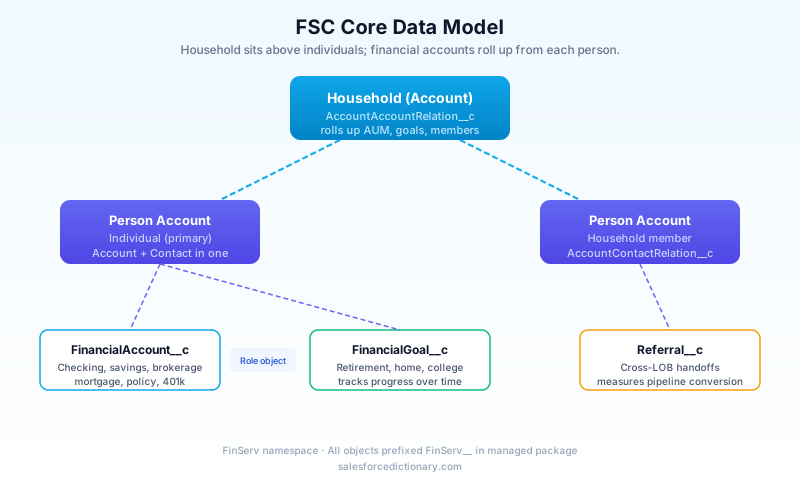
Start with Person Accounts. FSC uses the standard Person Account model to represent an individual as a single record that behaves like both an Account and a Contact. This matters because an individual in financial services is the customer, not a contact under some company. Person Accounts are a one-way door at the org level, so decide on them before you load a single record. Most retail FSC builds use them. Some commercial-heavy builds blend Person Accounts with business Accounts.
Households sit above individuals. In FSC a household is an Account record with a specific record type, and members are linked through the FinServ__AccountAccountRelation__c and FinServ__AccountContactRelation__c junction objects. These reciprocal relationship objects are the part people underestimate. They let you say "Jane is the spouse of John, and John is the spouse of Jane" with the inverse relationship created automatically. They also drive household rollups, so a household can show total assets, total liabilities, and member count without you summing it by hand.
Financial Accounts are the products a client holds: FinServ__FinancialAccount__c for the account itself, with related objects for account roles, transactions, and holdings. A checking account, a brokerage account, a 401k, a mortgage. Each is a Financial Account record tied to the owning individual and, through rollups, to the household. The FinServ__FinancialAccountRole__c object captures who is the primary owner, who is a joint owner, and who is a beneficiary. That role object is how you model a joint account correctly instead of duplicating it.
Financial Goals (FinServ__FinancialGoal__c) track what the client is saving toward: retirement, a house, college. Advisors use them to anchor conversations and to show progress over time.
Referrals (FinServ__Referral__c) capture cross-line-of-business handoffs. The branch banker spots a client who needs a wealth advisor, logs a referral, and the firm can actually measure whether that pipeline converts.
The trap here is over-modeling. You do not need every junction object populated on day one. Map the relationships your business actually reports on, load those, and resist the urge to mirror the entire managed package schema because it exists.
Three verticals: what FSC does differently per industry
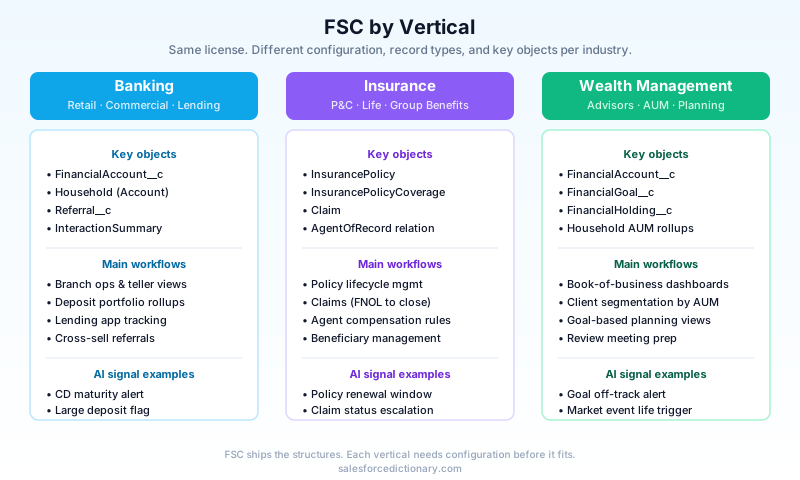
FSC is one product with three fairly different personalities. The license is the same. The configuration, record types, and features you turn on are not.
Banking
Retail and commercial banking lean on the financial account and household structures heavily, because a banking relationship is a portfolio of products across a family. The banking-specific features cover branch operations, teller and banker workflows, and deposit relationship views. Lending is the big one. FSC integrates with origination through the financial account model and supports application tracking, though most banks pair it with a dedicated loan origination system and sync status back into FSC. Branch banking also drives the referral engine hardest, since the whole point is moving a deposit customer into lending or wealth.
What banking teams care about most: a clean single view of the customer across deposit, lending, and card, plus the ability to route the right next conversation to the right banker. Actionable Intelligence, covered below, is where that routing actually happens.
Insurance
Insurance reshapes the model around policies. FSC's insurance features add policy management built on objects like InsurancePolicy, claims tracking, and the agent-of-record relationship that is central to how carriers and agencies operate. A policy has coverages, the policyholder has beneficiaries, and the servicing agent has a defined relationship to both. Property and casualty, life, and group benefits each bend the model differently, so insurance builds spend real time on record types and page layouts per line of business.
Claims is the workflow-heavy area. First notice of loss, claim assignment, status updates, and customer communication all run through Service Cloud functionality that FSC extends. The agent-of-record concept also feeds compensation and servicing rules, so getting that relationship object right is not cosmetic.
Wealth Management
Wealth is the most relationship-dense vertical. Advisors manage assets under management, want portfolio-level views, and live in the household and financial goal objects daily. FSC gives advisors rollups of AUM across accounts, held-away asset tracking, and goal-based planning views. The advisor productivity angle is real here: book-of-business dashboards, client segmentation by tier, and review meeting prep that pulls the household's full position into one screen.
The honest read across all three: FSC ships the structures, but each vertical needs meaningful configuration before it fits. There is no "turn on insurance mode" switch that produces a finished claims process. You are assembling features that were built for your industry, which is a head start, not a finished product.
Actionable Intelligence
Actionable Intelligence is FSC's rules-and-signals engine, and it is the feature that most distinguishes a real FSC build from a custom-object Sales Cloud build.
The pattern is signal to action. A signal is a meaningful event or condition: a large deposit hits an account, a CD is maturing in 30 days, a client's financial goal falls behind schedule, a life event gets logged. Actionable Intelligence evaluates these signals against configured rules and surfaces a prioritized, contextual recommendation to the right user. The banker opens the client and sees "CD maturing, propose rollover" rather than discovering it three days after the client moved the money to a competitor.
Why is this better than Flow alone? Flow is excellent at deterministic automation, and you will still use it everywhere. But Actionable Intelligence is purpose-built to rank and present next-best-actions to a human in the moment, with the financial context already assembled. Recreating that in raw Flow means building the signal evaluation, the prioritization, the surfacing component, and the dismissal tracking yourself. FSC gives you the framework and the financial data model it sits on. You configure the rules; you do not engineer the engine.
In practice you start small. Pick three or four high-value signals your bankers or advisors genuinely act on, configure those, and measure whether the recommendations get used. A dashboard full of ignored "insights" is worse than none, because people learn to dismiss the panel without reading it.
Agentforce in FSC (2026)
The AI story in FSC has shifted hard toward Agentforce. Einstein features still exist for prediction and recommendation, but in 2026 the conversation is about agents that take action, not just models that score records.

Agentforce in an FSC context means deploying agents grounded in your financial data model. A service agent can answer a client's question about a transaction, check the financial account record, and handle a routine request like a beneficiary update, escalating to a human when the request crosses a defined threshold. An advisor-facing agent can prep a meeting brief: summarize the household's positions, flag goals that are off track, and draft talking points before the advisor walks in.
The piece that makes this work is grounding. An agent is only as good as the data it can see and the actions it is allowed to take. This is where Data Cloud matters. Data Cloud unifies the customer profile across core banking, policy systems, and FSC itself, and Agentforce draws on that unified profile plus the FSC schema to ground its responses. Without that grounding, you get a chatbot that hallucinates account balances, which in financial services is a fast path to a regulator's attention.
Two cautions for 2026 builds. First, scope the agent's actions tightly. Read access and drafting are low risk. Anything that moves money or changes a policy needs explicit guardrails, human confirmation, and an audit trail. Second, agents inherit your data quality problems. If your household relationships are wrong, the agent confidently tells the advisor wrong things. Clean the model before you point AI at it.
Compliance and data governance
Financial services is regulated, and FSC includes structures that help, though none of them make you compliant on their own.
Interaction Summaries (InteractionSummary and related objects) give you a structured way to log client meetings, the participants, and the topics discussed, which matters for suitability and recordkeeping requirements. Compliant Data Sharing lets you control access to financial records with rules that sit alongside standard sharing, useful when access needs to follow regulatory lines rather than org-chart lines.
For the heavier requirements you pair FSC with platform features. Salesforce Shield adds field audit trail with extended history retention, event monitoring to see who accessed what, and platform encryption for sensitive data at rest. Consent management objects track what the client agreed to and when, which feeds both marketing rules and privacy obligations.
The point to internalize: FSC and Shield give you the tooling. Your compliance team defines the policy, and your admin configures the tooling to enforce it. Buying the licenses is not the same as passing the audit.
What FSC won't do for you
Time for the honest section, because FSC is genuinely good and also genuinely demanding.
It will not simplify your data model. FSC is more complex than Sales Cloud, not less. The reciprocal relationship objects, Person Accounts, and rollup configurations are powerful and unforgiving. A junior admin who learned on a standard org will hit a wall, and you will need someone who understands the FSC schema specifically.
It will not be cheap or fast to implement. FSC licensing carries a premium, and the integration work to feed it from core systems is the dominant cost. Budgets that account for licenses but not the integration project tend to stall halfway through, with a beautiful data model and no data in it.
It will not move on your schedule. FSC is a managed package, and the schema and features update on Salesforce's release cadence, three times a year. New objects appear, some features get reworked, and your customizations have to keep pace. Plan for regression testing every release, not just when you feel like it.
And it will not fix bad data. Point any of FSC's AI or Actionable Intelligence features at a messy household model and you scale the mess. The model is the foundation, and everything good in FSC sits on top of it.
Your next step
Before you configure anything, map your real relationships on paper: which individuals, which households, which financial accounts, and which of the FSC junction objects you actually report on. Then load a small, clean slice of production data into a sandbox and build one Actionable Intelligence signal end to end. If that signal surfaces correctly and your test users act on it, you have proven the model works and you can scale with confidence. If it does not, you have found your problem while it is still cheap to fix.
About the Author
Dipojjal Chakrabarti is a B2C Solution Architect with 29 Salesforce certifications and over 13 years in the Salesforce ecosystem. He writes and edits salesforcedictionary.com, published by KineticBit Inc., to help admins, developers, architects, and cert/interview candidates sharpen their fundamentals. More about Dipojjal.
Share this article
Sources
Related dictionary terms
 Our appAdWake up sharp. Not just awake.The alarm that rings through Silent and DND — free on iOS & Android.Get WakeSharp →
Keep reading

Agentforce Service: The Complete 2026 Guide (Formerly Service Cloud)
Service Cloud is now Agentforce Service. This 2026 guide cuts through the rebrand: the Service Agent, IT Service, Agentic Milestones, knowledge grounding, and the real deflection numbers.

Salesforce Data 360: The Complete 2026 Implementation Guide
Data 360 is Salesforce's unified data platform for the agent era. This 2026 implementation guide walks data streams, identity resolution, segmentation, activations, and zero-copy federation.

Salesforce Sharing & Visibility: The Complete 2026 Guide (OWD, Roles, Sharing Rules, Apex Sharing)
The complete 2026 guide to Salesforce sharing - OWD, role hierarchy, sharing rules, manual + Apex managed sharing, teams, territories, public groups, performance considerations, and pitfalls.


Comments
No comments yet. Start the conversation.
Sign in to join the discussion. Your account works across every page.