
Selling Through ChatGPT and Gemini: A Salesforce Merchant's Guide to the Agentic Commerce Protocols
AI assistants drove 20 percent of global holiday orders in 2025, and in July 2026 ChatGPT instant checkout goes GA on Salesforce catalogs. Here is how ACP and AP2 actually move an order from a chat window into your order pipeline, and what you have to configure before they do.

A customer types "best waterproof hiking boots under 150" into ChatGPT on a Tuesday night. She never opens a browser tab. ChatGPT shows her three products, one of them yours, with a price and a buy button sitting right there in the chat. She taps it, confirms with a card she saved months ago, and the order is done. You hear about the sale the next morning, when it lands in your order management console next to the ones that came through your own storefront. She never saw your homepage. She never used your search bar. By Thursday she may not remember your brand name at all.
That is the trade agentic commerce asks you to make in 2026. You give up the storefront as the place where buying happens, and in return you reach customers at the moment they ask an AI assistant a question, before they ever think to visit a site. Salesforce reported that AI agents drove about 20 percent of global orders during the 2025 holiday season, roughly 262 billion dollars in sales. In March 2026, AI-referred traffic to US retail sites converted 42 percent better than everything else. Those numbers are why every commerce vendor spent the last year building plumbing for chat windows they do not own.
This post is about that plumbing. Not the marketing story, which the Agentforce Commerce guide already covers. The mechanics: the two protocols that carry an order out of ChatGPT or Gemini and back into Salesforce, who holds the money and the liability along the way, and the settings you have to get right before you flip any of this on.
Two protocols, not one standard
There is no single agentic commerce standard, and pretending there is one will burn you. There are two serious protocols, backed by two different platform camps, and Salesforce supports both.
The first is the Agentic Commerce Protocol, ACP, co-developed by Stripe and OpenAI and open-sourced in late 2025. ACP is what powers ChatGPT Instant Checkout, which OpenAI launched on September 29, 2025. It defines two things: a product feed spec, so an AI channel can read your catalog, and a checkout API, so the agent can create a cart, apply your pricing and tax rules, and take payment without the shopper leaving the chat. Stripe handles the money movement through a delegated payment token. You handle the catalog, the inventory truth, and the fulfillment.
The second is the Agent Payments Protocol, AP2, announced by Google on September 16, 2025 with more than 60 launch partners including Mastercard, PayPal, American Express, and Salesforce. AP2 is a payments rail rather than a full commerce spec. Its core idea is three signed Mandates, carried as W3C Verifiable Credentials: an Intent Mandate that captures what the shopper authorized, a Cart Mandate that pins the exact items and price, and a Payment Mandate that releases funds. Those signatures give you a cryptographic paper trail for who agreed to what, which matters when an agent spends money on a human's behalf and someone later disputes it. AP2 treats cards, bank transfers, and stablecoins as equal citizens. Google wired it into Gemini and Google Search AI Mode.
Salesforce sits in the middle and speaks to both. Here is how the two compare from a merchant's chair.
| Dimension | ACP (OpenAI + Stripe) | AP2 (Google) |
|---|---|---|
| Primary channel | ChatGPT Instant Checkout | Gemini app, Google Search AI Mode |
| What it covers | Catalog feed plus checkout | Payment authorization rail |
| Payment layer | Stripe delegated token | Cards, bank, stablecoin via Mandates |
| Trust artifact | Shared payment token | Signed Intent, Cart, Payment Mandates |
| Salesforce GA on your catalog | July 2026 (ChatGPT) | Summer 2026 (Gemini, AI Mode) |
| Merchant of record | You | You |
The two rows that should stop you are the last two. The GA dates are close together, which means you are not choosing one channel and waiting on the other. You are staging both in the same quarter. And in both, you are the merchant of record, which is the single most important sentence in this whole shift.
Merchant of record is still you, and that is the point
When a sale closes inside ChatGPT, it is tempting to think of OpenAI as the store and yourself as the supplier. That is not the arrangement. In the Salesforce implementation of both protocols, you remain the merchant of record. The order lands on the same platform that runs your service cases, your loyalty program, and your marketing, not in a separate console you have to reconcile at month end.
That has three consequences people underrate.
You own the customer relationship and the data. The Order record, the payment, the tax calculation, and the fulfillment obligation all belong to you. The agent is a discovery and checkout surface, not a reseller taking title to your goods.
You own the liability. Returns, chargebacks, fraud, and consumer-protection obligations are yours. An AI agent that misreads a promotion and sells at the wrong price still creates an order you have to honor or cancel, and the cancellation reason belongs in your records, not OpenAI's.
You own the truth about inventory and price. The agent shows what your feed says. If your feed is stale, the agent sells something you cannot ship, and the shopper blames you, not the chat window.
So the work is not "let a third party sell for us." The work is to expose an accurate, real-time view of catalog and pricing to a channel you do not control, take a payment token you did not originate, and turn all of it into a clean order in your own system. That is an integration problem, and it looks like this.
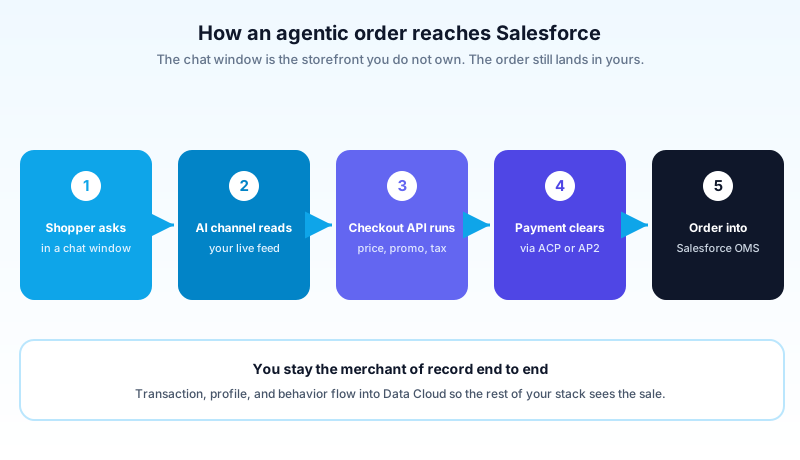
Read that flow left to right. The shopper asks a question in a chat window. The AI channel queries your syndicated feed to find matching products with live price and stock. When the shopper commits, the channel calls the checkout API, which runs your real pricing, promotion, and tax logic and returns a total. Payment clears through the protocol's token layer. The order drops into Salesforce order management as a normal order, and the transaction, the profile, and the behavior flow into Data Cloud so the rest of your stack can see it.
Getting your catalog into the channels
The good news for existing Salesforce merchants is that the hard part, a clean product catalog with structured attributes, is already sitting in Business Manager. Salesforce built the syndication so you publish structured product feeds to OpenAI directly from the catalog you already maintain, with clicks rather than a custom integration. No third-party middleware, no separate feed management tool.
That does not mean it is free. Three things decide whether your products show up well or badly inside an assistant.
Attribute quality is now conversion. When a shopper browses your site, a thin product description still converts because the photo and the reviews carry the weight. When an AI assistant is deciding which three products to surface out of thousands, it reads your structured attributes: material, size range, use case, compatibility, dimensions. A product with rich, accurate attributes gets recommended. A product with a two-line description and a blank size field is invisible, no matter how good it is.
Price and inventory freshness is a hard requirement. The feed is a promise. If your feed updates nightly but your prices change hourly during a flash sale, the assistant will sell yesterday's price and you will eat the difference. Real-time or near-real-time feed updates stop being a nice-to-have the moment an autonomous agent is transacting against them.
Channel parity has to be a decision, not an accident. You can choose to show different prices or products in different channels. What you cannot do is let it happen by mistake, because a shopper who sees one price in Gemini and another on your site notices instantly and trusts you less. Decide your parity policy first, then configure to it.
The three channels do not behave the same way, and treating them as one integration is how teams get surprised. This is the split.
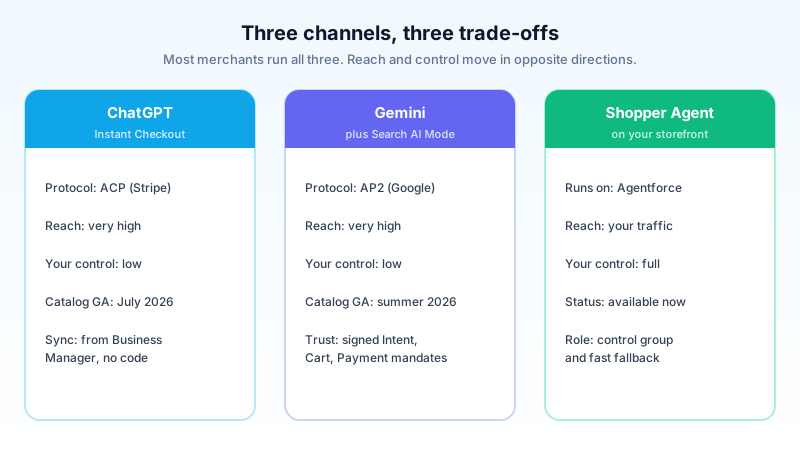
The channel on the far right, your own Shopper Agent on your storefront, is the one you fully control. It runs on your properties, follows your prompts, and keeps the whole session inside your walls. The two external channels reach far more people but hand you less control over how your brand is presented. Most merchants will run all three, and the Storefront Next rebuild that many teams are already doing is what makes the owned Shopper Agent viable at the same time.
The order comes back, and your pipeline was not built for it
Here is where implementations that looked fine in a demo fall apart in production. An order that originates in ChatGPT arrives with a different shape than an order from your storefront. It may carry no persistent browser session. It may have a payment token you have to reconcile against Stripe rather than a card you charged directly. The shopper may have no account in your system at all, because the assistant abstracted that away.
Your order management, your fulfillment triggers, your loyalty accrual, and your tax reporting all assumed a storefront-shaped order. Now they have to accept an agent-shaped one.
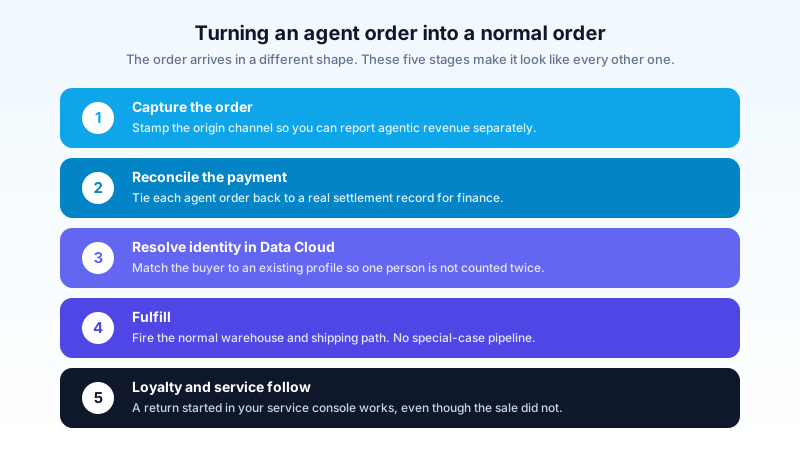
Walk the reconciliation. The order is captured with its channel stamped on it, so you can report agentic revenue separately later. The payment is reconciled against the protocol's settlement, so your finance team ties every agent order back to a real settlement record. Identity resolution in Data Cloud tries to match this buyer to an existing profile using email or payment fingerprint, so a first-time ChatGPT buyer who later logs into your site is recognized as one person, not two. Fulfillment fires off your normal warehouse and shipping path. Loyalty and service follow the same order downstream, so a return started in your service console works even though the sale started in a chat window.
If your architecture already runs on connected order data, this is configuration. If your order pipeline is a tangle of point-to-point integrations, wire the channel stamp and the identity resolution first, because those two are what let you measure and serve agentic orders like every other order. This is exactly the kind of cross-system routing that MuleSoft and event-driven patterns were built for, and it is worth reading the Data 360 implementation guide before you commit to a matching strategy.
Where this breaks
I would rather tell you the failure modes than pretend there are none.
Returns and disputes get murky. When the sale happened in a channel you do not own, the shopper's mental model of "where do I go to return this" is unclear. If they ask ChatGPT to process a return and ChatGPT cannot, they are annoyed at you. Publish the return path clearly and make sure your service agents can find agent-originated orders.
Fraud surface changes. AP2's signed Mandates exist precisely because an agent spending on a human's behalf is a new fraud vector. A verifiable credential trail helps, but you still need your own fraud rules tuned for a channel where the usual browser and device signals may be missing.
Attribution gets political. Marketing will want to claim agentic revenue. Merchandising will want to claim it. Neither built the storefront that got skipped. Stamp the channel on every order from day one so the argument is settled by data, not by who talks loudest.
Margin pressure is real. If assistants make comparison instant and frictionless, your worst-differentiated products get commoditized fastest. The answer is attribute quality and genuine differentiation, not hoping shoppers do not compare.
A rollout that survives peak season
Do not turn this on across the whole catalog the week before your biggest sales window. The pattern that works looks like the one Salesforce teams use for any high-blast-radius change.
Start with a bounded product set, ideally a category with clean attributes and stable pricing, and enable one channel. ChatGPT Instant Checkout first is reasonable, since its GA on Salesforce catalogs is July 2026 and it is the most mature. Watch the reconciliation for two weeks. Confirm that orders capture cleanly, payments tie out, identity resolves, and returns work end to end. Only then widen the catalog, and only then add Gemini and AI Mode as those reach GA over the summer.
Keep your owned Shopper Agent running the entire time. It is your control group and your fallback. If the external channels behave badly during a promotion, the storefront agent is the surface you can fix in minutes.
What to do this week
Pull up your product catalog and audit attribute completeness on your top 200 SKUs by revenue. That single list is what decides how you show up inside an assistant, and it is work you can start before any protocol is enabled. Then confirm two things with your team: that every order can be stamped with its origin channel, and that your Data Cloud identity resolution will match an agent buyer to an existing profile. Those three items, attribute quality, channel stamping, and identity resolution, are the foundation. The protocols are the easy part once the foundation holds.
Agentic commerce is not going to wait for your storefront redesign. The customers are already asking assistants what to buy. The only open question is whether your products are in the answer, and whether the order that follows lands cleanly in a system you actually run.
About the Author
Dipojjal Chakrabarti is a B2C Solution Architect with 29 Salesforce certifications and over 13 years in the Salesforce ecosystem. He writes and edits salesforcedictionary.com, published by KineticBit Inc., to help admins, developers, architects, and cert/interview candidates sharpen their fundamentals. More about Dipojjal.
Share this article
Sources
- Salesforce Announces Support for Agentic Commerce Protocol in Collaboration with Stripe (Salesforce Newsroom)
- As AI Agents Transform Commerce, Salesforce Unleashes Its Biggest Agentforce Commerce Release Yet (Salesforce)
- Announcing Agent Payments Protocol (AP2) (Google Cloud Blog)
- Salesforce releases AI agents among B2B ecommerce updates (Digital Commerce 360)
- Agentic MCP Shopper Tools Quick Start (Salesforce Developers)
Related dictionary terms
Practise it
Five questions on Platform Developer I
Exam-style questions with an explanation after each one. No account needed, and your answers build a weak-topic map once you have one.
Keep reading

Salesforce MCP: The Complete 2026 Guide
MCP is the open standard that lets Agentforce agents, Claude Desktop, and Cursor read records, run SOQL, and invoke Flows directly in your org. Here's what every Salesforce developer needs to know in 2026.

What Is Salesforce Headless 360? The Complete 2026 Guide for Developers, Admins & Architects
Salesforce Headless 360 exposes Salesforce capabilities as APIs, MCP tools, and CLI commands so work can happen in agents, Slack, voice, and custom apps without relying on the browser UI.
Salesforce Storefront Next: The Complete 2026 Guide
Storefront Next replaces SFRA with React 19, React Router 7, and Vite. This guide covers the full architecture, the B2C DX MCP Server, Commerce Apps, and the migration decision every Salesforce commerce team needs to make in 2026.

Salesforce Data 360: The Complete 2026 Implementation Guide
Data 360 is Salesforce's unified data platform for the agent era. This 2026 implementation guide walks data streams, identity resolution, segmentation, activations, and zero-copy federation.
Agentforce Commerce: The Complete 2026 Guide (Formerly Commerce Cloud)
Commerce Cloud is now Agentforce Commerce. This 2026 guide covers the unified B2C/D2C/B2B platform, Intent-Aware Search, ChatGPT catalog syndication, and the agentic-shopping rollout.
Comments
No comments yet. Start the conversation.
Sign in to join the discussion. Your account works across every page.