
Agentforce at the FIFA World Cup 2026: Deployment Lessons Every Architect Should Steal
Salesforce put Slack on the live World Cup and held Agentforce 360 back for 2027. That sequencing choice is the most reusable deployment lesson an architect will see all year.
A staff member in Toronto needs a credentialing problem solved before kickoff in three hours. Another in Guadalajara is chasing a vendor about pitch-side equipment that did not arrive. A third in Kansas City is coordinating a shift change across two languages. None of them has time to log into a ticketing console. They are working out of Slack, and the work moves at the speed of the message.
That is the FIFA World Cup 2026 as Salesforce is actually running it. The tournament kicked off on June 11, 2026, with 48 teams across 16 host cities in the United States, Canada, and Mexico, and an audience expected to clear 5 billion people. Salesforce signed on as the Official Tournament Supporter, which gave it a stage most vendors only dream about.
What Salesforce chose to put on that stage is the interesting part. Not the flashy new agent platform. The boring, dependable one. There is a lesson in that for anyone who has ever had to decide which product carries the weight of a launch, and this post pulls it apart.
What Salesforce Actually Deployed
Read the announcements carefully and the deployment splits into three distinct workloads, each assigned to a different product based on how much was riding on it.
Slack runs the live workforce operations for the 2026 men's tournament. Across all 16 host cities, the people organizing the event coordinate in Slack: shift handoffs, vendor escalations, incident response, the thousand small decisions that a tournament generates every hour. This is the live, high-visibility, no-second-chances workload, and it sits on Slack.
Agentforce 360, the flagship agentic platform, is pointed at the FIFA Women's World Cup 2027 in Brazil for fan engagement. Salesforce described that future deployment in specific terms: autonomous agents, personalized, omnichannel, multilingual. Notice the tense. That is a 2027 commitment, not a 2026 one. The men's tournament happening right now does not get the agentic fan experience.
Agentforce Service, Sales, and Marketing handle the back-office layer for both tournaments: communications with host cities, suppliers, and partners. This is the connective tissue, important but lower-stakes than either the live ops or the public-facing fan experience, and it runs on the established Agentforce application tier.
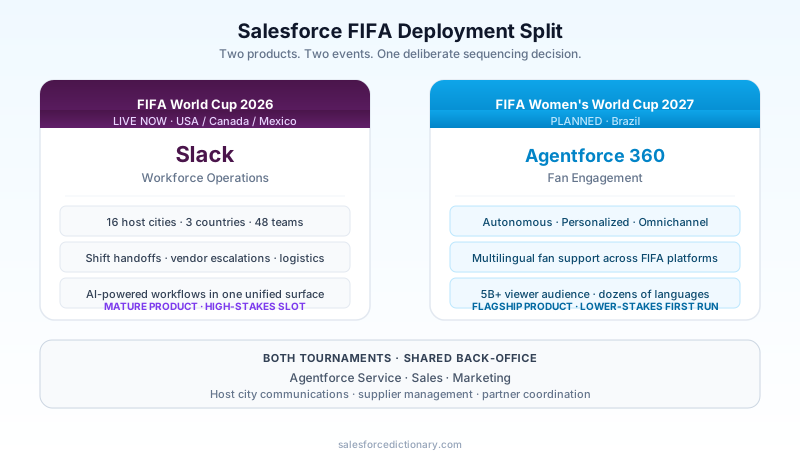
So three workloads, three risk profiles, three product choices. The pattern only becomes obvious once you line them up. The thing carrying the most live risk got the most mature tool. The newest, most heavily marketed product got the workload that is still a year out.
The Product-Risk Split: Deploy What You Trust Where It Counts
Here is the lesson, stated plainly. Salesforce had every commercial incentive to plaster Agentforce across the men's World Cup. It is the product they are selling hardest in 2026. The men's tournament is the bigger global moment by viewership. Putting autonomous agents in front of 5 billion people during the live event would have been the marketing coup of the year.
They did not do it. They put Slack there instead.
Slack is a mature product. It has been carrying mission-critical conversations for organizations of every size for over a decade. The failure modes are understood. The scaling behavior is known. When the stakes are a live global event with zero tolerance for an embarrassing outage, you reach for the tool whose worst day you can predict.
Agentforce 360 is excellent and it is also younger. Autonomous agents acting on behalf of an organization in front of billions of people carry a different risk shape than a messaging app. An agent can be wrong in ways a message channel cannot. It can hallucinate, it can take an action you did not intend, it can respond badly in a language nobody on the team can read in real time. Those risks are manageable, but you manage them by giving yourself time and a lower-stakes proving ground first. Which is exactly what the 2027 Women's World Cup gives Salesforce: a real, prestigious, but second-in-line event to prove the agentic experience before it ever becomes the default.
This maps directly onto a decision you face on every rollout. You almost always have a mature capability and a newer, more exciting one. The instinct, especially when leadership is excited about the new thing, is to debut it on the most visible workload to maximize the splash. Resist that. Put the mature capability where failure is most expensive and most public. Give the new capability a real but lower-stakes home where you can watch it under load, learn its failure modes, and build the operational muscle to run it. Then promote it.
The sequencing is the entire trick. Salesforce is not avoiding Agentforce on the World Cup. They are scheduling it. Trusted product on the live event. Flagship product on the next event, after a year of hardening. If you take one thing from this whole post, take that.
Designing for Peak Concurrency
Five billion people is not a number you architect for casually. Even if only a fraction ever touch an agent directly, the fan-engagement workload Salesforce has committed to for 2027 has to survive traffic that is spiky, global, and correlated with match events. A goal in the 89th minute does not produce a smooth ramp. It produces a wall.
The first design move is to stop thinking about your agent as one thing handling one request at a time. Think in worker pools. Conceptually, you want pools of agent capacity that can absorb bursts independently, so a flood of fan queries in one region does not starve the back-office agents serving host cities. Salesforce manages a lot of this for you on the platform side, but your design choices, how many Topics you spread work across, how you partition Actions, determine whether that capacity is usable.
Build your Topics and Actions to be stateless wherever you can. An Action that depends on in-memory state from a previous turn is an Action that fights horizontal scaling. When each invocation can be served by any available worker because it carries everything it needs or reads it from a fast store, the platform can spread load freely. State belongs in the data layer, not in the execution path.
That data layer needs a real-time cache strategy. During a match, thousands of agents may want the same handful of facts: the current score, a player stat, a venue gate status. Hitting your system of record for every one of those is how you create a self-inflicted outage. A read-through cache in front of frequently requested CRM and Data Cloud reads turns a thundering herd into a single refresh.
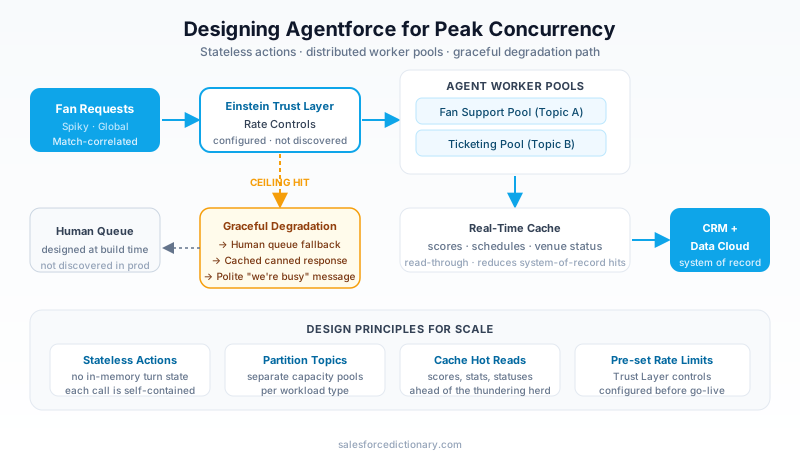
Then design for the moment it is not enough. Every high-scale system needs graceful degradation, a defined behavior for when demand exceeds capacity. The Einstein Trust Layer gives you rate controls; use them deliberately rather than discovering your ceiling in production. When the agent tier saturates, the right answer is rarely an error page. It is a clean fall-through to a human queue, a cached canned response, or a polite "we are busy, here is the one thing you actually need." Decide that behavior at design time. The teams that get embarrassed at scale are the ones who treated overload as an exception instead of a state to design for.
Multilingual by Design, Not by Accident
The 2027 fan deployment is explicitly multilingual, and that word hides a lot of work. A World Cup audience spans dozens of languages, often within a single host city. Bolting translation onto an agent after the fact produces the kind of stilted, occasionally wrong output that erodes trust fast. Multilingual has to be a design assumption from the first sprint.
Start with language detection as an explicit step in the flow, not an afterthought buried in a prompt. You want to know the user's language before you decide how to respond, because that decision shapes which Prompt Template, which grounding data, and which tone you reach for. Detection feeds routing.
Then build language-specific Prompt Templates in Prompt Builder rather than asking one English template to "respond in the user's language." A template authored for the target language, with examples and instructions in that language, produces noticeably better results than a translation instruction stapled to an English prompt. It costs more upfront and it pays for itself the first time an agent has to handle nuance, idiom, or formality that does not survive a literal translation.
Ground every response in a Data Cloud unified profile so the agent knows who it is talking to across channels and languages. A fan who asked about ticket transfers in Portuguese yesterday and shows up in Spanish today is the same person, and the unified profile is what lets the agent treat them that way. Language is a presentation layer over a single identity, not a fork into separate experiences.
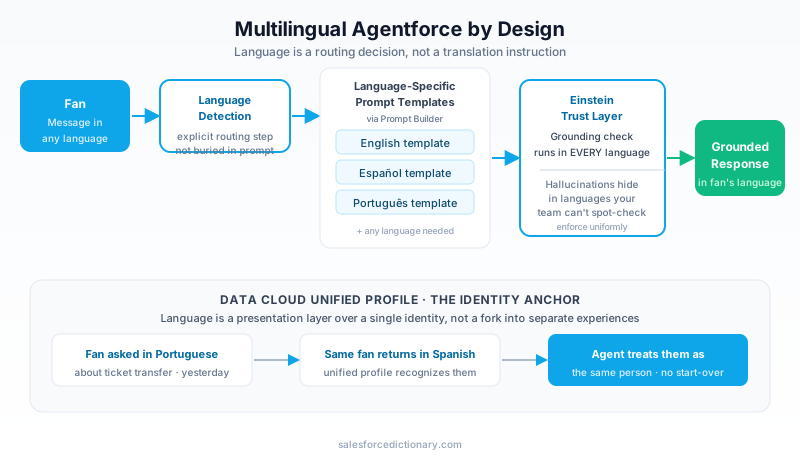
Finally, keep the Einstein Trust Layer grounding check in front of generation in every language, including the ones your QA team cannot read fluently. The danger in multilingual deployments is that hallucinations hide in the languages nobody on the team can spot-check. Grounding the response against retrieved facts before it goes out is your defense, and it has to run uniformly. An agent that is carefully governed in English and loosely governed in Arabic is an agent waiting to embarrass you in Arabic.
The Reference Deployment Playbook
FIFA is a reference deployment. That is most of why Salesforce wanted it. A working, prestigious, public proof point does more for adoption than any amount of slideware, because prospects can point at it and say "if it runs the World Cup, it can run our thing."
Your organization needs the same thing internally, at its own scale. Before you roll an agent out to a thousand users or every customer, you want one deployment that has actually run in real conditions, that the skeptics have seen work, and that gives you a known-good baseline to compare everything else against.
Pick a workload that is real but survivable. Real, because a toy pilot proves nothing and convinces no one. Survivable, because the point is to learn the failure modes somewhere a failure does not make the news. An internal-facing agent for a single department, a single high-volume but well-understood customer query, a back-office process with a human safety net: these make good proof deployments. Run it long enough to see it under genuine load, including the messy edge cases, then capture what you learned as the pattern you reuse.
The reference deployment is also how you win the political argument. The hardest part of broad agent rollout is rarely the technology. It is the architecture review where six stakeholders have six different fears. A working internal proof point answers most of those fears with evidence instead of assertions, which is a far stronger position than any architect arguing from first principles.
What to Do Before Your Next Agent Deployment
Start by writing down your product-risk split before anyone gets attached to a launch plan. List your workloads, rank them by how expensive and public a failure would be, and rank your capabilities by maturity. Assign the most mature tool to the highest-stakes workload. If the new shiny thing ends up on your riskiest launch, you have probably let excitement override judgment, and now is the cheap time to fix that.
Next, pressure-test your concurrency assumptions with real numbers, not vibes. Estimate peak load, not average load, and design the degradation path for the moment you exceed it. Make your Topics and Actions stateless, put a cache in front of your hot reads, and configure Trust Layer rate controls on purpose. Decide today what your agent does when it is overwhelmed, because the alternative is finding out in front of users.
If multilingual is anywhere on your roadmap, treat it as a day-one design constraint rather than a phase two feature. Stand up language detection as an explicit routing step, author language-specific Prompt Templates instead of translation instructions, ground responses through the Trust Layer uniformly across every language, and anchor identity in a Data Cloud unified profile so language stays a presentation choice.
Then go build your reference deployment. Choose one real, survivable workload, run it under genuine conditions, and let it become the proof point that carries your next architecture review. Salesforce spent serious money to get a public one. You can get an internal one for the price of picking the right first workload and running it honestly.
About the Author
Dipojjal Chakrabarti is a B2C Solution Architect with 29 Salesforce certifications and over 13 years in the Salesforce ecosystem. He writes and edits salesforcedictionary.com, published by KineticBit Inc., to help admins, developers, architects, and cert/interview candidates sharpen their fundamentals. More about Dipojjal.
Share this article
Sources
- Salesforce to Transform Fan Engagement and Tournament Operations at FIFA World Cup 2026 and FIFA Women's World Cup 2027 (Salesforce Newsroom)
- FIFA announces Salesforce as Official Tournament Supporter of FIFA World Cup 2026 and FIFA Women's World Cup 2027 (FIFA Media Release)
- Salesforce to Transform Fan Engagement and Tournament Operations (Salesforce Investor Relations)
- Salesforce lands FIFA World Cup 2026 support deal (Martech Notes)
Related dictionary terms
 Our appAdWake up sharp. Not just awake.The alarm that rings through Silent and DND — free on iOS & Android.Get WakeSharp →
Keep reading

Salesforce Multi-Agent Orchestration: The Complete 2026 Guide
In 2026, orgs run an average of 12 AI agents - half in isolated silos. Learn the primary-and-specialist architecture, Agent Fabric, and the A2A protocol that turn agent sprawl into coordinated enterprise AI.
Salesforce Slack AI: The Complete 2026 Guide
You return from a week off, your Slack has 4,300 unread messages across 27 channels, and a customer call in 30 minutes. This is what Slack AI was built for: how it works, how Agentforce plugs in, and where it still gets things wrong.

Salesforce Well-Architected for Agentforce
TDX 2026 unveiled the next chapter of Salesforce's Well-Architected Framework, evolving the Trusted, Easy, and Adaptable pillars specifically for Agentforce. Here's what changed and how to apply it to every agent you build.
What Is Agentforce 360? The Complete 2026 Guide for Salesforce Admins, Developers & Architects
Agentforce 360 is Salesforce's 2025 rebrand of its agentic-AI platform - built on the Atlas Reasoning Engine, Einstein Trust Layer, and Data 360. Here's the complete admin + dev + architect guide.


Comments
No comments yet. Start the conversation.
Sign in to join the discussion. Your account works across every page.