
Agentforce 360 for Net Zero: The Complete 2026 Guide
What Net Zero Cloud is in 2026, the Scope 1/2/3 tracking model, the disclosure-drafting agent, CSRD/SASB/GRI/CDP framework support, and the rollout plan that satisfies real audit.
You open the inbox at 8:47 on a Thursday and the CFO has forwarded an email from compliance with subject line "CSRD disclosure due in 90 days, who owns this". You scroll. Your name is on the distribution list. Your team has emissions data in three spreadsheets, a SaaS tool, an old SharePoint folder, and an ESG consultant who emailed a 2,200-cell Excel last quarter. Ninety days. Three audit-grade reports. Five sustainability frameworks. One person. You.
That is the operational reality Agentforce 360 for Net Zero (formerly Net Zero Cloud) is built for. Salesforce's ESG management platform consolidates Scope 1, 2, and most of Scope 3 emissions tracking, supplier engagement, target setting, and now in 2026 ships an Agentforce layer that drafts the disclosure reports themselves. The platform exists because sustainability disclosure has stopped being voluntary and become a real audit obligation in major jurisdictions.
This post walks through what Net Zero Cloud actually is in 2026, the Scope 1/2/3 tracking model that audit accepts, how the disclosure-drafting agent works, the framework support (CSRD, SASB, GRI, CDP), and the rollout plan that produces audit-grade reports instead of dressed-up estimates.
What Net Zero Cloud actually is in 2026
Net Zero Cloud is Salesforce's ESG (Environmental, Social, Governance) data management and disclosure platform. It runs on the Salesforce Core platform alongside Sales Cloud and Service Cloud. The data model is purpose-built for emissions, energy consumption, waste, water, supplier engagement, and sustainability targets.
The product is now branded "Agentforce 360 for Net Zero" alongside the broader Agentforce rebrand, though the help docs and SKU codes still reference Net Zero Cloud. Treat them as the same product.
What sits inside:
- Emissions data model. Standardized objects for emission sources, energy consumption, electricity bills, fuel usage, transportation, waste streams, supplier emissions.
- Calculations engine. Built-in conversion factors and methodology for translating activity data (gallons of fuel, kWh of electricity) into CO2-equivalent emissions across the three scopes.
- Framework-specific report builders. Configurable for CSRD (the EU's Corporate Sustainability Reporting Directive), SASB (industry-specific sustainability standards), GRI (Global Reporting Initiative), and CDP (the Carbon Disclosure Project).
- Supplier engagement. Workflow for collecting Scope 3 data from suppliers, validating it, and rolling it up into corporate disclosures.
- Target tracking. Set science-based targets (SBTi-aligned), track progress, project trajectories, model reduction scenarios.
- The Agentforce layer. Drafts disclosure reports, answers compliance questions grounded in the underlying data, surfaces gaps in the data needed for each report.
- Data Cloud integration. Ingests high-volume emissions, energy, and supplier data from across business systems (ERP, utility billing, supply chain platforms).
The platform sits at the intersection of compliance and operations. Compliance teams use it to produce the disclosure reports. Operations teams use it to identify where emissions reductions can happen.
The Scope 1, 2, and 3 model that audit accepts
The Greenhouse Gas Protocol defines the three scopes. Net Zero Cloud's data model follows it precisely.
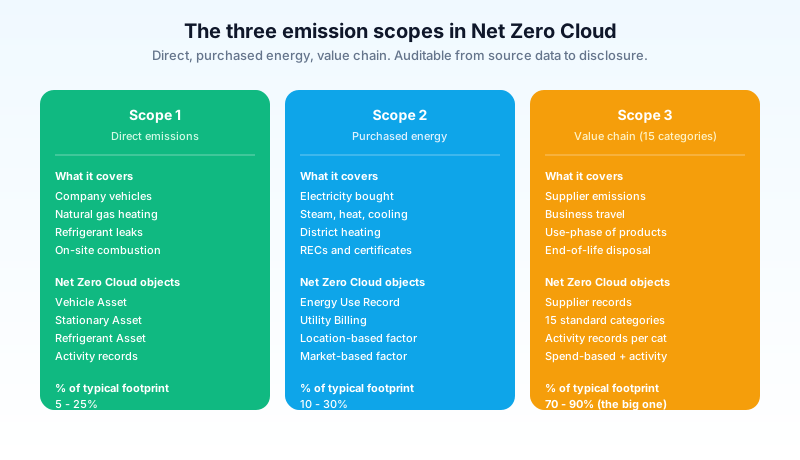
Scope 1: direct emissions. Things your organization directly burns or releases. Fuel for company vehicles, natural gas for heating, refrigerant leaks from HVAC. In Net Zero Cloud, captured via Vehicle Asset, Stationary Asset, and Refrigerant Asset records, with associated activity data records (fuel purchases, leak events).
Scope 2: purchased energy. Electricity, steam, heat, and cooling your organization buys. Captured via Energy Use Record entries that reference Utility Billing source records. Location-based (the grid mix where you operate) and market-based (the renewable energy certificates you purchased) calculations are both supported.
Scope 3: value chain. Everything else. Upstream (supplier emissions, business travel, employee commute, purchased goods and services) and downstream (use-phase emissions of sold products, end-of-life treatment). This is the largest and hardest scope. Net Zero Cloud breaks it into the 15 standard Scope 3 categories from the GHG Protocol, each with its own activity-data model.
The calculation engine ships with built-in emission factors from authoritative sources (EPA, IEA, DEFRA, EcoInvent). Custom factors can be added for organization-specific inputs.
The audit-grade requirement: every emissions number in your disclosure has to be traceable back to source activity data, with the calculation method, the emission factor used, and the date of last update visible. Net Zero Cloud captures all four. The platform is one of the few enterprise ESG products that produces audit-trail reports out of the box, which is the real reason large enterprises buy it over spreadsheet-based alternatives.
The disclosure-drafting agent
The headline 2026 addition is the Agentforce layer that drafts sustainability reports.
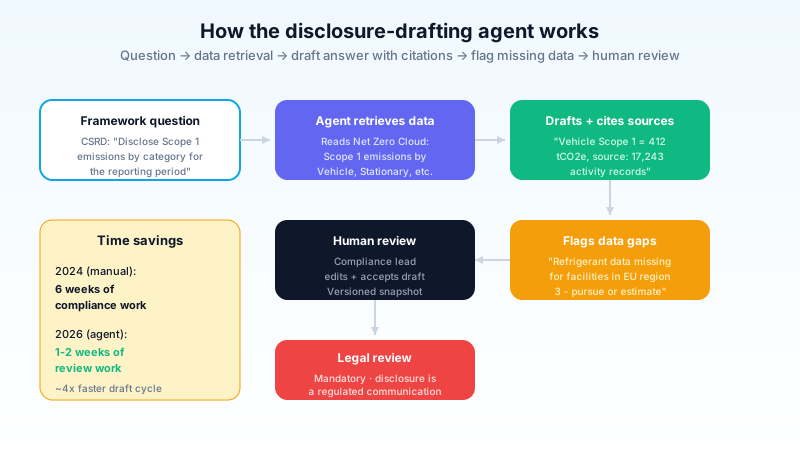
The workflow: a compliance lead opens the framework-specific report builder (CSRD, for example). The builder presents the questions the framework requires, organized by section. Instead of filling in answers manually, the lead invokes the agent. The agent reads the underlying Net Zero Cloud data, drafts an answer to each question, cites the source data, and flags any questions where the data is incomplete or missing.
What the agent does well:
- Pulls quantitative data (Scope 1, 2, 3 totals; year-over-year changes; intensity metrics) directly from the calculations engine, with the underlying activity records cited.
- Drafts qualitative descriptions (governance structure, materiality assessment summaries, target progress narratives) based on the prior year's disclosures plus current-year data updates.
- Flags missing inputs (a Scope 3 category with no supplier responses, a metric the framework requires that the org has not measured yet) so the compliance lead can pursue them.
- Versions every draft, so the legal review and the management review work against immutable snapshots.
What the agent does not do:
- Make materiality judgments. Materiality (what is "material enough" to report) is a human decision that involves stakeholder input and management judgment. The agent suggests; the compliance lead and management decide.
- Validate the source data. If the supplier sent fabricated emissions numbers, the agent reports those numbers. Data validation happens upstream of the agent.
- Replace the legal review. The disclosure is a regulated communication. Legal still reviews every published report.
The value of the agent is the time compression: a CSRD draft that took six weeks of compliance team work in 2024 now takes one to two weeks of agent-drafted-plus-human-reviewed work. The human work is reviewing and confirming, not authoring from scratch. The downside-protection is that the agent does not hide where the data is weak; the gap flags make the data quality problems visible, which is genuinely useful in a regulated context.
Framework support: CSRD, SASB, GRI, CDP
Each major framework has its own structure, question set, and assurance requirements. Net Zero Cloud ships framework-specific report builders for the four most common.
CSRD (Corporate Sustainability Reporting Directive). EU regulation, in force since 2024 for large companies and phasing in for smaller ones through 2028. Requires double-materiality (impact on the company plus impact of the company on the world), Scope 1/2/3 emissions, supply chain due diligence, and external assurance. The Net Zero Cloud CSRD builder maps the European Sustainability Reporting Standards (ESRS) to the platform's data model and outputs a compliance-ready document.
SASB (Sustainability Accounting Standards Board). Industry-specific standards (77 industries). Used heavily by US public companies for investor-grade ESG disclosures. The Net Zero Cloud SASB builder selects the relevant standards for your industry and prompts the agent to draft answers for each.
GRI (Global Reporting Initiative). The most widely-used voluntary framework globally, with a broader scope than just climate (includes human rights, labor practices, anti-corruption, etc.). The Net Zero Cloud GRI builder covers GRI Universal Standards and the topic-specific standards.
CDP (Carbon Disclosure Project). Annual questionnaire on climate change, water security, and forests. Submitted to CDP for scoring (the famous A through F grade). Used heavily by institutional investors. The Net Zero Cloud CDP builder maps the CDP question set to the platform's data and produces submission-ready responses.
Beyond the four built-in frameworks, the platform supports custom report templates for jurisdictions or industry-specific disclosures (UK Streamlined Energy and Carbon Reporting, Japan TCFD-aligned disclosures, etc.).
Supplier engagement: the hardest part of Scope 3
Scope 3 emissions typically account for 70 to 90 percent of an enterprise's total carbon footprint. Most of that is supply-chain emissions: the emissions of the goods and services your organization purchases. Collecting accurate data from suppliers is the single hardest data acquisition task in corporate sustainability.
Net Zero Cloud's supplier engagement workflow:
- Supplier onboarding. Add your top suppliers to the platform. Categorize them by spend, emissions intensity (using industry-average factors as a starting estimate), and strategic importance.
- Data collection campaigns. Send each supplier a questionnaire (template by industry) requesting their Scope 1, 2, and applicable Scope 3 data, allocated to your organization's purchases. Suppliers can respond directly in the platform or via a partner portal.
- Validation. Compare supplier responses to industry-average benchmarks. Flag outliers. Request supporting documentation for material discrepancies.
- Roll-up. Aggregate validated supplier data into your Scope 3 disclosure. Use industry averages for suppliers that did not respond.
- Year-over-year tracking. Compare supplier responses across years to track engagement quality and emissions reductions.
The platform makes the supplier-engagement workflow operationally manageable for an enterprise with thousands of suppliers, which is the threshold where spreadsheet-based approaches stop scaling. The trade-off is that the platform cannot force a supplier to respond. The response rate in year one is typically 30 to 50 percent of suppliers and 60 to 80 percent of spend. Year over year, those rates improve as suppliers internalize their own ESG programs.
The pieces of Net Zero Cloud that are bad
Calling out what is worse, with specifics:
The user experience is dense. The platform was built for compliance professionals, not for casual users. The data model is precise, the workflows are linear, the screens are dense. New admins coming from Sales Cloud or Service Cloud find the UX shift jarring. Plan for a longer training cycle than other Salesforce products.
The supplier portal experience is functional, not delightful. Suppliers responding to data requests use a portal that is clearly enterprise-buyer-side first, supplier-experience second. Response rates suffer when suppliers find the portal confusing. The 2026 release improved the portal navigation, but the supplier-side polish still lags the buyer-side capabilities.
Implementation is consultant-heavy. Net Zero Cloud implementations typically involve a Salesforce partner specializing in ESG. The data model is intricate enough that most internal admin teams cannot stand it up well in three months. Plan for partner involvement, and budget accordingly.
Pricing is opaque, like the rest of Salesforce. Net Zero Cloud is sold per organization with consumption components for supplier seat counts, document storage, and now agent usage. Get the pricing structure documented in the contract.
The agent-drafted reports still need careful legal review. The agent surfaces good drafts. The legal team still reviews every published disclosure word by word, because the disclosure is a regulated communication and the agent does not own the liability. Do not promise stakeholders that "AI handles the reports". AI accelerates the reports; humans publish them.
These are real frustrations. The platform is the right answer for enterprises with serious disclosure obligations. The rough edges are what to plan around.
Where Net Zero Cloud fits in the broader Salesforce stack
Net Zero Cloud is not standalone. It draws data from operational systems and feeds into reporting and stakeholder engagement systems. Where it sits in a 2026 Salesforce stack:
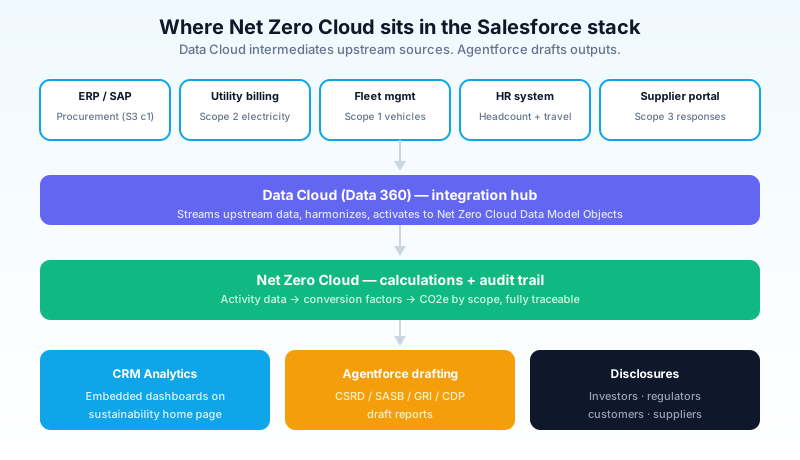
Upstream feeders. ERP systems (purchase data feeding Scope 3 category 1), utility billing (Scope 2 electricity and gas), fleet management (Scope 1 vehicles), HR (employee count for intensity metrics, business travel data), and supplier portals (Scope 3 supplier responses).
Data Cloud as the integration hub. Most modern implementations route the upstream data through Data Cloud, then activate to Net Zero Cloud as Data Model Object writes. This lets one ESG team see emissions data alongside the operational data that drives it, without each team maintaining its own ETL.
Net Zero Cloud as the calculation and audit-trail layer. Activity data lands in Net Zero Cloud, the calculations engine turns it into CO2e, the platform stores the calculation method and emission factor used, and the audit-trail report shows the full chain from source data to disclosure number.
CRM Analytics for visualization. Dashboards on emissions trends, target progress, supplier engagement rates, and intensity metrics live in CRM Analytics embedded on the sustainability team's Lightning home page. Executives see the same data in summary tiles.
Agentforce as the drafting layer. The disclosure-drafting agent reads Net Zero Cloud data and produces framework-specific reports.
Outputs. Investor communications, regulator submissions, supplier scorecards, internal dashboards, and customer-facing sustainability claims (the latter requires legal-team approval to publish).
The stack pattern matters because ESG data does not live in one place. Designing the integration before procuring Net Zero Cloud saves the rework of building point-to-point connectors after the platform is in.
The audit-ready rollout plan
The plan that produces audit-grade disclosures, not just dressed-up estimates:
Months 1-2: data sources audit. Inventory every system that holds emissions-relevant data. Utility bills, fleet fuel cards, business-travel SaaS, employee-commute survey, supplier ESG submissions, ERP procurement data. Document the source-of-truth for each emissions category. Do not start building in Net Zero Cloud until this inventory is complete.
Months 3-4: connect Scope 1 and Scope 2 sources. Configure data streams from utility billing, fleet management, facilities, and HR systems into Net Zero Cloud (often via Data Cloud intermediation). Verify that the calculations engine produces emissions numbers that match your prior-year manual calculations within reasonable tolerance.
Months 5-7: launch supplier engagement. Onboard the top 200 to 500 suppliers (covering 80 percent of spend). Send the year-one data collection campaign. Plan for a 50 percent response rate and use industry averages for the remainder.
Months 8-9: configure the framework-specific report builder. Pick the primary framework (CSRD if EU-subject, SASB if US investor-focused, GRI if global voluntary). Configure the builder. Let the agent draft the first version. Have the compliance team review and edit.
Months 10-11: external assurance review. Engage your auditor early. Walk through the platform with them. Confirm the audit-trail reports meet their assurance standard. Address any gaps before submission.
Month 12: publish. Final legal review, management signoff, publication to investors and regulators. Begin the next cycle on day one of the new year.
This is a 12-month first-cycle rollout. Year two and onward compress the cycle to 4 to 6 months because the foundational work (data connections, supplier onboarding, framework configuration) carries forward.
Common rollout failures and how to avoid them
Three patterns that consistently break Net Zero Cloud implementations:
Treating sustainability data like operational data. Operational data is collected continuously and analyzed in real time. Sustainability data is collected periodically (monthly utility bills, quarterly supplier responses, annual employee surveys), validated carefully, and audited externally. The cadence is different, the precision bar is higher, and the data hygiene work is harder. Teams that import their operational-data habits into the sustainability program produce numbers that fail external assurance.
Underestimating supplier engagement. Scope 3 reporting depends on supplier responses, and supplier engagement is genuinely difficult enterprise change management. The platform makes the workflow operationally manageable; the platform does not solve the political problem of getting busy supplier sales teams to respond to your data requests. Plan for procurement-team partnership, executive sponsorship, and multi-year response-rate improvement targets.
Stopping at compliance. The teams that get the most value out of Net Zero Cloud use the same data the disclosures consume to identify operational emissions reductions. The sustainability dashboard becomes a working tool for facilities teams, fleet managers, and procurement teams, not just a year-end disclosure exercise. Orgs that treat the platform as a compliance-only tool get compliance-only value.
The orgs that succeed treat Net Zero Cloud as a year-round operational platform that happens to produce audited disclosures. The orgs that fail treat it as a year-end disclosure tool that happens to hold data.
What to do next
Open Setup, search "Net Zero Cloud". If it is provisioned, you will see the app. Open it, look at the dashboard. If you see emissions data, the platform is in use. If the dashboards are empty, the rollout has not yet started; the next move is the data sources audit described above.
If you are evaluating Net Zero Cloud for purchase, the first concrete move is the disclosure obligation analysis. Which frameworks are you legally required to report against (CSRD, SEC climate rules if they are reinstated, industry-specific regulations)? Which frameworks are you voluntarily reporting against for investor or customer reasons? The framework list determines the platform configuration scope, and that scope drives the implementation cost.
If you are a sustainability lead handling disclosures via spreadsheets today, take one Scope 1 emission source you currently track manually. Document the input data source, the calculation method, and the prior-year result. That documentation becomes the spec for the equivalent Net Zero Cloud configuration when you do implement. The transition cost is the documentation cost, not the platform cost.
About the Author
Dipojjal Chakrabarti is a B2C Solution Architect with 29 Salesforce certifications and over 13 years in the Salesforce ecosystem. He writes and edits salesforcedictionary.com, published by KineticBit Inc., to help admins, developers, architects, and cert/interview candidates sharpen their fundamentals. More about Dipojjal.
Share this article
Sources
Related dictionary terms
Practise it
Five questions on Agentforce Specialist
Exam-style questions with an explanation after each one. No account needed, and your answers build a weak-topic map once you have one.
Keep reading
Salesforce CRM Analytics: The Complete 2026 Guide
CRM Analytics is Salesforce's native embedded analytics. This 2026 guide covers datasets, recipes, dashboards, Einstein Discovery models, and how to pick it over Tableau or standard Reports.
Salesforce Data 360: The Complete 2026 Implementation Guide
Data 360 is Salesforce's unified data platform for the agent era. This 2026 implementation guide walks data streams, identity resolution, segmentation, activations, and zero-copy federation.

What Is Agentforce 360? The Complete 2026 Guide for Salesforce Admins, Developers & Architects
Agentforce 360 is Salesforce's 2025 rebrand of its agentic-AI platform - built on the Atlas Reasoning Engine, Einstein Trust Layer, and Data 360. Here's the complete admin + dev + architect guide.
Comments
No comments yet. Start the conversation.
Sign in to join the discussion. Your account works across every page.