
Headless 360 Adoption Numbers Land
At a May 29 product webinar, Salesforce put hard usage numbers behind Headless 360 and Slack MCP: 4.5 million MCP calls, nearly a trillion API calls, and a million Slack MCP users in six weeks. The pitch is addressable-market expansion. The catch is consumption pricing.

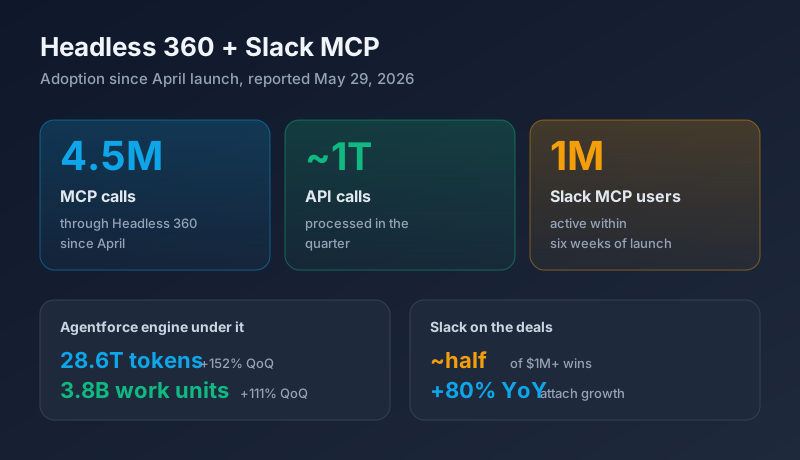
Salesforce held a product webinar on Friday, May 29, and used it to do something the April Headless 360 launch never did: put real numbers on the table. The platform that exposes every capability as an API, an MCP tool, or a CLI command has processed 4.5 million MCP calls and nearly a trillion API calls since it shipped at TrailblazerDX in April. Slack's MCP client crossed a million active users six weeks after launch. Those are not slide-deck projections. They are usage counters, and they are the first hard read on whether anyone actually wants a Salesforce you never log into.
The earnings results from earlier in the week, covered in the May 29 recap, were about revenue and ARR. This webinar was about plumbing. Here is what changed, what the numbers mean, and what you have to plan for.
The numbers Salesforce wanted you to see
Start with the headline figure. Marc Benioff called Headless 360 "probably the most exciting announcement" of the past three months, and the supporting metrics from the webinar transcript explain why he wanted it front and center.
Headless 360 processed 4.5 million MCP calls since the April launch. That is the new surface: external coding agents and AI clients hitting Salesforce through the Model Context Protocol instead of a browser. Alongside that, Salesforce processed nearly a trillion API calls in the quarter, the traditional integration path that has existed for years but is now carrying agent traffic on top of human-built integrations.
Slack is where the consumer-facing version of this story lives. Slack's MCP client passed a million active users within six weeks of launch. And Slack was attached to nearly half of Salesforce's million-dollar-plus wins in the quarter, up 80 percent year over year. The company is no longer selling Slack as a chat app. It is selling Slack as the place work gets routed to agents.
The broader Agentforce engine kept scaling underneath all of it. Salesforce processed 28.6 trillion tokens, up 152 percent sequentially, and created 3.8 billion Agentic Work Units, up 111 percent sequentially, per the Q1 FY27 analysis. Agentforce annualized revenue reached $1.2 billion at 205 percent year-over-year growth. Tokens and work units are the consumption that Headless 360 is designed to drive. More surfaces calling in means more tokens burned.
What "API is the UI" actually means now
The phrase has been around since April, and it still confuses people. So the executives spent the webinar correcting the read. "Headless doesn't mean no UI," said Parker Harris. "It means decoupling capabilities from the interface."
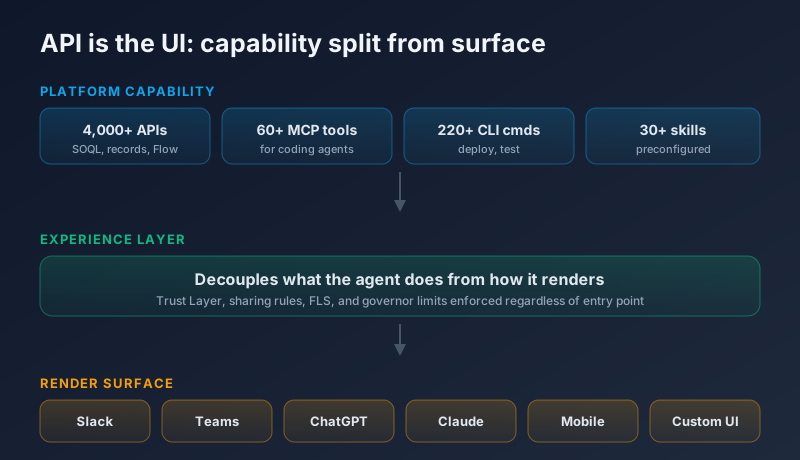
That distinction matters for anyone building on the platform. The point is not that screens disappear. The point is that the capability and the rendering surface are now separate things. A SOQL query, a Flow, an approval chain, a record update: each of those is exposed as a callable endpoint. Where the result shows up, Slack, Microsoft Teams, ChatGPT, Claude, a mobile app, or a custom React front end, is a separate decision made by an experience layer rather than baked into the platform.
The Salesforce Developers post on Headless 360 puts a sharper frame on it: the platform provides context and capability, and the LLM provides intelligence. The two used to be welded together inside a browser session designed for human fingers. They are now pulled apart. That is the architectural shift that matters, and it is why agents can finally act inside Salesforce without screen-scraping a Lightning page.
For developers, the concrete surface area is large. Salesforce counts more than 60 MCP tools for coding agents, 30-plus preconfigured coding skills, 4,000-plus existing APIs, and 220-plus CLI commands. Connect Claude Code, Cursor, or any MCP-compatible coding agent to an org and it can read metadata, generate Apex, run tests, and deploy through the pipeline without a custom integration layer in between.
The revenue logic: surfaces Salesforce never monetized
The most telling line from the webinar was not about technology. It was about money. Management said Headless 360 "expands our addressable market into surfaces we have never previously monetized."
Read that carefully. Every MCP call from Claude or ChatGPT, every agent action routed through Slack, every CLI deploy in a CI/CD pipeline is a Salesforce interaction that historically happened inside a browser seat Salesforce already charged for. Now those interactions can originate from outside the platform entirely. The Chief Revenue Officer gave the cleanest example: Anthropic's Sales Cloud usage grew fivefold in the quarter because employees started reaching it through Claude and Slack rather than logging in directly. "Sales Cloud has become more prominent and more strategic for them than ever, because of headless."
That is the bull case in one sentence. Usage goes up when you remove the requirement to log in. The Data, Control & Other revenue line accelerated to 23 percent growth, an early signal that the consumption shift is showing up in the financials and not just the demo.
There is a strategic layer underneath the revenue story. Running competing models like Claude and Gemini at the top of the stack while owning the data, the governance, and the orchestration underneath is a familiar enterprise infrastructure play. The models are interchangeable. The governed data and the integration depth are not. The harder question for any CIO standing up agent workflows on Headless 360 today is what it costs to rebuild those workflows on a competing platform in 2028. That number gets larger every quarter the org runs.
The catch nobody put on a slide: consumption pricing
Here is where the optimism needs a counterweight. The same day as the webinar, CIO published a piece warning that the Headless 360 monetization model could hand CIOs a budgeting headache they have seen before.
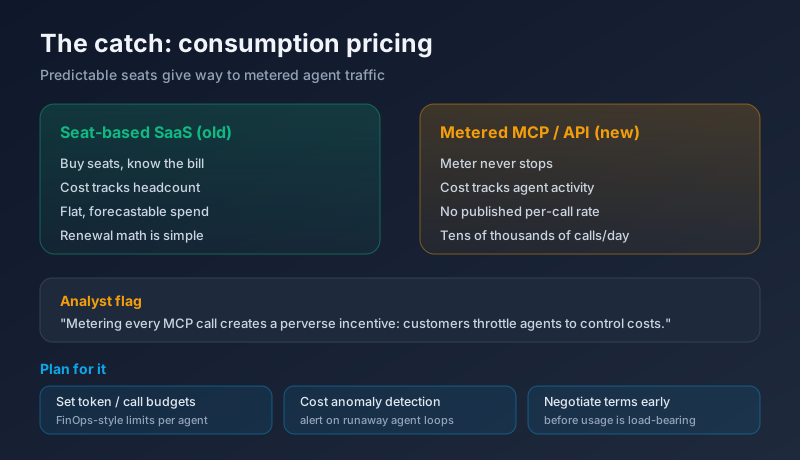
The concern is simple. Subscription pricing is predictable. You buy seats, you know the bill. Consumption pricing is not. When autonomous agents can generate tens of thousands of interactions continuously, the meter never stops, and the bill becomes a function of how busy your agents are rather than how many people you employ.
The analysts quoted in that piece were blunt. Dion Hinchcliffe of The Futurum Group noted that "CIOs have become highly sensitive to unpredictable consumption pricing after a decade of cloud cost overruns." Scott Bickley of Info-Tech Research Group was sharper: "Automation based on consumption metrics increases transaction volumes, costs will explode higher." And Ashish Chaturvedi of HFS Research flagged the perverse incentive: "If you start metering every MCP call and API interaction, you create a perverse incentive: customers will throttle agent usage to control costs." Metering the thing you want people to use more of is a tension Salesforce has not resolved.
Salesforce has not published a clean per-MCP-call price. For now, calls are billed through a mix of existing API consumption limits, Agentforce usage constructs, platform entitlements, and negotiated enterprise agreements. That ambiguity is itself a planning risk. You are adopting a consumption surface without a published rate card.
This is the same fault line that drove the BofA downgrade over AI monetization earlier in the month. The usage is real. Whether Salesforce can convert trillions of tokens and millions of MCP calls into durable, predictable revenue without scaring customers into rationing is still the open question.
What this means for your org
The shift is real enough that you should not treat it as a keynote abstraction. A few concrete implications.
Governance does not change with the entry point. An agent calling through MCP respects the same sharing rules, field-level security, and governor limits as a user clicking through a page. The Einstein Trust Layer applies to every Agentforce session regardless of whether it was triggered by a browser or an API. So the surface expanded, but the access model did not loosen. That is the reassuring part.
Quota planning gets harder. An agentic workflow can fire hundreds of SOQL queries in a single run. Enterprise orgs get 100,000 daily API calls on a rolling window, and MCP, CLI, and REST traffic all draw from the same pool. An agent that loops through accounts can drain a day's quota faster than any nightly batch job you have tuned. Audit your limits before you let agents run unsupervised.
Headless deployment changes your security posture. JWT OAuth is the recommended flow for browserless CI/CD, which means connected apps with uploaded certificates and tightly scoped permissions. That ties directly into the CLI credential redaction changes from earlier in the month. If your pipeline logs tokens, fix that before you wire agents into it.
What to do next
Do three things this week. First, pull your org's current API consumption report and model what happens if agent traffic doubles it, because that is the trajectory the May 29 numbers point at. Second, install the @salesforce/mcp server in a sandbox and connect one MCP-compatible coding agent to it, so you understand the surface before a business unit asks for it in production. Third, get your procurement team into a conversation about consumption terms now, while you still have negotiating room, rather than after agent usage is load-bearing and the renewal clock is running. The adoption is past the demo stage. Treat the budgeting and governance work the same way.
About the Author
Dipojjal Chakrabarti is a B2C Solution Architect with 29 Salesforce certifications and over 13 years in the Salesforce ecosystem. He writes and edits salesforcedictionary.com, published by KineticBit Inc., to help admins, developers, architects, and cert/interview candidates sharpen their fundamentals. More about Dipojjal.
Share this article
Sources
- Salesforce, Inc. (CRM) Discusses Product Innovation With Headless 360 and Slackbot (Transcript)
- Q1 FY27 Product & Innovation - Headless 360 + Slack Webinar (Salesforce Investor Relations)
- Salesforce's Headless 360 monetization play could give CIOs a familiar budgeting headache (CIO)
- What Salesforce Headless 360 Means For Developers (Salesforce Developers Blog)
- Salesforce FY27 Q1: Agentforce Crosses $1.2 Billion ARR (Shashi)
Related dictionary terms
Practise it
Five questions on Agentforce Specialist
Exam-style questions with an explanation after each one. No account needed, and your answers build a weak-topic map once you have one.
Comments
No comments yet. Start the conversation.
Sign in to share your take on this article. Your account works across every page.