
Pierre Fabre Picks Agentforce
Laboratoires Pierre Fabre, the French pharma and dermo-cosmetics group behind Avène, Ducray, and Klorane, will roll out Agentforce Life Sciences for Customer Engagement to 4,000 users across its prescription drug and OTC businesses. The deal is one of the largest non-US Salesforce displacements of legacy life sciences CRM announced this year.

Salesforce announced on May 21, 2026 that Laboratoires Pierre Fabre will roll out Agentforce Life Sciences for Customer Engagement to more than 4,000 internal users, alongside Agentforce 360 for Life Sciences (Salesforce Newsroom). The deployment will cover the company's prescription drug business and its dermo-cosmetics business under a single platform the company is calling "One CRM."
This is a substantive win for Salesforce in a market where the incumbent owns roughly 80 percent of seat share. It is also the cleanest public test yet of whether Agentforce Life Sciences can run both regulated pharma engagement and consumer-facing OTC retail on the same data model.
Who Pierre Fabre is, and why two CRM stacks were a problem
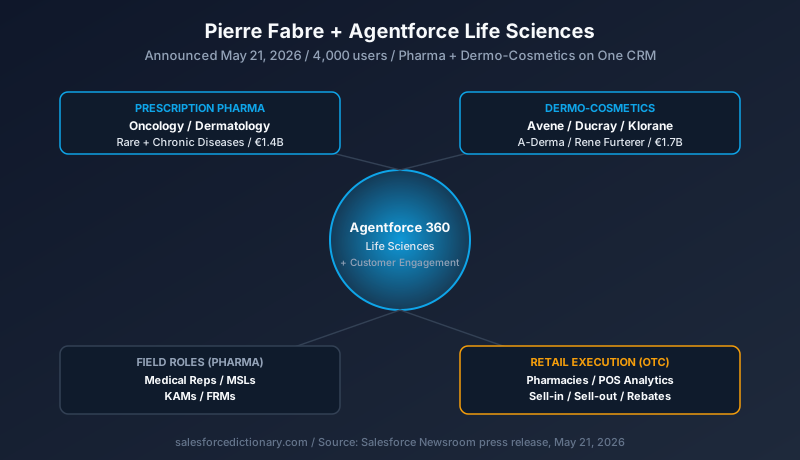
Pierre Fabre Laboratories is a French group based in the Tarn department of southwest France. The company reported 2025 revenue of €3.2 billion, split roughly 44 percent pharmaceuticals (€1.4 billion) and 55 percent dermo-cosmetics and personal care (€1.7 billion) (Pierre Fabre corporate profile). The group employs about 10,000 people across 43 locations, invests €250 million a year in R&D, and runs a brand portfolio that includes Eau Thermale Avène, Ducray, Klorane, A-Derma, René Furterer, Darrow, and Elgydium. On the pharma side, the therapeutic areas are oncology, dermatology, rare diseases, chronic diseases, and family healthcare.
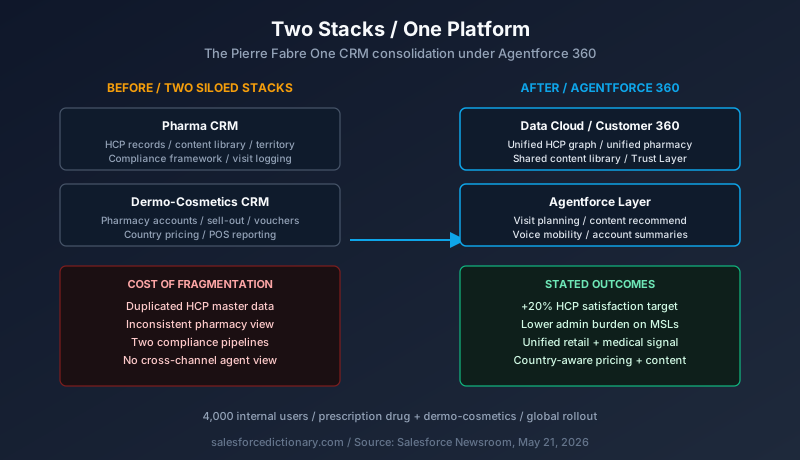
The structural issue is that those two businesses sell very differently. The prescription drug arm sells through medical representatives and medical science liaisons calling on physicians, hospitals, and key account managers. The dermo-cosmetics arm sells through pharmacies, retail beauty channels, and direct consumer touchpoints. Historically these run on separate CRM systems, separate content libraries, separate territory models, and separate compliance frameworks. The cost of that fragmentation is real: duplicated master data, inconsistent HCP records across the medical and OTC sides, and territory managers who cannot see what a pharmacy is doing across both product lines.
The Salesforce pitch is that Agentforce 360 collapses both motions onto one Customer 360 graph and one agentic layer. Whether that pitch holds up in practice is what 4,000 Pierre Fabre users are about to find out.
What Pierre Fabre is actually buying
Two products, working together.
The first is Agentforce Life Sciences for Customer Engagement, the agent-first commercial platform Salesforce shipped in September 2025 (Salesforce Newsroom). It is built for field-facing roles: medical reps, MSLs, field reimbursement managers, and key account managers. The product line covers AI-assisted visit planning, preapproved content recommendations grounded in approved medical and legal claims, voice-activated mobility, podcast-style account summaries, and what Salesforce describes as "smart visit consoles" for pre-call planning. Visit logging, compliance attestations, and follow-up tasks are written back automatically. For Pierre Fabre's MSLs, the explicit goal is administrative burden reduction so reps can spend more time on actual clinical conversations.
The second is Agentforce 360 for Life Sciences, the broader platform layer covering retail execution and POS analytics. For the dermo-cosmetics business, this is the side of the system that handles pharmacy visits, sell-in, sell-out, rebates, vouchers, country-specific pricing rules, and order management. Salesforce's framing in the announcement: improve "both care experiences and revenue, taking into account the complexities of country-specific sales rules and pricing structures" (Salesforce Newsroom).
Pierre Fabre has put a concrete target on the deployment: a 20 percent improvement in healthcare professional satisfaction, driven by tighter content alignment with clinical expectations and a more consistent physical and digital experience across channels.
Why this matters beyond one customer
Three reasons.
First, scale and brand visibility. Pierre Fabre is the world's second-largest dermo-cosmetics company and one of Europe's leading pharmaceutical labs. A multi-thousand-seat win in continental Europe is the kind of reference customer Salesforce can hold up in every pharma sales cycle for the next 18 months. The 140-organization milestone Salesforce published earlier in May (Agentforce Life Sciences customer roster) already included Pfizer, Takeda, AbbVie, AstraZeneca, Novartis, Moderna, Haleon, Fresenius, Chiesi, CSL, and Merck Animal Health. Pierre Fabre adds a different profile, a vertically integrated pharma plus consumer health house, which is a customer shape that legacy life sciences CRM has historically served poorly.
Second, the dermo-cosmetics dimension changes the conversation. Most life sciences CRM evaluations stop at the medical-rep workflow. Bringing Avène, Ducray, and Klorane onto the same platform forces Agentforce 360 to handle pharmacy retail in a way that is closer to consumer goods than to traditional pharma. If Salesforce can run that motion at scale, the addressable market for Life Sciences Cloud expands beyond pure prescription pharma into the entire OTC and consumer health adjacency. That is a strategically different total addressable market than the one the incumbent has spent two decades optimizing for.
Third, speed of deployment is the marketing weapon. Salesforce has been telling the market that Agentforce Life Sciences customers are going live in as little as five weeks, "in sharp contrast with legacy alternatives that have been in the market for years" (Salesforce Newsroom). For a 4,000-user deployment spanning two business lines and multiple countries, five weeks is not the operative number. But the relative cadence story (months, not multi-year migrations) is now backed by a marquee European reference if Pierre Fabre delivers it.
The Veeva backdrop
You cannot read this announcement without the Veeva context. Veeva Systems holds roughly 80 percent of global life sciences CRM seat share. In late 2022, Veeva announced it would move off the Salesforce platform onto its own Vault infrastructure. The formal contractual separation closed in September 2025, with a five-year wind-down for existing joint customers through 2030 (IntuitionLabs market analysis). That separation freed Salesforce to compete head-on in life sciences CRM for the first time since 2010.
The post-split scoreboard, as of early 2026: of the top 20 global pharma companies, about 9 have publicly committed to Veeva's Vault CRM, while roughly 3 have committed to Salesforce Life Sciences Cloud. The remainder are watching. Pierre Fabre is not in the top 20 by revenue, but the deal is the kind of mid-cap European win that signals where the wind is blowing for the next round of evaluations.
The substantive differentiator Salesforce is selling is the agentic layer. Veeva is also shipping agentic AI inside Vault CRM, but the Salesforce argument is that Agentforce sits on the broader Customer 360 graph (Data Cloud, Service Cloud, Marketing Cloud, Slack) and so the agent can act across the whole customer relationship and not just the medical-rep workflow. That argument plays better at companies that have both pharma and consumer-facing businesses to unify. Pierre Fabre is exactly that profile.
What the deployment will actually need
For Salesforce admins, architects, and partners following the story, here is the practical shape of a deployment like this.
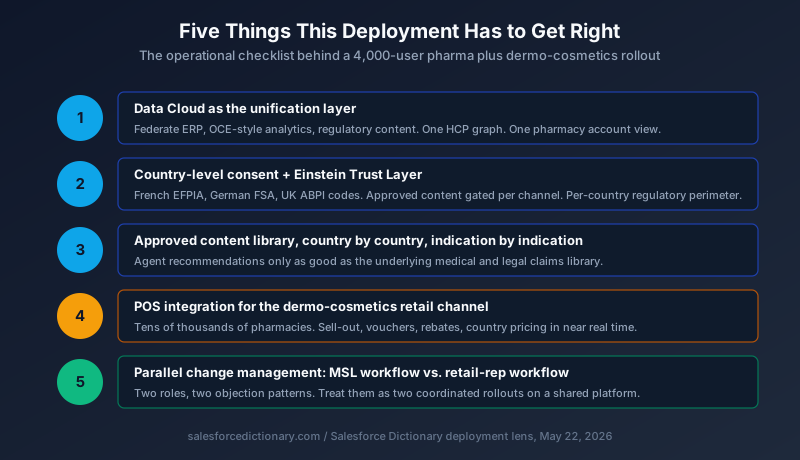
Data foundation first. The press release does not say so, but a 4,000-user, multi-country, two-business-line consolidation cannot run on inconsistent HCP master data. Expect Data Cloud as the data unification layer, with Pierre Fabre's existing systems (ERP, OCE-style analytics, regulatory content management) federated underneath. Without that step, the dermo-cosmetics and pharma sides will continue to maintain separate views of the same physician or pharmacy.
Identity and consent management at country granularity. European HCP engagement is governed by national codes (the French EFPIA implementation, the German FSA code, the UK ABPI code, and so on). Content has to be served only where it is approved, consent has to be tracked per channel, and any agent-generated suggestion has to respect the local regulatory perimeter. This is where the Einstein Trust Layer earns its keep.
Content alignment. Pierre Fabre's stated target of 20 percent HCP satisfaction improvement is downstream of content quality. Agentforce content recommendations are only as good as the approved medical and legal claims library underneath. Building that library, country by country, indication by indication, brand by brand, is the unglamorous work that determines whether the rollout hits its numbers.
POS integration for the OTC side. The dermo-cosmetics arm runs through tens of thousands of pharmacies across Europe and beyond. Sell-out reporting, voucher redemption, rebate accruals, and country-specific pricing rules have to flow back into the platform in close to real time, or the agent suggestions on the field side will lag the actual retail signal.
Change management. 4,000 users does not deploy itself. The MSL workflow and the dermo-cosmetics retail rep workflow are different roles, with different objection patterns. Treating them as one rollout is a mistake. Treating them as two coordinated rollouts on a shared platform is the play.
What to watch over the next six months
A few markers.
Salesforce will almost certainly use Pierre Fabre as a Dreamforce 2026 case study. The relevant question is what they put on the slide. If it is HCP satisfaction lift, content cycle time reduction, or rep administrative-time reclaim, those are durable proof points. If it is a generic productivity number with no methodology, that is marketing.
The five-week go-live cadence Salesforce keeps citing will be tested by the dermo-cosmetics rollout. Retail execution is messier than medical rep engagement, and the POS data pipelines are where deployments slow down. If Pierre Fabre is in production on both sides inside a single fiscal year, that is a serious counterargument to "legacy alternatives" on time-to-value.
Watch the next two or three European pharma announcements. If the pattern holds (mid-cap European pharma with consumer health adjacencies picking Salesforce over Veeva), that is a market shift, not a one-off win. If the next announcements are biotech startups or US-only mid-caps, Pierre Fabre is a signal but not a trend.
And watch what happens at the Salesforce Q1 FY27 earnings call on May 27. Customer wins of this size do not show up in revenue for several quarters, but the company's commentary on Life Sciences Cloud bookings and pipeline will tell you whether the field is seeing more deals like this one or whether Pierre Fabre is the exception.
Bottom line
Pierre Fabre is doing what enterprise software vendors hope every large customer will do: ripping out two siloed CRM stacks and consolidating onto one agentic platform. The 4,000-seat number is the headline. The structurally interesting part is that the consolidation covers both regulated pharma and consumer-facing dermo-cosmetics on the same data model, which is a use case the incumbent life sciences CRM was not designed for. If the rollout works, Salesforce gets a reference customer that opens up the pharma plus consumer health adjacency. If it stalls, the deployment becomes a cautionary tale about scope. Either way, May 21, 2026 is a date worth bookmarking in the Salesforce-versus-Veeva story.
About the Author
Dipojjal Chakrabarti is a B2C Solution Architect with 29 Salesforce certifications and over 13 years in the Salesforce ecosystem. He writes and edits salesforcedictionary.com, published by KineticBit Inc., to help admins, developers, architects, and cert/interview candidates sharpen their fundamentals. More about Dipojjal.
Share this article
Sources
Related dictionary terms
Practise it
Five questions on Agentforce Specialist
Exam-style questions with an explanation after each one. No account needed, and your answers build a weak-topic map once you have one.
Comments
No comments yet. Start the conversation.
Sign in to share your take on this article. Your account works across every page.