
CNX26: Agentforce Marketing Ships
Salesforce Connections 2026 closed with Piper and Hunter reaching GA, Content Agent and Goals Agent entering pilot, Marketing Cloud Next rebranded, and GEO introduced as the replacement for traditional SEO.

Salesforce Connections 2026: Agentforce Marketing Ships
Salesforce shipped Piper and Hunter out of beta at Connections in Chicago this week, put two more marketing agents into pilot, and told a room full of marketers that the SEO playbook they have run for fifteen years is finished. The conference ran June 3 to 4. Here is what actually changed, what is real today versus a demo, and what you should look at before your next campaign planning meeting.
CMO Patrick Stokes framed the keynote around what he called "the age of Marketing makers." His line, for the record: "We are entering a new age, the age of Marketing makers. Everything we've known, we have to go back and think about it again." Strip the theater off that and you get the practical message of the event. The work moves from doing the tasks to directing the agents that do the tasks.
Piper is generally available, and it is the headline
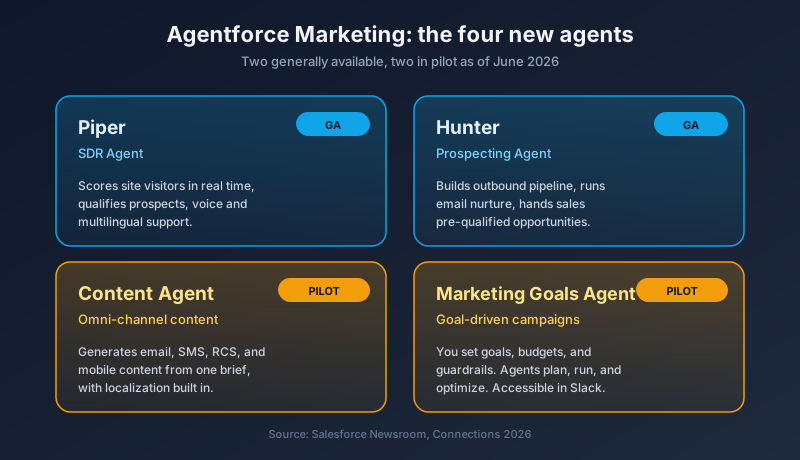
Piper, the Agentforce SDR Agent, is now generally available. It watches website visitors in real time, scores them, and qualifies the ones worth a conversation. The version that hit GA adds voice interaction and multilingual support, so it handles a prospect who would rather talk than type, and it does it in more than one language.
The number Salesforce put on stage came from a customer deployment: a 68% increase in qualified-lead conversion, with the agent live in 37 days. The detail worth noticing in that case study is who built it. Marketing and IT ran the rollout together. That is the part most teams underestimate. Piper reads your traffic, your forms, and your consent state, and none of that works without IT in the room from day one.
GA matters here for a specific reason. It means Salesforce will sell it with an SLA, support it, and put it on real customer roadmaps, not just a sandbox. If you evaluated Piper during beta and parked it because beta software does not belong in front of net-new leads, that objection is gone now.
Hunter handles the outbound half
Hunter, the Prospecting Agent, also reached GA, and it covers the side Piper does not. Where Piper works the inbound traffic that already landed on your site, Hunter goes outbound. It identifies contacts, builds the target list, and runs automated email nurture sequences until a prospect is warm enough to hand off. The output is a pre-qualified opportunity dropped onto a sales rep's desk.
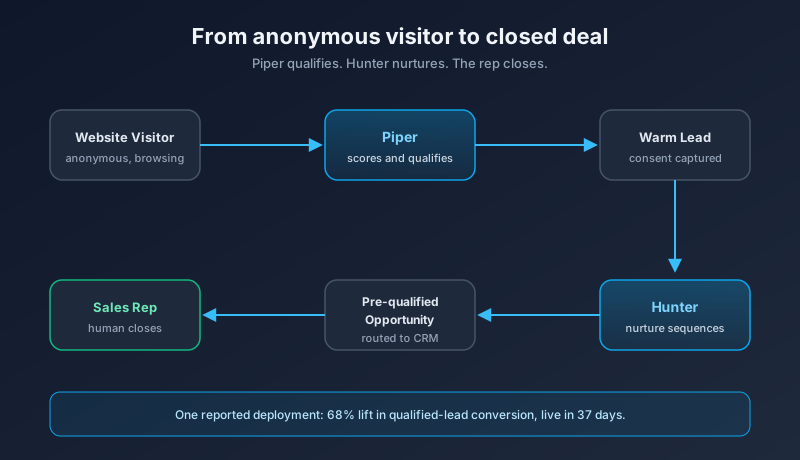
Run the two together and you get a closed loop. A stranger hits your site, Piper qualifies them, Hunter nurtures them through email, and a human rep takes the conversation that is actually ready to close. The pitch is that the rep stops spending mornings on cold research and list-building and starts the day with opportunities that already cleared a bar. Whether that holds depends on how honestly your agent is tuned. An agent that over-qualifies to hit a dashboard number just moves the cold-calling problem onto the sales floor with extra steps.
Content Agent and Goals Agent: real, but in pilot
Two more agents were announced, both in pilot as of June 2026, and the pilot label is doing real work in that sentence. Treat these as direction, not as something to wire into a Q3 campaign.
The Agentforce Content Agent generates content across email, SMS, RCS, and mobile applications from a single brief. You describe the campaign, and it produces the email, the mobile message, the SMS, the RCS conversation, and personalized variants, with localization handled in the same workflow. It runs through a new AI-powered content canvas interface. The promise is that one marketer describes an omni-channel campaign in plain language and gets a first draft of every channel back at once, instead of briefing four specialists and stitching the pieces together later.
The Marketing Goals Agent goes a level up. You define the goal, the budget, the guardrails, and how much autonomy the agent gets. Inside those boundaries it creates, executes, and optimizes campaigns on its own. It is accessible from Slack, which fits the broader pattern Salesforce has pushed all year of making Slack the place where you talk to your agents.
Here is the honest read. Pilot means limited access, rough edges, and behavior that will change before GA. The Goals Agent in particular asks you to hand budget and execution authority to software, and "guardrails" only protect you if you set them carefully and your data is clean enough for the agent to act on. Worth requesting access to learn the interaction model. Not worth betting a quarter's number on yet.
Marketing Cloud Next is the new name on the box
The rebrand is small in effort and large in how Salesforce will talk about marketing from now on. Marketing Cloud Next is now the official product name for the Growth and Advanced editions. Above it, Agentforce Marketing becomes the umbrella brand that ties the whole portfolio together.
For existing customers, this is mostly naming. Your editions, your contracts, and your features do not change because of a label. What does change is the framing in every future conversation with your account team. Marketing is now sold as an agentic product line first, with the classic Marketing Cloud capabilities positioned underneath the agents rather than as the headline. If you are budgeting for a renewal, expect the agent story to lead the pitch.
GEO: Salesforce says SEO is finished
The most provocative claim of the week had nothing to do with the agents. Salesforce introduced GEO, Generative Engine Optimization, and positioned it as the replacement for traditional SEO in a world where people ask an AI assistant instead of scrolling a results page.
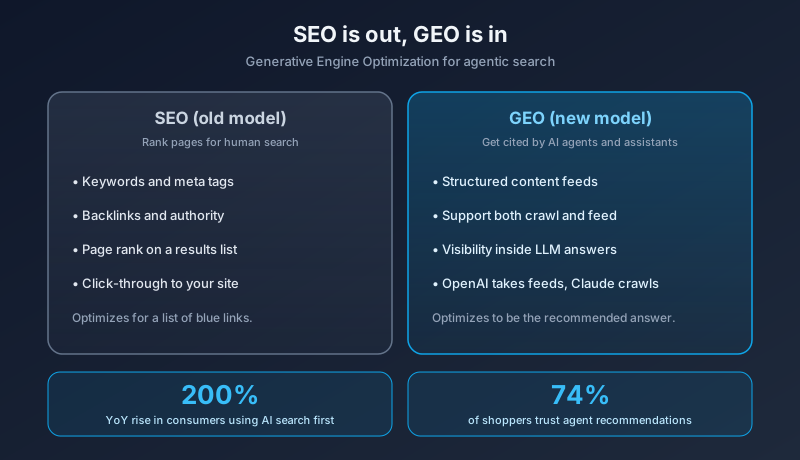
The argument rests on a behavior shift. Salesforce cited a 200% year-over-year increase in consumers who reach for AI search first, and said 74% of shoppers now trust recommendations from an agent. If that holds, the game stops being "rank on page one" and becomes "be the answer the assistant gives." You are no longer optimizing for a human scanning ten blue links. You are optimizing to be cited inside a generated answer that the shopper may never click past.
The practical part is concrete. Different AI systems ingest your catalog differently. Per the Diginomica coverage, OpenAI is preparing to receive structured product feeds, while Claude relies on crawling your site. So brands have to support both mechanisms, crawl and feed, or they go invisible to whichever assistant their customers happen to use. Salesforce also showed Brand Center for managing brand assets, Tableau MCP integration, and Headless 360 MCP tools that expose marketing capabilities, so you can do things like create a segment or build a campaign straight from Slack.
A reasonable skepticism applies. A CRM vendor announcing that the old discovery model is dead, right as it ships a new product line to replace it, is selling something. The behavior data is directional, not gospel. But the underlying point is hard to argue with: if your buyers are asking assistants for recommendations, being absent from those answers is a real cost, and "crawl plus feed" is a cheap insurance policy to start on now.
The data backing the pitch
Salesforce released its State of Sales 2026 report the same week, and the numbers are the evidence behind the whole agentic story.
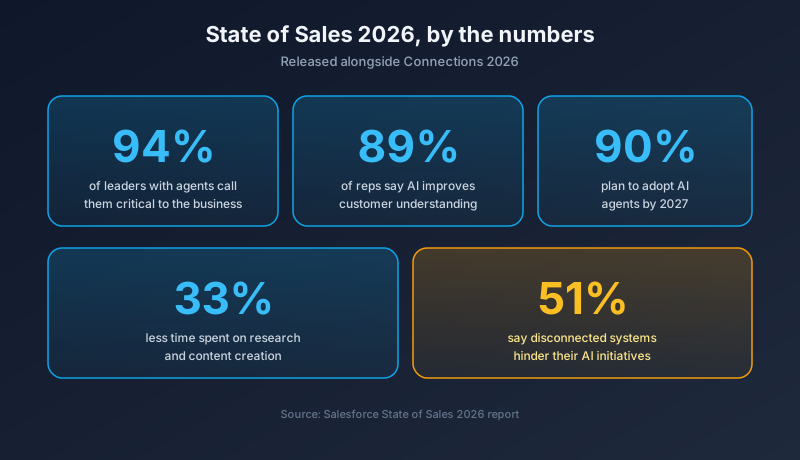
The headline figures: 94% of sales leaders who already run agents call them critical for meeting business demands, 89% of reps agree AI improves how well they understand customers, and 90% of respondents plan to adopt AI agents by 2027. Teams using AI report a 33% reduction in time spent on research and content creation.
The most useful stat is the uncomfortable one. 51% of AI-using sales leaders say disconnected systems are holding their initiatives back. That is the quiet tax on all of this. Piper, Hunter, and the rest only perform as well as the data they sit on. An agent pointed at fragmented, stale records produces confident wrong answers faster than a human would. The integration work you have been deferring is now the thing standing between you and the demo.
What to do now
Pick one inbound funnel and pilot Piper against it with a control group, so you can measure the conversion lift on your own traffic instead of trusting the 68% headline. Bring IT into that conversation on day one, not after the contract. Request pilot access to the Content Agent and Goals Agent to learn the interaction model, but keep them out of live revenue campaigns until GA. And run a one-week GEO audit: check whether your product data is reachable by both a crawler and a feed, because that is the cheapest fix on this entire list and the one with the clearest downside if you skip it. Then read the full Agentforce Marketing announcement and the State of Sales 2026 report before your next planning cycle.
About the Author
Dipojjal Chakrabarti is a B2C Solution Architect with 29 Salesforce certifications and over 13 years in the Salesforce ecosystem. He writes and edits salesforcedictionary.com, published by KineticBit Inc., to help admins, developers, architects, and cert/interview candidates sharpen their fundamentals. More about Dipojjal.
Share this article
Sources
- Salesforce Puts an AI Marketing Team in Every Marketer's Hands (Salesforce Newsroom)
- Salesforce Connections 2026 (Official Event Page)
- Salesforce Announces State of Sales Report for 2026 (Salesforce Newsroom)
- Salesforce Connections 2026: SEO is out and GEO is here (Diginomica)
- Key Innovations Announced During the Connections 2026 Keynote (SFMC Tips / Medium)
- Salesforce Connections 2026: The Future of Marketing is Agentic (Salesforce Break)
Related dictionary terms
Practise it
Five questions on Agentforce Specialist
Exam-style questions with an explanation after each one. No account needed, and your answers build a weak-topic map once you have one.
More news

Salesforce Buys Contentful for Agentforce
Salesforce signed to acquire Contentful on June 1, adding a headless content layer to Headless 360 and Agentforce. The Berlin-founded CMS serves 4,800 brands. Reported price: $1B to $1.5B, half its 2021 peak. Closes Q3 FY2027.
Agent Broker Hits GA, June 2026
Salesforce moves Agent Broker to GA in June 2026, shipping the visual authoring canvas, Agent Script, and Salesforce-model support. Guided Determinism is the production pattern for multi-agent orchestration. Here is what changed.
Comments
No comments yet. Start the conversation.
Sign in to share your take on this article. Your account works across every page.