
Salesforce x FIFA World Cup 2026
Salesforce became the Official Tournament Supporter of FIFA World Cup 2026 on June 5. The tournament kicked off June 11 across 16 host cities in Mexico, Canada, and the United States. Slack runs workforce operations. Agentforce 360 powers fan engagement. Here is what is actually deployed and why the split matters.
Salesforce and FIFA World Cup 2026: Agentforce and Slack Power the Planet's Biggest Stage
A volunteer coordinator in Guadalajara needs to confirm a shuttle schedule change that affects staff in Kansas City and Toronto at the same time, in three languages, before the next match kicks off in four hours. That coordination problem, multiplied across 16 cities and three countries, is the operational reality of the largest men's World Cup ever staged. As of this tournament, it runs on Slack.
Salesforce became the Official Tournament Supporter of FIFA World Cup 2026 on June 5. The tournament kicked off June 11 and runs through July 19 across Mexico, Canada, and the United States. Here is what each Salesforce product actually does, which tournament it is doing it for, and why the split between Slack and Agentforce is the most interesting part of the deal.
The Deal
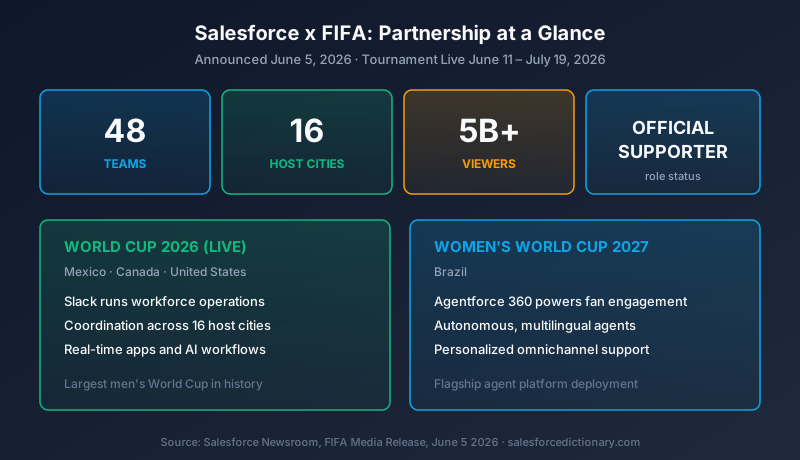
The terms are simple to state. Salesforce is the Official Tournament Supporter of both FIFA World Cup 2026 and FIFA Women's World Cup 2027, which will be held in Brazil. The men's tournament is the headline: 48 teams, the largest field in World Cup history, played across 16 host cities in three countries, with a global audience FIFA and Salesforce expect to exceed 5 billion people.
No contract value was disclosed. That is normal for a sponsorship of this type, and the absence of a number is not a knock on the deal. What Salesforce gets is association with the single largest live media event on earth, plus a production-scale proving ground for its platform. What FIFA gets is software that runs the tournament. Both sides have something concrete at stake.
The framing from the top was the Agentic Enterprise, the term Salesforce has used all year to describe an organization run with autonomous AI agents in the loop. Patrick Stokes, President and CMO at Salesforce, put it this way in the Salesforce announcement: "The FIFA World Cup is the moment the world stops to watch, and delivering it is one of the most complex undertakings in global sport. We're honored to partner with FIFA World Cup 2026 and FIFA Women's World Cup 2027 to bring the power of the Agentic Enterprise to two historic tournaments."
Romy Gai, Chief Business Officer at FIFA, kept it short. "The greatest tournaments require the very best partners alongside us. Salesforce's technology and expertise will help support the delivery of two landmark competitions."
The Split That Matters
Read the press release carefully and one detail stands out. The two flagship products are not deployed at the same tournament. They are split across the two events, and the split is deliberate.
For FIFA World Cup 2026, the men's tournament that is live right now, the workhorse is Slack. Slack coordinates workforce management across all 16 host cities. It brings tournament personnel, the apps they use, and AI-powered workflows into one place, so staff across cities and countries can share information and coordinate in real time.
For FIFA Women's World Cup 2027 in Brazil, the flagship is Agentforce 360. It will power fan engagement across FIFA's digital platforms, with autonomous agents handling human-level support and personalized, multilingual interactions at scale.
Both tournaments share a common back office. Agentforce Service, Sales, and Marketing manage FIFA's relationships and communications with host cities, suppliers, and partners across both events.
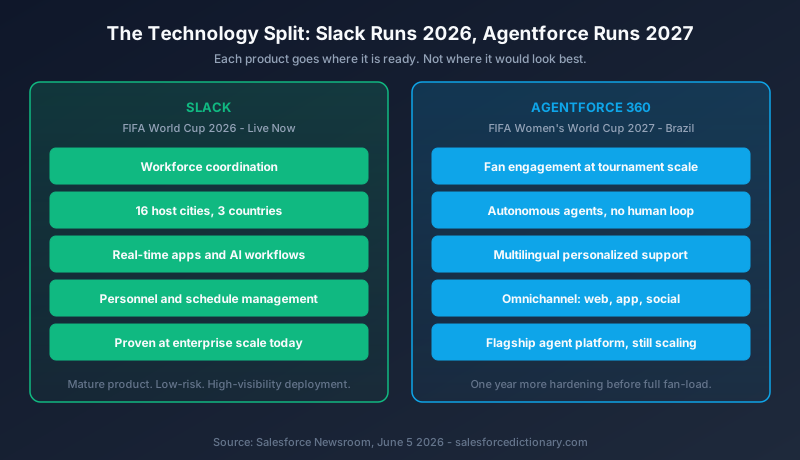
Why does this matter? Because it tells you what Salesforce is confident shipping today versus what it is still scaling toward.
Operations is a coordination problem. It is people, schedules, logistics, and messaging across distributed teams. Slack solves that today, at the scale of an enterprise that already runs on it, and it has the AI workflow layer Salesforce has been building into it all year. Putting Slack on the live men's tournament is a low-risk, high-visibility bet. The work is real, the failure modes are manageable, and the product is mature.
Fan engagement at 5 billion viewers is a different animal. Autonomous agents answering fan questions in dozens of languages, across web, app, and social, during live matches, with no human in the loop for most of it, is genuinely hard. The fact that Agentforce 360 is pointed at the 2027 Women's World Cup rather than the live 2026 men's tournament reads as a sequencing decision. Slack proves operations now. Agentforce gets a year of additional hardening before it carries fan-facing load at full tournament scale.
That is not a criticism. It is a sensible deployment order, and it is more honest than slapping the newest product on the biggest stage and hoping. The interesting question is whether the 2027 fan-engagement rollout actually lands as described, because that is the harder of the two problems and it is the one that involves the flagship agent platform.
What Slack Is Doing at the 2026 Tournament
Strip away the marketing and the Slack deployment is a textbook case of distributed operations.
A World Cup is not one event. It is dozens of simultaneous operations: venue management, transport, security coordination, broadcast logistics, volunteer scheduling, accreditation, and match-day staffing, repeated across 16 cities in three countries with different languages, time zones, and local partners. The coordination overhead is enormous, and most of it is information moving between people who are not in the same room or the same country.
Slack's pitch here is the consolidation of that into one surface. Personnel, the apps they rely on, and AI-powered workflows in a single place. Martech Notes reported that Slack is the operations layer for the tournament, with Agentforce handling the fan side at the later event. The AI workflow piece is what makes this more than a group chat. Routing a logistics change to the right city teams, summarizing a long incident thread for an incoming shift, surfacing the relevant document without a manual search: these are the kinds of automations Slack has been adding through its agentic features.
For anyone tracking Slack's repositioning, this is the proof point. Salesforce has spent the year recasting Slack as the front door to the Agentic Enterprise, the place where humans and agents work together. A live World Cup running its operations on that exact model is the demonstration the pitch needed.
What Agentforce 360 Will Do in 2027
The 2027 deployment is the more ambitious half. Agentforce 360 will run fan engagement across FIFA's digital platforms for the Women's World Cup in Brazil.
The job is support and interaction at a scale no human team can staff. Autonomous agents answering fan questions, handling ticketing and travel queries, surfacing schedules and results, and doing it in multiple languages across whatever channel a fan shows up on. The key words in the announcement are autonomous, personalized, omnichannel, and multilingual. Each one is a real technical requirement, not decoration.
Autonomous means the agent resolves the interaction without a human, most of the time. Personalized means it accounts for who the fan is and what they have asked before. Omnichannel means the same agent works across web, mobile, and social without the fan starting over. Multilingual means it does all of that in the language the fan uses. Put together, that is a serious bar, and clearing it during a live global tournament is the test that matters.
Why This Is a Template, Not Just a Sponsorship
The reason to pay attention to this deal even if you never touch sports tech is that FIFA is a stress test Salesforce can point to.
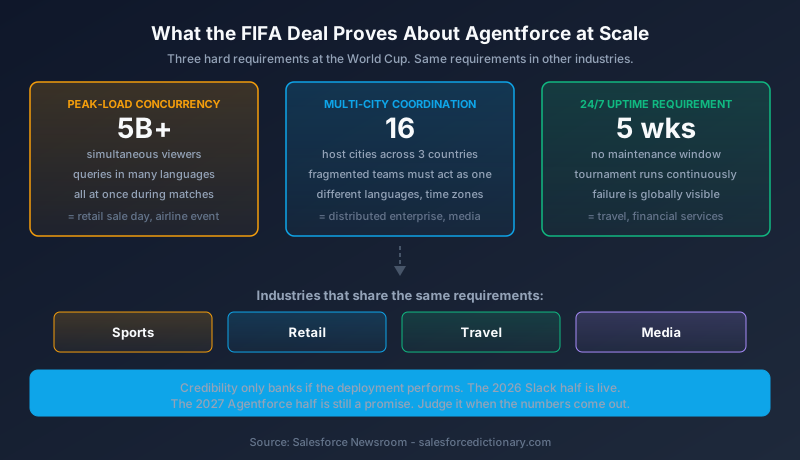
Three properties make a World Cup a hard environment, and each maps to a problem other industries have. First, peak-load concurrency. A global audience above 5 billion means spikes of simultaneous queries during matches, in many languages at once. Second, multi-city coordination. Sixteen host cities across three countries means fragmented teams that have to act as one. Third, the uptime requirement. There is no maintenance window during a World Cup. It runs 24/7 for five weeks.
Those are the same problems faced by a retailer on a peak sale day, an airline during a weather event, a media company during a major live broadcast. If Salesforce can show its platform held up under FIFA conditions, that becomes a reference any enterprise in sports, retail, travel, or media can evaluate against. A sponsorship buys visibility. A working deployment at this scale buys credibility, and credibility is the thing Agentforce has been short on relative to its growth numbers.
The catch, and it is worth being clear about it, is that the credibility only banks if the deployment performs. The men's tournament running on Slack is the part Salesforce can already talk about with confidence. The Agentforce 360 fan-engagement claim is a 2027 promise. Until that ships and holds under load, the template is aspirational on its most ambitious axis.
What to Do Now
If you run operations on Slack, watch how FIFA's workforce coordination is structured during this tournament. Salesforce will publish case material, and the patterns for routing, AI workflows, and cross-team coordination at this scale are directly reusable. Pull those into your own Slack agentic setup rather than reinventing them.
If you are evaluating Agentforce for high-concurrency, multilingual customer engagement, do not treat the FIFA name as evidence yet. The fan-engagement piece is a 2027 deployment for the Women's World Cup. Track the Salesforce investor relations page and Salesforce Newsroom for the actual performance numbers once that tournament runs, and judge the platform on those, not the logo.
If you are a Salesforce architect, study the split itself. The decision to put a mature product (Slack) on the live event and the flagship agent platform on the later one is a model for your own rollouts. Deploy the proven thing where failure is expensive, and give the newer thing a lower-stakes first run. That sequencing logic is the most transferable lesson in this entire announcement.
About the Author
Dipojjal Chakrabarti is a B2C Solution Architect with 29 Salesforce certifications and over 13 years in the Salesforce ecosystem. He writes and edits salesforcedictionary.com, published by KineticBit Inc., to help admins, developers, architects, and cert/interview candidates sharpen their fundamentals. More about Dipojjal.
Share this article
Sources
- Salesforce to Transform Fan Engagement and Tournament Operations at FIFA World Cup 2026 and FIFA Women's World Cup 2027 (Salesforce Newsroom)
- FIFA announces Salesforce as Official Tournament Supporter of FIFA World Cup 2026 and FIFA Women's World Cup 2027 (FIFA Media Release)
- Salesforce to Transform Fan Engagement and Tournament Operations (Salesforce Investor Relations)
- Salesforce lands FIFA World Cup 2026 support deal (Martech Notes)
- Salesforce to Run Fan Engagement and Tournament Operations at FIFA World Cup (DestinationCRM)
- Salesforce Partners with FIFA for 2026 and 2027 World Cups (Gurufocus)
Related dictionary terms
 Our appAdWake up sharp. Not just awake.The alarm that rings through Silent and DND — free on iOS & Android.Get WakeSharp →
More news
Salesforce Buys Fin for $3.6B
Salesforce signed to buy Fin (formerly Intercom) for $3.6B all-cash on June 15. Fin's Apex model resolves 76% of tickets autonomously. Agentforce Help Agent launched at $2 per resolved issue. Closes Q4 FY2027.
CNX26: Agentforce Marketing Ships
Salesforce Connections 2026 wrapped with Piper (SDR Agent) and Hunter (Prospecting Agent) hitting GA, Content Agent and Goals Agent entering pilot, Marketing Cloud Next rebranding under Agentforce Marketing, and GEO replacing SEO.


Comments
No comments yet. Start the conversation.
Sign in to share your take on this article. Your account works across every page.