
Air Force Fleet on Missionforce
On July 8 Salesforce said an 85-person Air Force squadron went live on Missionforce to run a $13.5 billion, 84,000-vehicle fleet. Here is what actually shipped and what is still a pilot.

An 85-person Air Force squadron just went live on Salesforce to run a $13.5 billion vehicle fleet. On July 8, Salesforce said the 441st Vehicle Support Chain Operations Squadron now manages more than 84,000 vehicles across nearly 389 locations on Missionforce National Security, the company's defense business unit.
This is the deployment the $72 million Air Force license from May was supposed to produce. Back then the story was a contract with Agentforce pilots and no go-live date. Seven weeks later there is a running system with numbers attached. Here is what actually shipped, what is still labeled "forthcoming," and how much of it is agents versus plumbing.
From signed paper to a live fleet
The May announcement was a procurement event. A $72M enterprise license, executed as a task order under the Army's $5.6 billion IDIQ from January, with Agentforce named as a pilot and no production date. That is the normal shape of a federal award. It commits money and grants access. It does not prove the software runs.
July 8 is the proof of run. The 441st, the squadron that keeps the Air Force's ground vehicles moving, is on the platform in production. Salesforce can now name a fleet size, a location count, a personnel count, and a shipped application. That is a different category of claim than "the Air Force selected Salesforce," and it is the reason this is news rather than a rerun.
Seven weeks from license to production is fast for a federal deployment, and the contract structure is why. Because the Air Force bought through the Army's existing $5.6 billion vehicle rather than running its own competition, there was no fresh source selection to wait on. The paperwork closed in January. May funded the license. The engineers spent the early summer standing up the environment instead of sitting in front of a procurement board. That is the entire point of a governmentwide contract, and this is the first visible payoff of that model inside Salesforce's defense unit.
The distinction matters for anyone tracking Agentforce adoption. Contract announcements are cheap. A named government reference running measurable workloads is not, and Salesforce has spent 2026 short on exactly that kind of proof.
The squadron and the scale
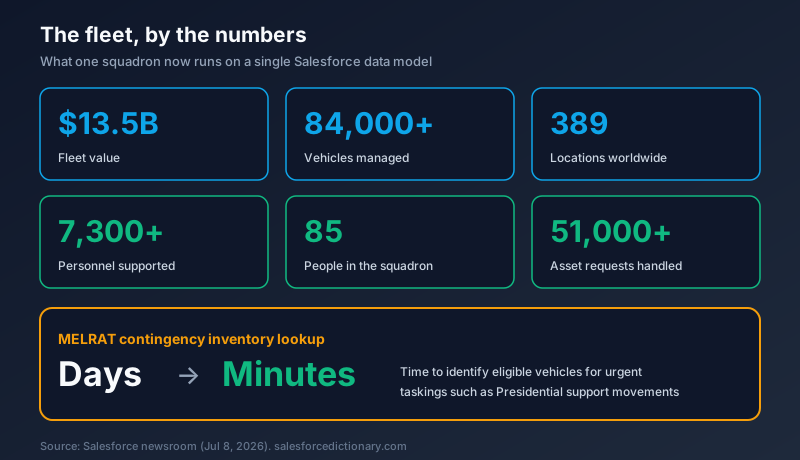
The numbers are the story, so start with them. The 441st runs a fleet valued at $13.5 billion: more than 84,000 vehicles, from staff cars to specialized support equipment, spread across close to 389 locations worldwide. The squadron behind all of it is 85 people. Those 85 in turn support more than 7,300 personnel who touch the fleet.
Read the ratio. Eighty-five people accountable for 84,000 vehicles is roughly one person per thousand assets, on a fleet worth more than most public companies. That is the operational reason a spreadsheet-and-ERP setup stops working. There is no headcount to throw at reconciliation. The only way an 85-person team holds visibility over 84,000 moving assets is a single system that reconciles itself.
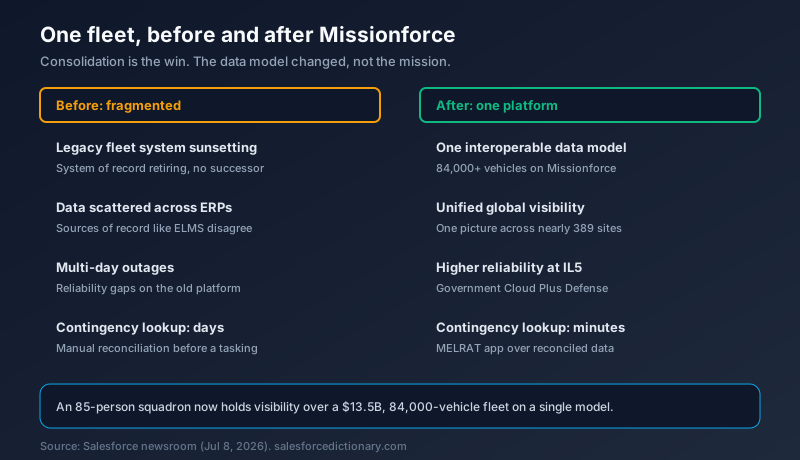
Vehicle support chain work is unglamorous and unforgiving. Someone has to know which vehicles exist, where they are, what condition they are in, which are due for maintenance, and which can be pulled for an urgent tasking, across 389 sites, close to real time. Before Missionforce, the squadron faced its legacy fleet system sunsetting, with data scattered across ERP systems of record like ELMS. Those systems held pieces of the picture, but pieces in different databases are not a picture. When a contingency lands, the cost of that fragmentation is measured in the hours spent reconciling records instead of moving vehicles.
What actually went live: MELRAT and the numbers
The concrete deliverable with a name is MELRAT, an application Salesforce built for the squadron to handle contingency support. Its job is to find eligible vehicles fast when something urgent lands, like Presidential support movements. Salesforce says MELRAT cut the time to identify eligible inventory for those contingencies from days to minutes.
That claim is worth reading precisely, because it is the most substantive one in the release. This is not an autonomous agent making decisions. It is a search-and-match application over unified data. Someone still asks the question and someone still makes the call. What changed is that the answer arrives in minutes instead of days, because the vehicle data finally sits in one place with one schema. That is a real operational win, and it is a data-consolidation win, not an AI win. Salesforce describes MELRAT as an application, not an agent, and you should keep that line straight.
The other cited results follow the same pattern. Streamlined asset logistics supporting more than 51,000 requests. Improved global visibility from unified data. Higher system reliability than the sunsetting predecessor, which had suffered multi-day outages. Every one of those is a benefit of moving fragmented data onto one interoperable platform. None of them needs an agent to be true. That is not a criticism. It is the correct order of operations. You cannot run trustworthy agents on data that does not reconcile.
Live versus "forthcoming"
Here is the part the headline flattens. Some of this stack is running today and some of it is roadmap, and the release mixes the two.
Live now: Agentforce Public Sector for unified data capture and predictive analytics, CRM Analytics dashboards for commanders, self-service portals for global collaboration, Salesforce Shield for encryption and monitoring, and MELRAT. That is a working system of record with analytics and one custom app on top.
Labeled forthcoming: Agentforce Field Service and Operations for real-time work-order coordination, automated budgeting calculations, and AI-driven predictive maintenance and data validation. In other words, the parts that would let an agent schedule maintenance, coordinate field work, and forecast spend without a human in the loop are the parts that have not shipped yet.
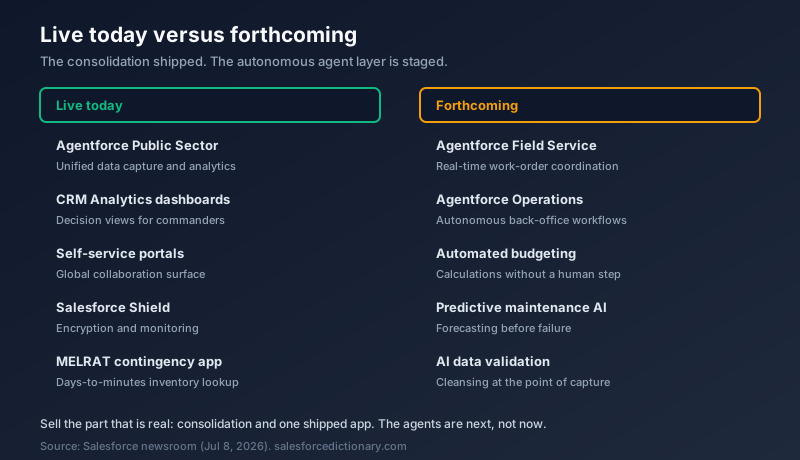
So the accurate summary is narrower than "the Air Force runs its fleet on AI agents." The Air Force runs its fleet on a consolidated Salesforce data platform with analytics and one contingency app live today, and the autonomous field-operations layer is a future phase. If you are selling Agentforce internally on the back of this story, sell the part that is real. The consolidation shipped. The agents are staged.
Why the 85-person squadron is the actual selling point
Salesforce chose this reference carefully, and the choice tells you who the pitch is for.
Kendall Collins, CEO of Missionforce, called the squadron "a masterclass in how a lean, mission-focused team paired with Salesforce can drive real global impact." Strip the promotion and the message is a scale argument: a small team ran a huge, high-stakes operation on this platform without adding people. That is the exact anxiety a CIO in any regulated, asset-heavy business carries. Fleets, medical devices, field equipment, financial contracts, all the same shape. Too many assets, too few people, a retiring system of record, no budget for a bigger team.
Bill Pessin, Salesforce's SVP of National Security, framed it as a deliberate bet. The company aligned "the right people, processes, and technology to scale with the DoW and the Intelligence Community," he said, calling the Air Force work "a culmination of that foresight, delivering the digital superiority and multi-tenant scale required to meet operational demands." Multi-tenant scale is the phrase to note. It signals the same platform is meant to hold more services, not just this squadron. The 441st is a proof of tenancy as much as a proof of function.
The defense setting adds the compliance proof most vendors cannot show. This runs on Salesforce Government Cloud Plus Defense at Impact Level 5, the authorization tier for controlled unclassified national security data. If the platform holds a fleet at IL5, a bank's data-residency questions look small by comparison. That is the transfer Salesforce wants a commercial buyer to make, and it is a fair one to make.
The skeptic's read
Two cautions keep this honest.
First, the money already moved. This is not new contract value. It is delivery on the $72M license from May, itself a task order under the $5.6B Army vehicle from January. The July 8 release adds a proof point, not a dollar. Anyone scoring it as fresh revenue is double-counting.
Second, the market shrugged. CRM slipped more than 1% in premarket the same day, dragged by a broad tech selloff, and the trade wires tagged the item neutral. A named government deployment of this size moving the stock zero is its own data point. Investors have decided that Salesforce customer wins, even good ones, are not the number they are grading. They are grading Agentforce revenue growth, and a fleet-management reference with the agent layer still forthcoming does not settle that question. It supports the pipeline story. It does not close the revenue gap the stock has been marked down for since spring.
None of that makes the deployment soft. It is a live system, at real scale, with a measurable before and after and a hard compliance bar cleared. It makes the deployment a reference, which is what it is built to be, and references compound slowly. One squadron live at IL5 is worth more to the next defense task order and the next regulated-industry deal than it is to next quarter's print.
What to do next
If you pitch Salesforce into asset-heavy or regulated accounts, pull this release into your reference deck today, and pull the exactly right claim from it. The proven line is consolidation: an 85-person team holding visibility over 84,000 assets on one data model, with one contingency app cutting a days-long lookup to minutes. Lead with that. Do not oversell the agents, because the field-operations and predictive layers are still labeled forthcoming, and a sharp buyer will check.
If you run Agentforce internally, use this as the template for sequencing. Consolidate the data and ship one high-value app first, measure it in time saved the way MELRAT reports days to minutes, then stage the autonomous pieces behind that proof. The order is the lesson. Get the data reconciled onto one model, earn a number you can show, and let the agents follow the plumbing rather than lead it.
And if you track CRM, file this where it belongs: a durable reference win, not a catalyst. Watch the next earnings call for whether Government Cloud and Missionforce get named in the prepared remarks. If they do, public sector is a growth story Salesforce is willing to underwrite out loud. If they do not, it is a quiet build, and July 8 was a slide, not a turn.
About the Author
Dipojjal Chakrabarti is a B2C Solution Architect with 29 Salesforce certifications and over 13 years in the Salesforce ecosystem. He writes and edits salesforcedictionary.com, published by KineticBit Inc., to help admins, developers, architects, and cert/interview candidates sharpen their fundamentals. More about Dipojjal.
Share this article
Sources
Related dictionary terms
Practise it
Five questions on Salesforce certifications
Exam-style questions with an explanation after each one. No account needed, and your answers build a weak-topic map once you have one.

Comments
No comments yet. Start the conversation.
Sign in to share your take on this article. Your account works across every page.