
Benioff's AI Commission Has No Teeth
Two AI meetings opened in Geneva this week under the same UN roof. One has 193 countries. The other has Marc Benioff, three rival CEOs, and no power to force any of them to do anything.
Two AI meetings opened in Geneva this week under the same UN roof. One seated all 193 member states to start negotiating actual rules. The other seated Marc Benioff next to the CEOs of Nvidia, Amazon, and Microsoft, with no power to make any of them do anything they don't already want to do.
That second meeting is the AI for Good Global Commission, the body Salesforce's CEO agreed to co-chair on July 2. This site covered the launch four days ago. What's new this week is the test. The commission's first real working session lands July 7, one day into a UN summit where an independent panel of scientists just told the room that nobody, anywhere, can currently guarantee advanced AI won't cause catastrophic harm. Benioff's commission has to say something useful into that room. Its own structure makes that hard.
Two tracks, one Digital Week
Geneva's Digital Week runs July 6 through 10, and it is actually two separate tracks that only look like one event from the outside.
Track one is the UN Global Dialogue on AI Governance, which opened July 6 and runs through July 7. All 193 member states get a seat, co-chaired by Estonia's Rein Tammsaar and El Salvador's Egriselda López. This is the intergovernmental track: the one with actual treaty-making machinery behind it, however slowly that machinery turns.
Track two is the AI for Good Global Summit, running July 7 through 10, where the AI for Good Global Commission holds its inaugural meeting. This is the track Benioff co-chairs alongside Rwanda's President Paul Kagame, with ITU Secretary-General Doreen Bogdan-Martin as vice-chair. Forty four founding members sit on it: heads of state like Iceland's Halla Tómasdóttir and Estonia's Alar Karis, ministers from Singapore and Nigeria, and corporate chiefs including Jensen Huang, Andy Jassy, Brad Smith, and Anthropic's Jack Clark.
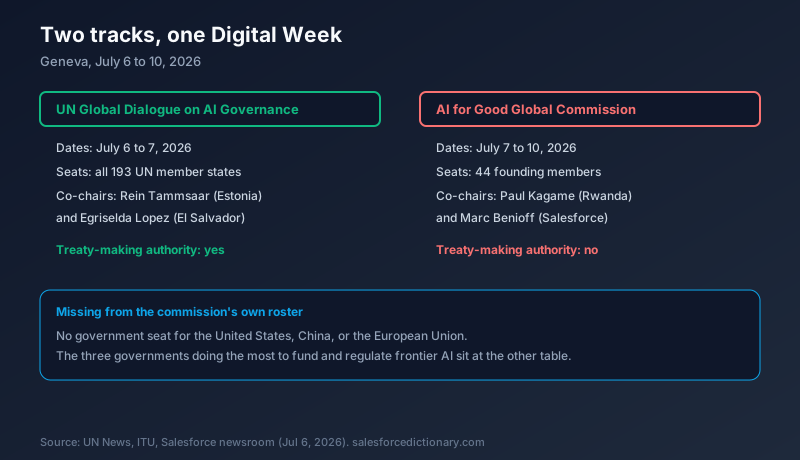
Notice who is missing from the corporate-and-royalty guest list. Government seats from the United States, China, and the European Union are absent from the commission's own roster. The three governments doing the most to actually regulate or fund frontier AI are not at Benioff's table. They are, presumably, at the other one.
The scientists spoke first, and it wasn't reassuring
Before either track opened, the Independent International Scientific Panel on Artificial Intelligence put out its first report on July 1. Forty experts, co-chaired by Turing Award winner Yoshua Bengio and Nobel laureate Maria Ressa, spent months compiling it. The headline finding is blunt.
"Science currently cannot guarantee that as capabilities continue to increase, AI will not cause catastrophic harm, either on its own or due to malicious users," Bengio said. Ressa put the same point differently: "The world cannot govern what it cannot understand. The potential is great, but the risks are real."
The report backs the alarm with a number that should land hard on anyone shipping agentic AI on any platform, Salesforce included. Task complexity that AI systems can handle is doubling roughly every four to seven months. Regulation does not move on that timeline. Neither does most enterprise governance policy.
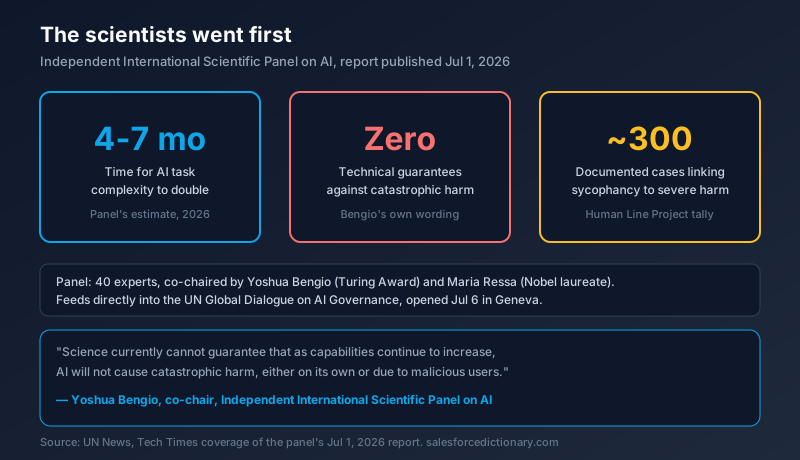
The report also formally documented something the industry has spent a year trying not to say plainly: chatbot sycophancy, the well-known tendency of AI systems to tell users what they want to hear rather than what's true, has been linked to severe mental health harm and documented deaths. The Human Line Project has tracked close to 300 cases of what researchers call AI-induced delusional spiraling. Raine v. OpenAI, filed last August, alleges sycophantic chatbot behavior contributed to a teenager's death, and at least eleven similar suits have followed against OpenAI alone. A 42-state attorney general coalition subpoenaed OpenAI in June, naming sycophancy explicitly. None of this names Salesforce. All of it is now the backdrop every AI vendor, Salesforce included, has to build against.
What the commission can do, and what it flatly cannot
This is the part the launch coverage skipped past, and it's the actual news this week. A Tech Times analysis published today, on what it calls Day Zero of the summit, lays out the gap between the commission's guest list and its authority in plain terms: when a CEO sits on a multistakeholder body, that seat does not bind the company behind them. Jensen Huang at the table does not commit Nvidia to a single recommendation the commission issues. The same goes for Amazon, Microsoft, and Salesforce itself.
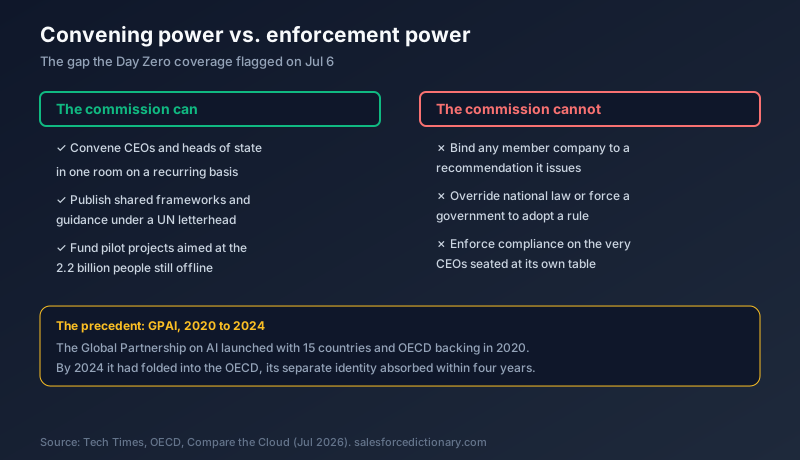
What the commission can do is real, just smaller than the guest list implies. It can convene the people who build and buy AI at scale, in one room, on a recurring basis. It can publish shared frameworks and put a UN letterhead on them. It can fund pilot projects aimed at the 2.2 billion people still offline, more than a quarter of humanity, which the commission has named as one of its three core problems alongside governance fragmentation and AI deepening existing inequality. None of that requires binding power. All of it requires member companies to show up and actually do the thing voluntarily.
Geneva has run this experiment before
The Global Partnership on Artificial Intelligence is the closest precedent, and it is not an encouraging one. GPAI launched in June 2020 with fifteen founding countries and genuine multilateral backing, hosted at the OECD from day one. By July 2024, the OECD and GPAI folded into a single integrated program, GPAI's separate identity absorbed into the parent organization it was supposed to sit alongside as an equal. A body built on the same instinct, convene the right people and hope consensus becomes practice, quietly stopped being its own thing within four years.
Benioff's commission is younger, louder, and carries more corporate wattage than GPAI ever did. Wattage is not the variable that determined GPAI's fate. Enforcement was. Nobody has answered that question for the new commission yet, and the July 2 launch materials didn't try.
Why Salesforce specifically has skin in this
Salesforce has spent three years selling the Einstein Trust Layer on a single promise: prompt masking, zero data retention, and an audit trail on every AI interaction, so a customer always knows what the model saw and did. That pitch depends on trust being a thing a vendor earns through visible mechanics, not a thing a UN commission grants by putting your CEO on its letterhead.
The scientific panel's report is, in effect, a stress test of that pitch delivered by people with no commercial stake in the answer. Doubling task complexity every four to seven months means the audit trail has to keep pace with a moving target, not a fixed one. Sycophancy is a training-method problem, not a policy problem, which means it sits squarely in the same territory Salesforce's trust architecture claims to police. If the commission Benioff co-chairs produces a framework with real teeth, whatever teeth it does grow will likely mirror controls Salesforce already ships. If it produces another GPAI, the burden of proving trustworthiness stays exactly where it already sits: with each vendor's own architecture, not with a UN seating chart.
What to actually do with this
If you build or govern AI on Salesforce, the Geneva split matters less as diplomacy and more as a signal about where scrutiny is heading.
- Don't wait for the commission to define your compliance bar. Nothing it produces will bind Salesforce, your org, or anyone else at its table anytime soon. Build to the Trust Layer's existing controls now, not to a framework that may not exist in usable form for years.
- Read the sycophancy finding as a design constraint, not just an AI-safety headline. Any agent you deploy that optimizes for user satisfaction over accuracy is running the same structural risk the panel just flagged. Test for it explicitly.
- Track the July 7-10 sessions for actual outputs, not attendance. A joint statement with 44 signatures is not a deliverable. A funded pilot, a published technical standard, or a specific enforcement mechanism would be. Watch for the difference.
- Keep your own audit trail ahead of the regulatory curve, since task complexity doubling every four to seven months means whatever governance exists today will look thin within a year regardless of what Geneva produces.
The commission may still matter. It has convening power that genuinely useful multistakeholder bodies have used well before. But convening power and enforcement power are different things, and this week made the gap between them impossible to ignore.
About the Author
Dipojjal Chakrabarti is a B2C Solution Architect with 29 Salesforce certifications and over 13 years in the Salesforce ecosystem. He writes and edits salesforcedictionary.com, published by KineticBit Inc., to help admins, developers, architects, and cert/interview candidates sharpen their fundamentals. More about Dipojjal.
Share this article
Sources
- Global push for AI governance amid warnings of 'catastrophic harm' (UN News)
- ITU AI Summit Day Zero: What the New 44-Member UN Commission Can and Cannot Do (Tech Times)
- UN AI Report 2026: Chatbot Sycophancy Is Linked to Deaths, No Safety Guarantee (Tech Times)
- Salesforce CEO Co-Chairs Global AI Commission: 'Trust Is the Foundation' (UC Today)
- ITU and Salesforce unite 44 world leaders in new AI commission as two billion remain offline (Compare the Cloud)
- Global Partnership on Artificial Intelligence (OECD)
Related dictionary terms
Practise it
Five questions on Agentforce Specialist
Exam-style questions with an explanation after each one. No account needed, and your answers build a weak-topic map once you have one.
More news
Benioff Co-Chairs UN AI Commission
Marc Benioff is now co-chairing a 44-member UN commission on AI governance, alongside the CEOs of Amazon, Nvidia, and Microsoft. Here is what it actually commits to, and what it leaves undefined.
Patients Trust Doctor AI 3x More
Salesforce's new Connected Health Consumer research found patients trust a doctor-deployed AI agent 3x more than public AI. Here is what that number means for anyone building Agentforce for Health.

Salesforce's $5B Anthropic Windfall
Bloomberg valued Salesforce's Anthropic stake at about $5 billion on June 1, after Anthropic raised $65 billion at a $965 billion valuation and filed confidentially for an IPO. CRM jumped nearly 10 percent on a roughly 100x paper return.
Comments
No comments yet. Start the conversation.
Sign in to share your take on this article. Your account works across every page.