
Benioff Co-Chairs UN AI Commission
Salesforce's CEO is now co-chairing a 44-member United Nations commission on AI governance, seated next to the CEOs of Amazon, Nvidia, and Microsoft. Here is what the group actually committed to, and what it left blank.
On July 2, Marc Benioff stood beside Rwanda's president and the head of the United Nations' telecom agency and announced he now co-chairs a new global commission on artificial intelligence. The founding member list next to him reads like a seating chart from a rival earnings call: the CEOs of Amazon and Nvidia, the president of Microsoft, the co-founders of Anthropic and Cohere. Forty four names, one shared title, and a first meeting scheduled for Geneva in five days.
It is called the AI for Good Global Commission. The launch came with a lot of language about trust and access, and comparatively little about what the group is actually going to do. That gap is worth pulling apart, because Salesforce has spent three years building its entire AI pitch around the word "trust," and its own CEO just put his name on a body that is now supposed to define what that word means for governments, companies, and the 2.2 billion people who are not online yet.
What actually got announced
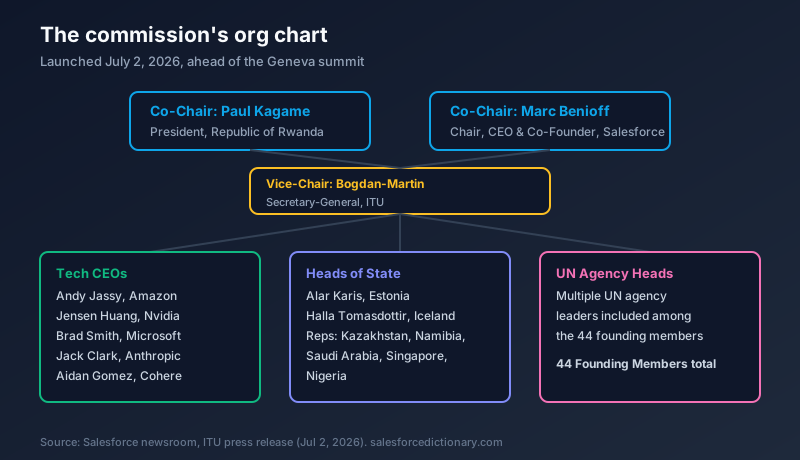
The mechanics are straightforward. Paul Kagame, president of Rwanda, and Marc Benioff, chair and CEO of Salesforce, are co-chairs. Doreen Bogdan-Martin, secretary-general of the International Telecommunication Union, holds the vice-chair seat. Beneath them sit more than 40 founding members: heads of state, industry executives, and the leaders of several UN agencies.
Kagame framed the effort in moral terms: "Technology is supposed to be a force for good, and we have a responsibility to use it accordingly." Benioff picked up the same register: "AI is the most profound technological transition in history. Our values have to guide every step, because responsibility is the core of AI ethics." Bogdan-Martin, whose agency is hosting the whole thing, called for "collective leadership to ensure AI benefits all people, everywhere."
None of that is a policy. It is a mission statement, delivered by three people with genuinely different jobs: a head of state, a UN telecom regulator, and the CEO of a company that sells AI software for a living.
Who is actually in the room
The tech bench is the part that will get the headlines, and it earns them. Andy Jassy (Amazon), Jensen Huang (Nvidia), Brad Smith (Microsoft), Jack Clark (Anthropic co-founder), and Aidan Gomez (Cohere co-founder) all carry the Founding Member title alongside Benioff. That is five of the companies currently racing each other to sell the compute, models, and agent infrastructure this commission is supposedly going to help govern.
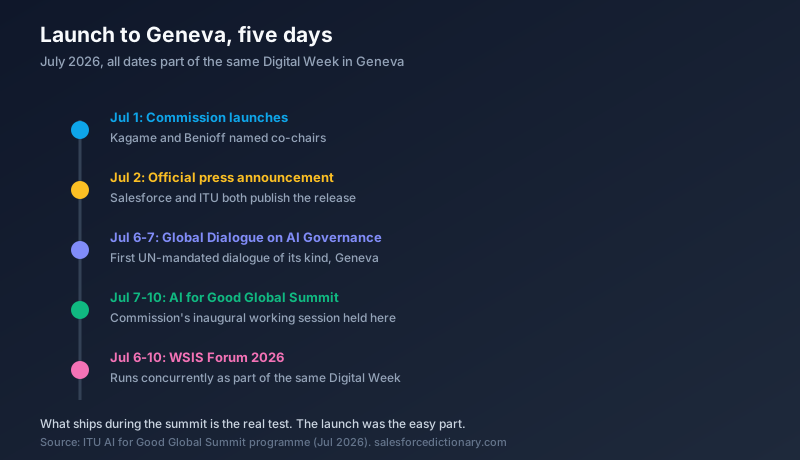
The government bench is smaller but geographically wider than the usual G7 photo op: Estonia's president Alar Karis, Iceland's president Halla Tómasdóttir, and policy representatives from Kazakhstan, Namibia, Saudi Arabia, Singapore, and Nigeria. Several UN agency heads round out the roster. The inaugural session happens during the ITU's AI for Good Global Summit, July 7 to 10 in Geneva, itself nested inside a busier Digital Week that also runs the first UN-mandated Global Dialogue on AI Governance (July 6-7) and the WSIS Forum 2026 (July 6-10).
One name on that tech bench is worth pausing on if you follow Salesforce closely. Jack Clark co-founded Anthropic, the model provider Salesforce has been tightening its relationship with all year, including a stake reported near $5 billion back in June. Clark sitting on the same commission as Benioff is not a coincidence of scheduling so much as a reflection of how tangled the AI supply chain has already become: the CEO whose company sells Agentforce and the co-founder of the lab whose models increasingly power it are now also co-governing, on paper, the rules both of their companies will eventually have to follow.
The stated purpose
Salesforce's own framing centers on the access gap: roughly 2.2 billion people worldwide still have no internet connection, and the commission's stated job is to keep AI from widening that gap instead of closing it. The inaugural session is scoped to four areas: health, education, food security, and disaster response, chosen because they are where the distance between what wealthy nations can already do with AI and what developing nations can do is largest.
That is a defensible list of problems. It is also a list that any of the 44 founding members could have written independently, which is part of what makes the announcement read more like a press event than a governance body with a work plan.
What the announcement does not say
This is the part that should slow down anyone tempted to take the Geneva stagecraft at face value. Multiple outlets covering the launch, not just Salesforce's own newsroom, flagged the same set of open questions.
There is no defined deliverable. The commission is chartered to "help define practical pathways," which is a mandate broad enough to justify almost any output, or none. There is no enforcement mechanism. Nothing in the announcement explains how a recommendation from this commission becomes a binding rule anywhere, for anyone. There is no liability framework. When an AI system causes real harm, in health, in disaster response, in any of the four stated focus areas, the commission has not said who answers for it. And there is no disclosed conflict-of-interest policy for a body where the people writing guidance on responsible AI are the same people whose companies profit from AI adoption at scale.
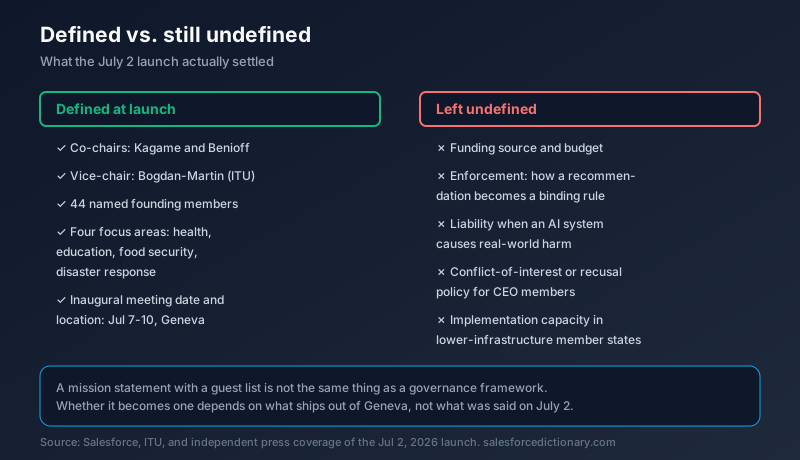
Add to that a practical concern: several of the government representatives, from Kazakhstan, Namibia, and Nigeria among them, come from countries that may not have the compute infrastructure to implement whatever standards eventually come out of this commission, even if they wanted to. A recommendation nobody can execute is not governance. It is a communique.
Why this matters beyond Benioff's calendar
It would be easy to file this under general tech-industry news and move on. It belongs here instead because Salesforce built its entire generative AI product line on the promise that trust is a solved problem on its platform. The Einstein Trust Layer exists specifically to tell customers that prompts get masked, that data never trains a foundation model, and that every AI interaction leaves an audit trail. That pitch has been Salesforce's main defense against the same "who is accountable when AI gets it wrong" question the new commission is now nominally trying to answer at planetary scale.
Benioff co-chairing a UN body on AI governance is a bet that Salesforce gets to help shape whatever comes next in AI regulation, rather than just comply with it after the fact. The EU AI Act is already live and tightening, with its rules for high-risk AI systems phasing in through next year. Government Cloud customers already answer to procurement rules that reference AI risk, and public sector buyers in health and disaster response, the exact focus areas this commission named, tend to move slowly until a recognized standard gives them permission to move at all. If this commission produces anything with teeth, a framework, a certification, a disclosure standard, expect Salesforce to be first in line to say its platform already meets it, the same way it has spent three years pointing to the Trust Layer every time a competitor gets caught mishandling AI data.
That is a reasonable strategic play, and it is not new for Benioff, who has sat on UN-adjacent panels and World Economic Forum boards for years under the same "stakeholder capitalism" banner he built Salesforce's public image around. It is also exactly the kind of self-grading that critics of the commission's structure are pointing at right now: a body meant to hold AI companies accountable, staffed in large part by the people running those companies, with no published rule on how a Founding Member recuses when a recommendation happens to favor their own product roadmap.
What to actually do with this
Nothing here changes a setting in your org today, and no admin needs to touch a permission set because of a press conference in Geneva. That said, do not shrug this off completely.
- Do not update compliance documentation yet. There is no binding standard to cite. Anyone telling a customer or auditor that Salesforce is now "UN-certified" on AI is overstating a founding-member seat at a table.
- Watch public sector deals for new language. If you work with Government Cloud customers, especially in the countries with a seat on this commission, expect RFPs and procurement standards to start referencing this body within a few quarters. Flag it when you see it.
- Track the July 7-10 summit output, not the launch. The launch was the easy part. Whatever the commission actually produces during Digital Week in Geneva is the first real signal of whether this becomes a working body or a standing photo op.
- Keep leaning on what Trust Layer actually documents today. Data masking, zero data retention, audit trails, these are the concrete controls you can point to right now. A UN commission seat is not one of them.
Check back after Geneva. If the commission publishes an actual framework instead of another joint statement, that is the point where this stops being a press release and starts being something you have to plan around.
About the Author
Dipojjal Chakrabarti is a B2C Solution Architect with 29 Salesforce certifications and over 13 years in the Salesforce ecosystem. He writes and edits salesforcedictionary.com, published by KineticBit Inc., to help admins, developers, architects, and cert/interview candidates sharpen their fundamentals. More about Dipojjal.
Share this article
Sources
- Global Leaders Launch AI for Good Global Commission to Expand Access, Strengthen Trust and Accelerate Impact (Salesforce)
- Global Leaders Launch AI for Good Global Commission (ITU)
- Exclusive: UN launches 'AI for Good' commission (Axios)
- UN Launches AI Governance Commission With Nvidia, Amazon, and Microsoft CEOs Ahead of Geneva Summit (Eastern Herald)
- Einstein Trust Layer (Salesforce Help)
Related dictionary terms
Practise it
Five questions on Agentforce Specialist
Exam-style questions with an explanation after each one. No account needed, and your answers build a weak-topic map once you have one.
More news

Free Agentforce Lands in Singapore
Salesforce switched on free Agentforce and Slack CRM for Singapore SMBs on July 1, 2026. Hours later, Guggenheim upgraded the stock to Buy. Here is what shipped, what it costs once you exceed free, and what to check first.
Salesforce's $5B Anthropic Windfall
Bloomberg valued Salesforce's Anthropic stake at about $5 billion on June 1, after Anthropic raised $65 billion at a $965 billion valuation and filed confidentially for an IPO. CRM jumped nearly 10 percent on a roughly 100x paper return.
Comments
No comments yet. Start the conversation.
Sign in to share your take on this article. Your account works across every page.