
Patients Trust Doctor AI 3x More
Salesforce surveyed 3,200 patients across eight countries and found they trust an AI agent inside their own doctor's portal three times more than a public chatbot, but only when a human is one click away.
Salesforce asked 3,200 patients across eight countries a plain question: would you trust an AI agent with your health? The answers split on one variable, and it was not the model. It was who deployed it. An agent living inside a patient's own doctor's portal earned three times the trust of a public chatbot like ChatGPT. Same underlying technology, opposite verdict.
That number landed in late June as the third edition of Salesforce's Connected Health Consumer report. For anyone building healthcare AI on Agentforce, it is the most useful data point of the quarter. It says the trust problem is real. It also says the advantage is winnable, and entirely conditional. Miss the conditions and the 3x evaporates.
What the research actually measured
The survey covered 3,200 adults aged 18 and up, fielded between March 24 and April 10, 2026, across the United States, Canada, Mexico, Brazil, the United Kingdom, Ireland, Australia, and New Zealand. All respondents were health consumers, not clinicians. This is the third annual run of the study, so Salesforce has a multi-year read on how patient attitudes are moving, not a one-off snapshot.
Start with the obvious caveat. This is Salesforce's own commissioned research, published by a company that sells the exact product the findings happen to support. Read the 3x as directional rather than gospel. The useful part is not the headline anyway. It is the structure underneath it, and that structure holds up regardless of who paid for the survey.
The 3x is about accountability, not the model
Here is the headline finding stated precisely. Patients are three times more likely to trust an AI agent built into their doctor's secure portal than a public AI chatbot. Salesforce's own reading is that institutional accountability and provider context drive the gap. When the agent carries a clinic's name, someone is answerable for what it says. When it is a general-purpose chatbot, no one is.
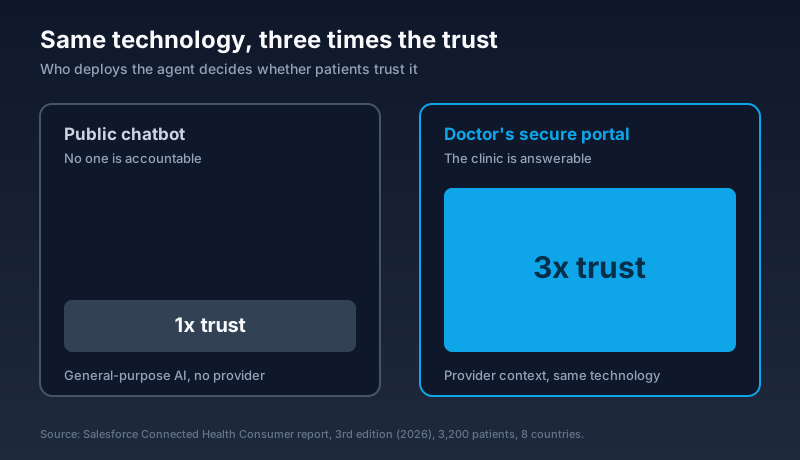
The comfort numbers back that up. Sixty-one percent of patients said they are comfortable using agentic AI in healthcare contexts. Sixty-four percent said they would share their full medical history with an AI agent for a faster diagnosis. Those are high figures for a domain where people guard their data harder than almost anywhere else. Provider context is what moves them. The patient is not trusting the algorithm. They are trusting the institution standing behind it.
That is a specific and slightly awkward result for the general-purpose AI vendors. It suggests the winning position in healthcare is not the smartest model. It is the accountable deployment. A mid-tier model wearing a hospital's badge beats a frontier model with no one to call when it is wrong.
The conditions are non-negotiable
The trust comes with a price, and the survey is blunt about it. A clear path to a real person is the thing patients will not give up.
Eighty-nine percent said a clear "escalate to human" option is essential before they will trust AI for administrative support. For medical support, that figure rises to 90 percent. Ninety-one percent said patients should have the right to opt out of AI-generated clinical recommendations entirely. On the fear side, roughly one in three named their top concern: 36 percent pointed to accuracy of diagnosis or treatment, and 30 percent to the privacy and security of their health data.
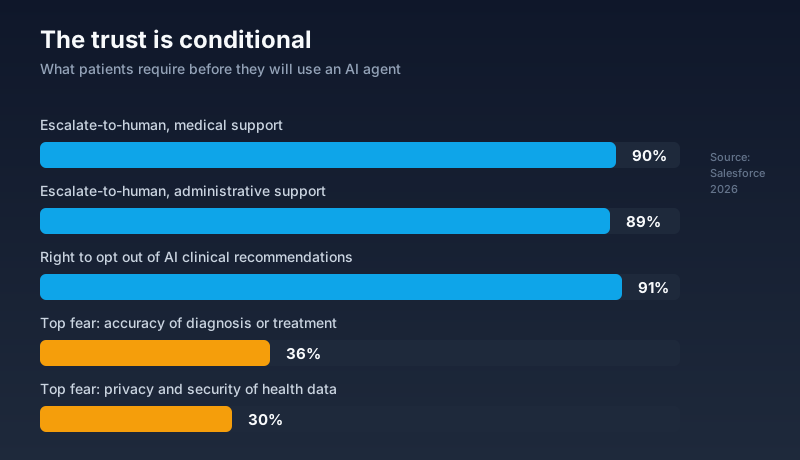
Read those together and the design constraint is hard to miss. An agent with no visible human handoff is not a lighter version of a trusted agent. It is an untrusted one. The escalation button is not a courtesy feature you add in a later release. It is the entry fee. Ship without it and you forfeit the provider-context advantage the same survey says is yours to take.
What patients actually want the agent to do
The research is equally clear about where patients want AI and where they do not. The demand is administrative, and it is driven by how badly the current experience works.
Forty-six percent said they delay care because digital processes confuse them. Fifty-eight percent delay or skip care because scheduling is too difficult. Forty-nine percent hang up after ten minutes on hold with a doctor's office. Sixty-six percent have run out of medication while waiting for a prescription approval. Ninety percent wish their primary doctor were automatically notified after an emergency room visit. This is the friction patients live with, and they want it gone.
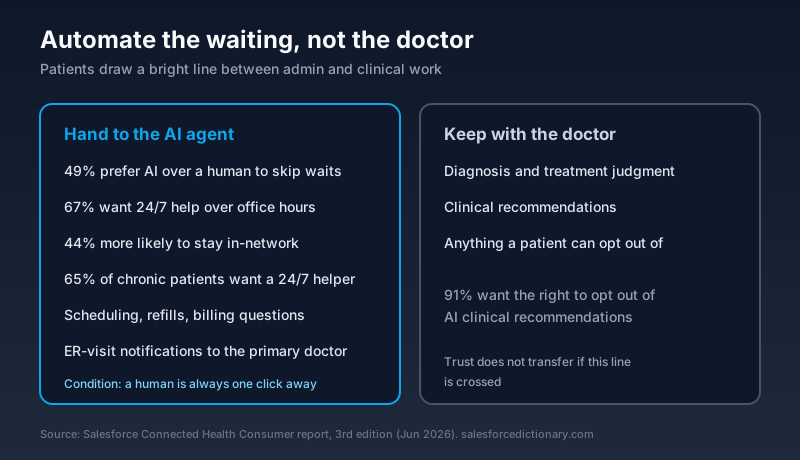
So the appetite is concrete. Forty-nine percent said they would prefer an AI agent over a human to avoid wait times, as long as a human backup stays visible and reachable. Sixty-seven percent would rather have 24/7 AI help than office-hours phone access. Forty-four percent said they are more likely to stay in a provider's network if a round-the-clock assistant is on offer, which turns patient experience into a retention number a health system can actually put on a board slide. Among patients managing chronic conditions, 65 percent said a 24/7 helper would significantly ease that management.
The clinical line stays bright through all of it. Patients want AI to take the waiting and the paperwork off their plate. They do not want it standing in for their doctor's judgment. Get that boundary wrong and the trust you built on the administrative side does not transfer. It collapses.
Why this lands for Salesforce specifically
The Einstein Trust Layer has been Salesforce's answer to "who is accountable when AI gets it wrong" for three years now: prompt masking, zero data retention, and an audit trail on every interaction. In most industries that reads as a reassurance slide. In healthcare it becomes a procurement checkbox a compliance officer signs against. The survey is telling Salesforce that the controls it already built are the exact controls patients are checking for.
The rest of the stack lines up with the findings. Health Cloud grounds an agent in governed patient data with sharing rules enforced, rather than in a model's memory of the open internet. Agentforce for Health ships prebuilt agents aimed at the administrative jobs the survey says patients want automated, scheduling and refills and case updates, not clinical calls. A separate Salesforce study found 71 percent of US healthcare workers expect agentic AI to be essential to operations within five years, so the provider-side demand tracks the patient-side appetite. Recent tie-ups with HealthEx, Verily, and Viz.ai extend how much clinical data those agents can safely reach.
Put plainly, the 3x does not come from a better model. It comes from the plumbing that makes a deployment accountable, and that plumbing is what Salesforce has been selling into healthcare all along.
The part worth staying skeptical about
Give the vendor framing its due weight and then look past it. Yes, Salesforce chose the questions, and yes, the report exists to support a product line. Notice which findings survive that skepticism anyway. The escalation demand does not soften if a rival runs the same survey. Neither does the accuracy fear, the privacy fear, or the administrative-not-clinical boundary. Those are constraints on any agent, from any vendor, and they are genuinely inconvenient for the "deploy an autonomous agent and walk away" pitch that a lot of the market is running right now.
There is a sharper edge here too. A provider-deployed agent inherits the provider's trust, which means it also inherits the provider's liability. The 3x is a loan, not a gift. Build the agent badly, let it hand out a wrong answer with no human in reach, and you spend real institutional trust on a first impression you do not get back. The same accountability that earns the trust is what makes losing it expensive.
What to actually do with this
If you architect or administer a healthcare Salesforce org, this research converts into a short build checklist. Work it in order.
- Scope the first agent to administrative work. Scheduling, prescription refills, billing questions, emergency-room-visit notifications. That is where the survey shows trust and demand already exist. Do not open with clinical guidance.
- Wire a visible, one-click human handoff into every flow before you ship. Not buried three menus deep. Ninety percent of patients treat a clear path to a person as the price of entry, so treat it as a launch blocker, not a backlog item.
- Turn on the audit trail and confirm zero data retention in the Trust Layer, then document both. Hand that documentation to your compliance team unprompted. In healthcare, the audit trail is the trust.
- Ground the agent in Health Cloud data with sharing rules enforced. Do not point it at a generic knowledge base scraped from the web. Provider context is the entire advantage, and it lives in governed data.
- Keep clinical recommendations behind explicit consent and an opt-out. Ninety-one percent of patients expect that right. Regulators will expect it too, so build it now rather than retrofit it later.
The near-term move is a one-page audit of every planned or live agent against those five points, with the escalation path checked first. The 3x trust gap is an advantage Salesforce has effectively handed to any health org on its platform. It is yours to keep only if you build the accountability the survey says patients are already looking for.
About the Author
Dipojjal Chakrabarti is a B2C Solution Architect with 29 Salesforce certifications and over 13 years in the Salesforce ecosystem. He writes and edits salesforcedictionary.com, published by KineticBit Inc., to help admins, developers, architects, and cert/interview candidates sharpen their fundamentals. More about Dipojjal.
Share this article
Sources
- New Research: Patients Trust Their Doctor's AI Agents 3x More Than Public AI (Salesforce)
- Patients prefer healthcare providers' AI agents to public chatbots, with human oversight non-negotiable, survey finds (Fierce Healthcare)
- AI Agents Can Cut Healthcare Paperwork by 30%, Study Shows (Salesforce)
- The 2026 Connected Health Consumer Report, Third Edition (Salesforce)
- Salesforce partners with HealthEx, Verily and Viz.ai to build out healthcare AI agents (Fierce Healthcare)
- Salesforce Prescribes Agentforce for Health to Speed Time to Treatment and Improve Outcomes with Digital Labor (Salesforce)
Related dictionary terms
Practise it
Five questions on Agentforce Specialist
Exam-style questions with an explanation after each one. No account needed, and your answers build a weak-topic map once you have one.
More news

Benioff Co-Chairs UN AI Commission
Marc Benioff is now co-chairing a 44-member UN commission on AI governance, alongside the CEOs of Amazon, Nvidia, and Microsoft. Here is what it actually commits to, and what it leaves undefined.

Help Agent Pay-Per-Resolution
Salesforce launched Agentforce Help Agent on June 25, 2026, with pay-per-resolution pricing at $2 per resolved issue. Here is how it works and where it breaks.
Comments
No comments yet. Start the conversation.
Sign in to share your take on this article. Your account works across every page.