
Free Agentforce Lands in Singapore
Salesforce turned on free Agentforce and a native Slack CRM for Singapore small businesses on July 1. Hours later, Guggenheim upgraded the stock and called the AI panic overblown. Same day, two bets on the same question.

Salesforce switched on free Agentforce and a native Slack CRM for small businesses in Singapore on July 1. A few hours later, on the other side of the Pacific, a Wall Street analyst told his clients to buy Salesforce stock because the AI-panic story priced into it was wrong. Same company, same day, two very different bets on the same question: does Salesforce's AI strategy actually hold up.
One bet came from a product team shipping a free tier into a new market. The other came from an analyst who has watched the stock lose more than a third of its value this year. Neither one settles the argument alone. Put them together and you get a more honest read on where Salesforce actually stands than either headline gives you on its own.
What shipped in Singapore
The announcement itself is narrow: Agentforce is now built into Salesforce Suites for small businesses in Singapore, and Slack CRM ships with it, at no extra cost on top of what these businesses were already paying.
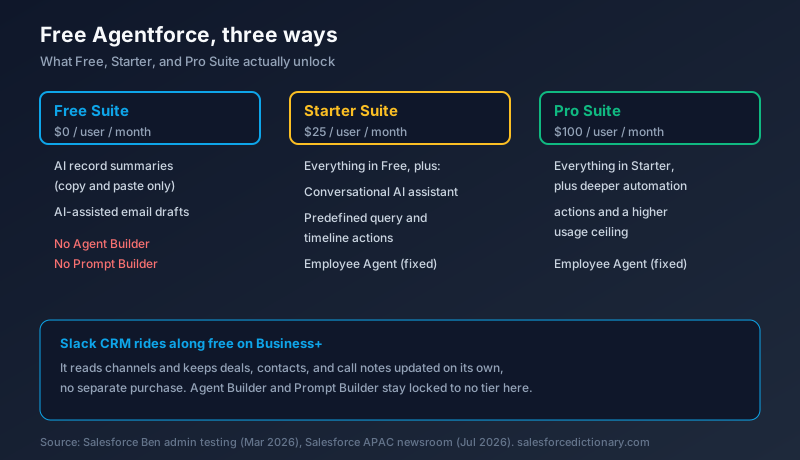
Three tiers, three different products in practice. Free Suite gets AI record summaries you can copy and paste, plus AI-assisted email drafting. No Agent Builder, no Prompt Builder, nothing you can customize. Starter Suite, at $25 per user per month, adds a conversational AI assistant and a fixed set of predefined actions: query records, pull an activity timeline, extract fields from what a user typed. Pro Suite, at $100 per user per month, raises the usage ceiling and adds deeper automation actions, but the Employee Agent stays fixed at every tier. You cannot rebuild it. You get what Salesforce prebuilt for you, dressed up as flexibility.
Slack CRM rides along free with a Business+ Slack subscription. It reads the channels your team already uses, and it keeps deals, contacts, and call notes current without anyone opening a record. That part is not new. It first went generally available in the US back in March, as the most sweeping rework of Slack since the $27.7 billion acquisition. What is new is the geography: Singapore is one of the first international markets to get the full bundle, not a scaled-down regional version of it.
Vernon Cheo, who heads emerging small and medium business for Salesforce ASEAN, put the pitch plainly: "SMBs are the backbone of Singapore's economy. Agentic AI provides these organizations the means to make exponential impact without the time and effort typically required for enterprise-scale transformation." Phil Hassey, CEO of the ASEAN analyst firm CapioIT, backed the framing from outside the company, arguing that small businesses across the region need technology that is intelligent, connected, and embedded directly in their workflow rather than bolted on top of it.
The land-and-expand math
None of this is charity. It is the same playbook Salesforce has run in the US since March, exported to a market with a specific pain point. Singapore Business Federation survey data cited in the announcement points to cost and a lack of in-house expertise as the two biggest reasons small businesses there have not adopted AI yet. A free tier removes the first objection. A CRM that lives inside a messaging app your team is already using removes most of the second.
The strategic logic is straightforward once you see it. Give a small business the free tier, let Slack CRM quietly become the system of record for their customer conversations, and by the time they outgrow it, ripping it out costs more than paying to upgrade. Every record is already connected to the full Salesforce platform. No migration, no re-entry, no starting over. One CIO who deployed the Slack CRM version described it as one of the easiest enterprise technology rollouts he had seen in two decades, and that ease is the entire point. Friction is what kills adoption at the low end of the market. Salesforce designed this to have none.
The catch, from someone who actually used it
Press releases describe the pitch. Christine Marshall, a 12-times certified Salesforce MVP, tested the US version of this free tier back in March and published what she found. Setup took her under 30 seconds after turning on AI features from the Welcome bar. That part holds up. The limitations show up right after.
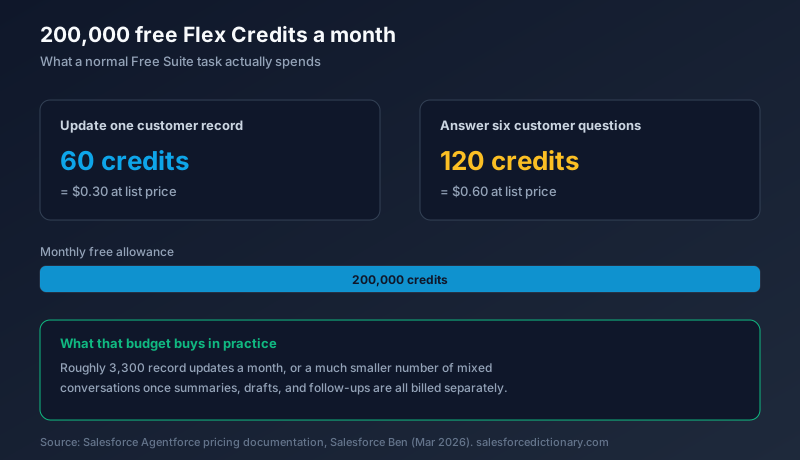
Marshall called the Free Suite functionality "fairly limited," and the receipts back her up. A typical customer record update runs 60 Flex Credits, about $0.30 at list price. Answering six customer questions runs 120 credits, about $0.60. The free monthly allowance is 200,000 credits, which sounds generous until you do the arithmetic: roughly 3,300 record updates, and a lot less than that once summaries, drafts, and follow-ups all draw from the same pool. A small business running real daily volume through this will find the free tier is a trial, not a plan.
That is by design, and Salesforce has not hidden the logic. The free tier exists to get a business's data and workflow habits inside the Salesforce ecosystem. It is not built to run a business at scale for free indefinitely. The moment usage climbs past casual, the upgrade path to Starter or Pro is right there waiting, already frictionless because the data never moved.
Meanwhile, Wall Street re-rates the stock
The Singapore announcement is a small, deliberate move in a long game. The bigger swing that day came from a research desk in New York.
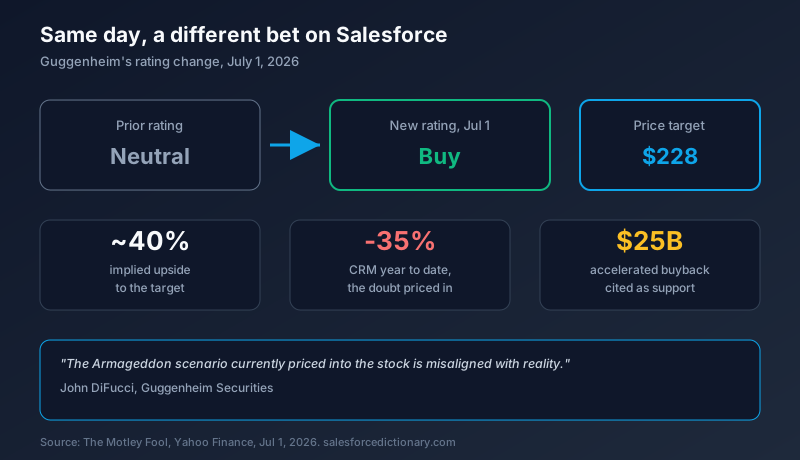
Guggenheim analyst John DiFucci upgraded Salesforce from Neutral to Buy on July 1, with a $228 price target, roughly 40% above where the stock was trading. That target lands against a stock that has fallen more than a third year to date and sits well below its 52-week high near $274. DiFucci did not wave away the AI risk. He named it directly, and then argued the market has overcorrected for it: "The Armageddon scenario currently priced into the stock is misaligned with reality."
The reasoning behind the upgrade leans on three things. Agentforce closed Q1 with $1.2 billion in annual recurring revenue, real traction rather than a pilot-stage number. Salesforce is running a $25 billion accelerated share buyback, which DiFucci reads as management putting its own capital behind the stock at these prices. And insider trading activity for 2026 has skewed toward buying rather than selling, a small but real signal that the people closest to the numbers are not bracing for the worst.
None of that proves the bears are wrong. A single upgrade is one analyst's opinion, not a verdict, and the "SaaSpocalypse" fear driving the sell-off (the idea that AI agents route around traditional software licenses entirely) has not gone away just because one price target moved. What the upgrade does show is that the AI-panic story is contested, not settled, and that the contest is playing out in the same week Salesforce is trying to prove its AI products actually drive adoption at the ground level.
Where the two stories meet
Here is the connection that matters. Guggenheim's bull case rests partly on Agentforce's growth number. Growth numbers come from somewhere. They come from exactly the kind of motion Salesforce ran in Singapore on July 1: get a business onto the free tier, get its workflow habits locked into Slack CRM, and let Flex Credit consumption pull it toward a paid Suite once the free allowance runs dry. If that motion works at scale, in market after market, the $1.2 billion ARR number keeps climbing and the bull case gets easier to defend. If small businesses try the free tier, hit the Flex Credit wall in month one, and walk away instead of upgrading, the growth story stalls exactly where the bears say it will.
The Singapore rollout is a small sample of that engine running for real, in public, on a specific date. It is worth watching what the actual conversion numbers look like once Salesforce reports them, because that is the data point that will settle this argument better than any single analyst rating.
What to check before you roll this out
If you administer a Salesforce org for a small business, in Singapore or anywhere this bundle eventually lands, do not treat "free" as "unlimited." Do this first.
- Read your Flex Credit balance before you commit workflows to it. Know your monthly allowance and estimate your actual record-update and query volume against it before you build a process around the free tier.
- Decide what stays manual. Agent Builder and Prompt Builder are locked out of every Suites tier, free or paid. If your business needs a customized agent, this bundle is not that product, and you should stop evaluating it as one.
- Watch the Slack CRM data quality. It writes to your CRM automatically from channel conversations. Spot-check a week of auto-logged records before you trust it as your system of record.
- Confirm your region and tier. This bundle launched for Singapore SMBs on July 1. If you are elsewhere, check whether it has reached your market yet before you plan around it.
Salesforce is betting its AI story on adoption at the small end of the market proving out the platform at the large end. Wall Street just placed a matching bet on the same thesis. Whether either one pays off depends on whether small businesses that try the free tier actually stick around once the free credits run out.
About the Author
Dipojjal Chakrabarti is a B2C Solution Architect with 29 Salesforce certifications and over 13 years in the Salesforce ecosystem. He writes and edits salesforcedictionary.com, published by KineticBit Inc., to help admins, developers, architects, and cert/interview candidates sharpen their fundamentals. More about Dipojjal.
Share this article
Sources
- Salesforce Brings Agentforce into Salesforce Suites and Slack CRM for Small Businesses in Singapore (Salesforce)
- Free Agentforce for Small Business: An Admin's First Impressions (Salesforce Ben)
- Why Salesforce Stock Is Up Today (The Motley Fool)
- Guggenheim Just Upgraded Salesforce Stock. Here's Why. (Yahoo Finance)
- Guggenheim Upgrades CRM Stock, Says AI Fears Will Pressure Salesforce But Not Kill It (TipRanks)
Related dictionary terms
Practise it
Five questions on Agentforce Specialist
Exam-style questions with an explanation after each one. No account needed, and your answers build a weak-topic map once you have one.
More news
Fable 5 Ban Lifted, It Builds Flows
Claude Fable 5 was pulled offline worldwide on June 12 under a US export control order, then redeployed July 1 with a patched jailbreak defense. A Flow expert had already tested it against Agentforce Vibes.

Claude Tag Lands in Slack
Anthropic's Claude Tag landed in Slack on June 23, 2026. Salesforce owns Slack, sells Agentforce, and holds a $5B Anthropic stake. The co-opetition math is getting complicated.
Comments
No comments yet. Start the conversation.
Sign in to share your take on this article. Your account works across every page.