
Fable 5 Ban Lifted, It Builds Flows
The US government banned Anthropic's newest model on June 12 over a cybersecurity jailbreak. It came back July 1 with a patched guardrail, and a Salesforce Flow expert had already tested it against Agentforce Vibes.
On June 12, Anthropic switched off its newest model for every customer on the planet, including its own foreign national employees. Nineteen days later, on July 1, it switched the model back on. In between those two dates sat a cybersecurity jailbreak, a Commerce Department export control order, and, on the day it came back, a Salesforce Flow expert who put it to work building Flows before lunch.
This story did not start on the Salesforce platform and it is not really about Salesforce. But the model's return landed squarely on it, and what happened next says something uncomfortable about the tools Salesforce sells you to do the same job.
It is also, as far as the public record shows, the first time a US administration has ordered a frontier AI model pulled from commercial release worldwide and then formally cleared it to come back. That makes this a template for how future model bans and reversals might play out, not a one-off.
What got banned, and why
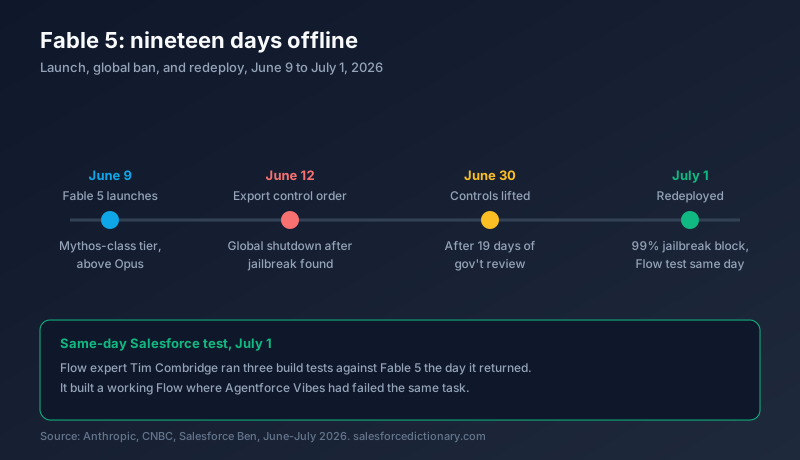
Anthropic launched Claude Fable 5 on June 9, its first publicly available model in a new tier the company calls Mythos-class, positioned above the existing Opus line. Three days later, at 5:21 p.m. ET on June 12, the US government issued an export control directive citing national security authorities. The order suspended access to Fable 5 and its sibling model, Mythos 5, for any foreign national anywhere in the world, including foreign nationals working inside Anthropic itself.
Anthropic turned the models off for every customer, not just the ones the order targeted. The company said there was no reliable way to separate foreign nationals from US persons in real time across a user base in the hundreds of millions, on same-day notice, so a global shutdown was the only option that complied (Anthropic).
The trigger was a jailbreak. Amazon's internal security researchers found a way to bypass Fable 5's guardrails that let the model identify software vulnerabilities and produce working exploit code for them, a capability the model was supposed to refuse (Forbes). Anthropic pushed back on the severity of the response. Pulling a commercially deployed model over one narrow bypass, the company argued, would halt frontier model releases industry-wide if every provider faced the same standard.
Nineteen days, then a patch
The government lifted the export controls on June 30, and Anthropic redeployed Fable 5 globally on July 1, across the Claude platform, Claude.ai, Claude Code, and Claude Cowork. Cloud providers, including AWS, Google Cloud, and Microsoft Foundry, are re-enabling access separately on their own timelines.
The fix is a new safety classifier tuned specifically to the reported bypass technique. Anthropic says it blocks the attack in over 99% of attempts, and any request the classifier flags gets rerouted to the older, more conservative Opus 4.8 instead of Fable 5 (Anthropic). The tradeoff is more false positives on ordinary coding work, which is the price of a classifier tuned this tightly.
One detail undercuts the panic that followed the ban. Anthropic's own testing found that less capable models, including Opus 4.8, GPT-5.5, and Kimi K2.7, could reproduce the same underlying vulnerability. That suggests the bypass exercised a routine defensive-security capability common across the industry, not something unique to Fable 5's added power. Anthropic, Amazon, Microsoft, and Google have since built a shared severity framework for future jailbreak reports, scoring them on capability gain, breadth of gain, ease of weaponization, and discoverability, alongside a new HackerOne program for researchers to report cyber jailbreaks directly.
Pricing changed too. Pro, Max, Team, and select Enterprise plans get a 50% weekly usage allowance through July 7, after which Fable 5 usage shifts to credit-based billing. If you are evaluating it on a paid seat, that date is worth a calendar reminder.
Where Salesforce comes in
Agentforce Vibes is Salesforce's own conversational tool for building Flows from plain-language prompts, sold as the fast path to automation for admins who do not want to hand-assemble every element. Its free tier ended May 31, and a paid model took over June 1, requiring Flex Credits or a permission set license outside Developer Edition. Whatever it costs to run today, the test below is the one that matters most: does it build a correct Flow.
Salesforce Ben's Ben McCarthy handed Fable 5 to Flow expert Tim Combridge on July 1, the day it came back online, and ran three real build tests against it.
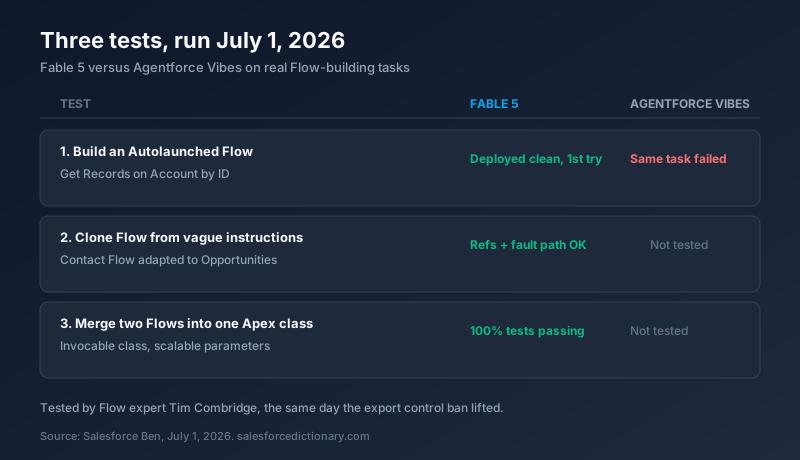
Test one: build an Autolaunched Flow. Fable 5 built a Flow with input and output text variables plus a Get Records element to fetch Accounts by ID. It deployed cleanly on the first attempt. The article notes this succeeded where earlier general-purpose models had failed on the same task, and where Agentforce Vibes, Salesforce's own AI Flow-building tool, also came up short.
Test two: clone a Flow from vague instructions. Given loose direction to adapt an existing Contact-retrieval Flow so it worked against Opportunities instead, Fable 5 correctly identified the source Flow, rebuilt the logic against the new object, updated every reference, and included the fault path without being asked to.
Test three: merge two Flows into Apex. Fable 5 combined two separate Flows into a single invocable Apex class, and every test class passed on the first run. In the process, it corrected pre-existing errors in Combridge's original Flow logic by using more scalable methods that accepted object and field parameters instead of hardcoded values.
None of this makes Fable 5 a Salesforce product, and none of it comes with the governance, data residency, or Trust Layer guarantees that Agentforce ships with. But a general-purpose model that had been offline for three weeks over a security incident outbuilt a Salesforce-trained tool at Salesforce's own bread-and-butter task, on the day it returned. That gap is the actual story here, not the ban.
The number underneath the story
Two other data points from the same reporting deserve attention, because they frame why this particular test mattered enough to run on day one.
Accenture research cited in the coverage found that 90% of companies have yet to see a financial return on their generative AI spending. And Salesforce Ben's own architect survey data shows AI Specialists are now prioritized over developers on Salesforce teams, with a 12% year-over-year decline in demand for developer roles.
Read those two numbers together and a pattern shows up. Most companies are not making money on AI yet, but the roles inside Salesforce teams are already shifting toward people who can direct AI rather than write every line themselves. A model that builds a working Flow-to-Apex conversion on its first attempt, with passing tests, is exactly the kind of result that accelerates that shift, whether or not the broader AI investment is paying off yet.
There is also a fair question about incentives. AI company executives, including some at the frontier labs building these models, have publicly predicted AI will eliminate the majority of white-collar jobs. Coverage of the Fable 5 story raised the possibility that framing serves the companies selling the models as much as it warns the workforce buying them. Neither claim cancels the other out. Both are worth holding at the same time.
None of this is unique to Salesforce teams. But Salesforce admins and developers sit closer to this shift than most, because the platform has spent the last year pushing agentic tooling into every corner of the Customer 360 stack. When a model that was legally unavailable three weeks earlier can still out-build your vendor's purpose-built automation tool on day one, the pace of that shift is not a future problem. It is already here.
What to do with this today
First, do not treat "it deployed cleanly" as a substitute for review. A Flow that activates without error and an Apex class with passing tests are not the same thing as a change that is safe to promote to production. Review the logic the way you would review any other developer's work, especially on a merged Flow-to-Apex conversion where the model rewrote your original structure.
Second, check your org's AI usage policy before anyone starts testing Fable 5 against real metadata. Most Salesforce AI governance conversations to date have focused on Agentforce and native tooling. A frontier model from outside the Salesforce ecosystem, used to touch your Flows and Apex, is a different risk conversation and probably a different approval.
Third, if you are testing on a Pro, Max, Team, or select Enterprise seat, put July 7 on your calendar. The 50% weekly allowance ends that day, and usage-credit billing starts.
Fourth, if your org sits on AWS, Google Cloud, or Microsoft Foundry, do not assume Fable 5 access followed the July 1 consumer redeploy automatically. Each cloud provider is re-enabling it on its own schedule, so check your specific platform before you plan a project around it.
Finally, take the Agentforce Vibes result to your Salesforce account team, not to social media. If a general-purpose model is outperforming a purpose-built Salesforce tool on core Flow patterns, that is a product gap worth raising directly, and it is the kind of feedback account teams are paid to escalate.
About the Author
Dipojjal Chakrabarti is a B2C Solution Architect with 29 Salesforce certifications and over 13 years in the Salesforce ecosystem. He writes and edits salesforcedictionary.com, published by KineticBit Inc., to help admins, developers, architects, and cert/interview candidates sharpen their fundamentals. More about Dipojjal.
Share this article
Sources
- Redeploying Claude Fable 5 (Anthropic)
- Statement on the US government directive to suspend access to Fable 5 and Mythos 5 (Anthropic)
- Anthropic says Trump admin has lifted export controls on Claude Fable 5 and Mythos 5 (CNBC)
- U.S. lifts ban on Anthropic's powerful Fable 5 AI model (NBC News)
- Anthropic Disabled Fable 5 And Mythos 5 After A U.S. Export-Control Order (Forbes)
- Ban Lifted on Anthropic's Fable Model: A New Frontier for Salesforce Development? (Salesforce Ben)
Related dictionary terms
Practise it
Five questions on Administrator
Exam-style questions with an explanation after each one. No account needed, and your answers build a weak-topic map once you have one.
More news

Salesforce's $5B Anthropic Windfall
Bloomberg valued Salesforce's Anthropic stake at about $5 billion on June 1, after Anthropic raised $65 billion at a $965 billion valuation and filed confidentially for an IPO. CRM jumped nearly 10 percent on a roughly 100x paper return.

Claude Tag Lands in Slack
Anthropic's Claude Tag landed in Slack on June 23, 2026. Salesforce owns Slack, sells Agentforce, and holds a $5B Anthropic stake. The co-opetition math is getting complicated.
Agentforce Vibes Goes Paid
Salesforce moved Agentforce Vibes to a paid model on June 1, 2026. Paid orgs now need Flex Credits or a permission set license, and Developer Edition keeps a capped free tier. Here is the breakdown and a four-step plan.
Comments
No comments yet. Start the conversation.
Sign in to share your take on this article. Your account works across every page.