
Vibe Coding Reaches the Enterprise
Starbucks is building in-house AI tools against a $400 million annual software bill, and Salesforce Ben now calls vibe coding a survival test for Salesforce. Plus: six days after the permissions U-turn, the community has weighed in, and the verdict is not kind.

Starbucks spends roughly $400 million a year on software, and it is now building AI tools in-house to replace applications it buys from vendors like Microsoft and IBM. That detail anchors a Salesforce Ben piece published July 15 whose headline does not hedge: Salesforce will only survive the AI era if it can compete against vibe coding. The same day, the same outlet published the community's verdict on the permissions U-turn we covered last week. Two stories, both about the same fragile commodity: whether customers still believe what Salesforce tells them about prices and deadlines.
The Build-It-Yourself Threat Moved Upmarket
When we covered vibe-coded defections in our July 13 roundup, the examples were small. A property management firm here, a startup there, five and six figure contracts walking out the door to custom apps built with Claude Code and Replit, and Salesforce answering with a 70% discount on Starter Suite. Painful for the SMB funnel, survivable for a company with Salesforce's enterprise base. The comfortable read was that vibe coding tops out where complexity begins.
Sasha Semjonova's new piece, published July 15 and updated July 16, removes that comfort. The Starbucks example is the whole point: this is not a ten-person shop replacing a CRM starter plan. It is a Fortune 500 company with a nine-figure annual software budget deciding that some of what it buys from Microsoft and IBM can now be built internally with AI. Salesforce is not named as one of the vendors being displaced. It does not need to be. The precedent is the story.
Brody Ford, who covers enterprise software for Bloomberg News, put the shift plainly in the article: "AI is making a lot of teams say 'hey, maybe we could build this ourselves. Maybe we don't actually need to keep paying this vendor who we maybe don't want to be paying'."
What makes Starbucks different from the earlier wave, in Ford's telling, is who is saying it out loud: "The Starbucks [case] was so interesting because it was one of the first examples of a real big enterprise coming out and saying 'yes, this is our intention'. Largely, it's been these SMB voices with lower complexity."
And the part that should worry every SaaS vendor with a renewal calendar: "CIOs tell me if they see one or two real successful large companies doing it, it very much could open the floodgates."
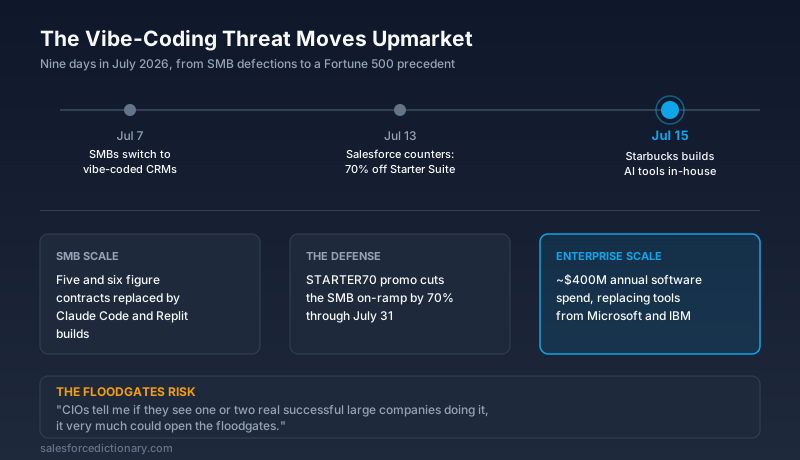
That floodgates line deserves a beat. Enterprise IT is a herd. No CIO wants to be first to rip out a vendor and explain a failure to the board, but nobody wants to be last to capture savings the peer group already banked. One credible Starbucks-sized success story converts build-it-yourself from a risk into a benchmark, and benchmarks show up in renewal negotiations whether or not the customer ever intends to build anything.
The Pricing Math Doing the Damage
The uncomfortable center of Semjonova's argument is a price table. Agentforce costs $500 per 100,000 credits, or $2 per conversation, or $125 per user per month for Agentforce Vibes. Claude runs from free to $90 per month at the top consumer tier. Those numbers sit next to each other in the article, and they will sit next to each other in procurement decks all year.
The comparison is not apples-to-apples, and it is fair to say so. Agentforce ships inside your CRM with your data, your security model, and a vendor who answers the phone. Claude at $90 a month is a general-purpose assistant plus a coding tool; turning it into a working business system costs engineering time that never appears on the subscription invoice. Anyone who read our technical debt piece on vibe coding knows the hidden line items: no security review, no upgrade path, no one to call when the thing breaks during quarter close.
But pricing anchors do not care about nuance. A CFO who sees $125 per user per month next to $90 flat does not open a total-cost-of-ownership spreadsheet. They ask why the first number is so much bigger, and the burden of proof lands on whoever proposed the Salesforce line item. That is the real mechanics of the threat: not that enterprises will actually rebuild their CRM with Claude Code, but that the credible option of doing so resets what they are willing to pay for not doing so.
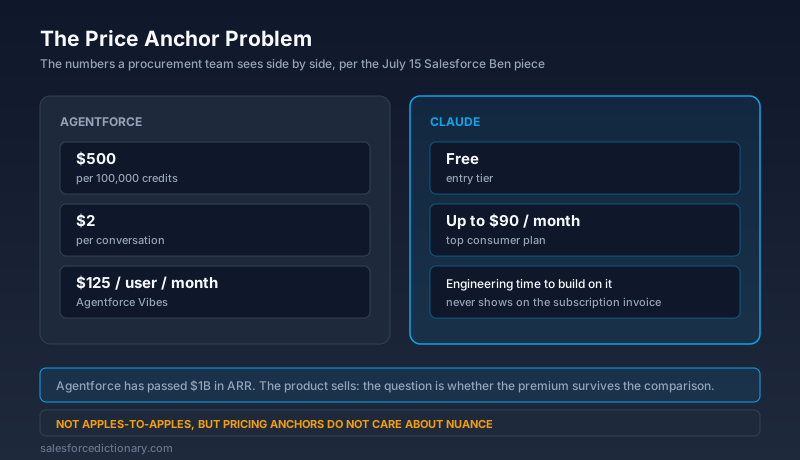
None of this means Agentforce is failing commercially. The article notes Agentforce revenue has passed $1 billion in annual recurring revenue, a real milestone that Salesforce earned in roughly two years. The question Semjonova raises is not whether the product sells today. It is whether the premium survives a world where every renewal conversation starts with "we priced out building it ourselves."
Squeezed From Three Directions
The article frames Salesforce's position as a three-way squeeze, and the frame holds up. Pressure one is the community, which is worn down by the pace of AI product launches, renames, and repositioning. Pressure two is Wall Street, which wants proof the AI story converts to revenue. Pressure three is the build-side competition: Anthropic, OpenAI, and tools like Cursor, which keep lowering the cost of the alternative.
The investor pressure is not abstract. CRM traded near $167.65 on July 16, down about 34.7% over the trailing year, with the market cap around $137 billion. Analysts have not given up, with a consensus Buy rating and a 12-month target near $245, but a target 47% above the price is less a vote of confidence than a demand: the AI monetization has to show up. A company under that kind of pressure cannot easily cut Agentforce prices to blunt the vibe-coding comparison, which is exactly the bind Semjonova describes.
Ford's read on how vendors respond is the most useful sentence in the piece: "Most vendors are trying to capture this energy. Most vendors are trying to find a way to make sure the users stay within their platform, and that they can build apps on top of that rather than abandoning them. They want to have [users] who are excited to build their own solutions, but they've got to keep them in the ecosystem."
That is a precise description of why Agentforce Vibes exists. Salesforce's bet is that people who want to vibe-code will do it inside the platform, against governed data, at $125 per user per month. The open question is whether an ecosystem toll roughly 40% higher than the outside toolchain's top consumer tier keeps builders in, or just reminds them monthly what the door costs.
The Community Delivers Its Verdict on the Permissions U-Turn
The second story is quieter but will touch more of your week. On July 9 we covered Salesforce cancelling the retirement of permissions on profiles, a plan first announced in January 2023 with a Spring '26 deadline, softened in 2024, then killed in a quietly edited Knowledge article. Six days later, Salesforce Ben went back and asked the community what it actually thinks. The answer: mostly unsurprised, and frustrated anyway.
Solution Architect Sanna Siltanen: "Not surprised at all. [It's] a big mess." Admin David Lanham called it "pretty typical for Salesforce rollouts" and advised admins to ignore the reversal and keep migrating to permission sets regardless. Solutions Architect Skot Nelson noted that "permission sets and groups are still better for object permission." Salesforce MVP Louise Lockie suspects the retirement still lives somewhere on the very long-term roadmap, with the honest caveat that most of Salesforce's resources are pointed at Agentforce right now.
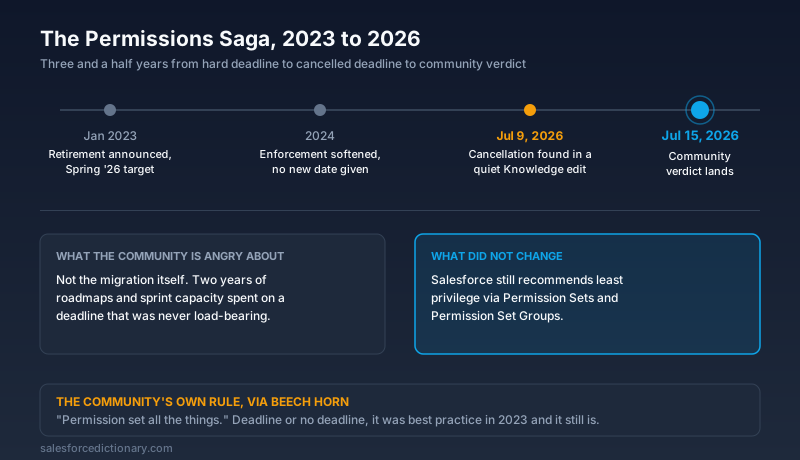
Read the reactions closely and the frustration is not about permissions at all. Nobody is angry they migrated; permission sets are better, and almost everyone quoted says so. The anger is about the two years of roadmap slides, remediation plans, and sprint capacity spent against a vendor deadline that turned out not to be load-bearing. Gartner Director Analyst Simon Whight explained the downstream cost: permission modernization is "difficult to justify as a standalone initiative" when it takes months of work. Teams that got that work funded on the strength of Salesforce's deadline now have to explain to leadership why the forcing function evaporated, and teams that have not started will find the budget conversation harder than ever.
Salesforce, for its part, acknowledged the mess without undoing it. A spokesperson conceded "this change in direction may be frustrating" and that customers needed more time, while reaffirming that "a permission set-led security model remains our recommended approach." The destination is unchanged. Only the map got shredded.
The most quotable response belongs to technology architect Beech Horn: "Permission set all the things." Deadline or no deadline, that is still the right answer. Least privilege through Permission Sets and Permission Set Groups was best practice in January 2023, it was best practice the day the deadline died, and it is best practice today. The cancellation removed the false urgency, not the reason.
It is hard to miss what these two stories share. The vibe-coding piece is about customers losing confidence that Salesforce's prices reflect what things should cost. The permissions piece is about admins losing confidence that Salesforce's deadlines reflect what will actually happen. A platform company sells certainty as much as software, and both stories this week were about certainty leaking out of the product.
What to Do Next
If you own a Salesforce renewal in the next two quarters, run the build-versus-buy math yourself before procurement runs it for you. Price the vibe-coded alternative honestly, including the engineering salaries, the security review, and the maintenance no subscription line ever shows, and walk into the negotiation knowing both numbers. If you are an admin still sitting on profile-based permissions, adopt Beech Horn's rule as written: permission set all the things, starting with your finance, admin, and integration profiles, on your own calendar instead of the one Salesforce cancelled. The vendors' plans changed twice this week. Yours does not have to.
About the Author
Dipojjal Chakrabarti is a B2C Solution Architect with 29 Salesforce certifications and over 13 years in the Salesforce ecosystem. He writes and edits salesforcedictionary.com, published by KineticBit Inc., to help admins, developers, architects, and cert/interview candidates sharpen their fundamentals. More about Dipojjal.
Share this article
Sources
- Salesforce Will Only Survive the AI Era If It Can Compete Against Vibe Coding (Salesforce Ben)
- What the Community Really Thinks About Salesforce's Permissions U-Turn (Salesforce Ben)
- Salesforce Permissions & Profiles: The Latest Retirement Updates (Salesforce Ben)
- Salesforce SMB Customers Switch to Vibe-Coded CRMs (Salesforce Ben)
- Salesforce (CRM) Stock Price & Overview (Stock Analysis)
Related dictionary terms
Practise it
Five questions on Agentforce Specialist
Exam-style questions with an explanation after each one. No account needed, and your answers build a weak-topic map once you have one.
More news

Profiles Keep Their Permissions
Salesforce cancelled its plan to retire permissions in profiles, quietly updating a Knowledge article with no announcement. First promised for Spring '26, the deadline died with no replacement date.

Agentforce Vibes Goes Paid
Salesforce moved Agentforce Vibes to a paid model on June 1, 2026. Paid orgs now need Flex Credits or a permission set license, and Developer Edition keeps a capped free tier. Here is the breakdown and a four-step plan.
Salesforce News Roundup: July 13, 2026
ML anomaly detection and a default Transaction Security Policy hit Salesforce production today, while a 70% Starter Suite discount targets SMBs drifting toward vibe-coded CRMs.
Comments
No comments yet. Start the conversation.
Sign in to share your take on this article. Your account works across every page.