
Agentforce Vibes Goes Paid
Agentforce Vibes stopped being free on June 1, 2026. Paid orgs now need Flex Credits or a permission set license, Developer Edition keeps a capped free tier, and GPT-5 is selectable. Here is what changed and what to do about it.

Agentforce Vibes stopped being free on June 1. If you opened it in a production org or a client sandbox this week and got prompted for credits or a license, that is the change, working as designed. The free agentic coding assistant that shipped alongside Einstein for Developers is now a paid feature for every org except Developer Edition, and even Developer Edition lost its safety net. We are a week into the new model, so this is a good moment to lay out exactly what changed, what each path costs you, and the work it puts on admins and dev leads.
If you have been treating Vibes as a no-cost autocomplete that happens to understand Apex and LWC, that assumption expired. The tool did not get worse. The billing did.
What Agentforce Vibes is, briefly
Agentforce Vibes is Salesforce's agentic coding assistant. It lives in the IDE and in the Vibes workspace, it reads your org metadata, and it does the things you would expect a coding agent to do in 2026: scaffold Apex classes, write LWC, draft test methods, explain unfamiliar code, and propose multi-file changes you can review and apply. The pitch was that it knows the platform, so it produces Salesforce-shaped output instead of generic boilerplate that ignores governor limits and bulkification.
For most of its life it cost nothing to use. You signed in, you typed, it answered. That made it easy to adopt and easy to take for granted. The change on June 1 is not to the product surface. It is to who pays and how.
What actually changed on June 1
Three things flipped at once.
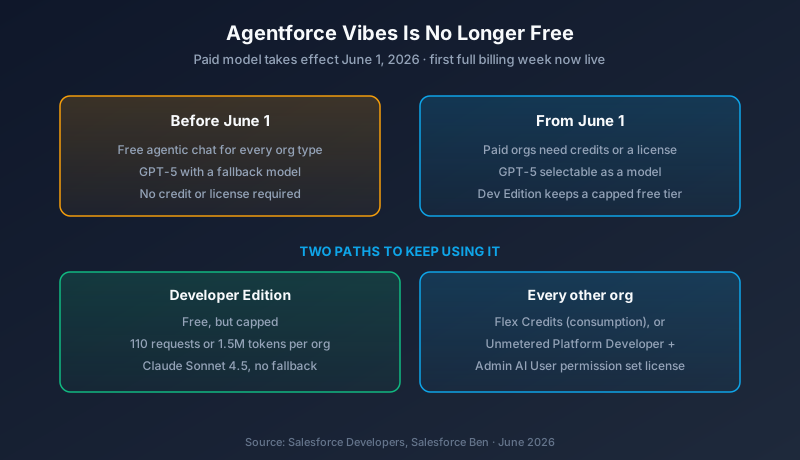
First, free access ended for every non-Developer Edition org. Production orgs, Enterprise sandboxes, the lot. The agentic chat that powers Vibes now requires either Flex Credits or a specific permission set license before it will run. No credits, no license, no Vibes.
Second, Developer Edition kept a free tier, but a tighter one. You get up to 110 requests or 1.5 million tokens per org, whichever you hit first, running on Claude Sonnet 4.5. The number that stings is the one that disappeared: the fallback model. Previously, when the primary was unavailable, requests rolled over to a backup. That cushion is gone. Hit the cap or hit an outage and you are simply done until it resets.
Third, GPT-5 became a selectable model. The previous hybrid arrangement, which paired GPT-5 with an automatic fallback, is retired. You now choose your model rather than relying on the platform to swap one in behind your back. More control, less hand-holding.
None of this was a surprise to anyone reading release notes. Salesforce flagged the move in late April and the community wrote it up through May. June 1 was simply the date the meter switched on.
The two paid paths, and which one fits
For any org that is not Developer Edition, you have two ways to keep using Vibes. They are priced on different logic, and picking the wrong one is how you overspend.
Flex Credits
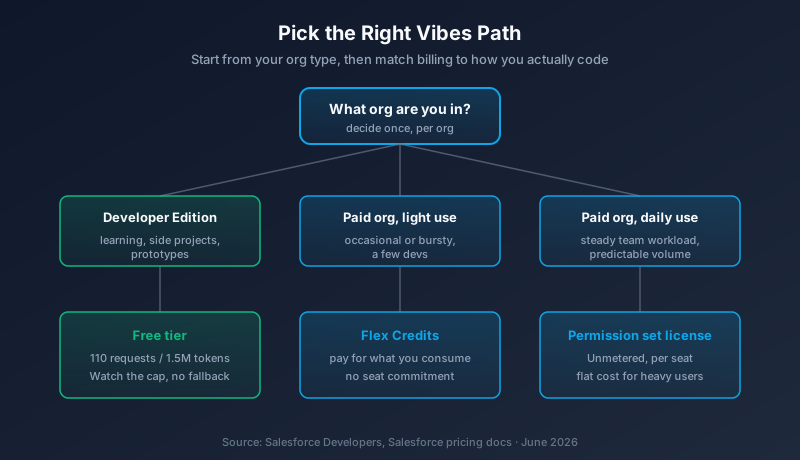
Flex Credits are Salesforce's consumption currency for Agentforce. You buy a balance, and usage draws it down as you go. The appeal is that there is no seat commitment. A team that uses Vibes in bursts, a few heavy days around a release and quiet weeks in between, pays for the bursts and nothing for the quiet. Flex Credits also sit underneath the broader Agentforce pricing model, so if you already provisioned them for runtime agents, you are not opening a new line item to add Vibes. You are spending from the same wallet.
The catch with consumption pricing is the same as it always is. Costs are variable, and variable costs are easy to lose track of. A coding agent that proposes large multi-file diffs and re-reads your metadata on every prompt can consume more than a chat assistant that answers a question and stops. Watch the burn rate in the first month before you assume the bill will be small.
The permission set license
The other path is the Unmetered Platform Developer and Admin AI User permission set license. Unmetered is the operative word. Assign it to a user and that user's Vibes usage does not draw down credits. For a developer who lives in Vibes every working day, a flat per-seat cost is more predictable than watching a credit balance erode prompt by prompt.
The rule of thumb is unglamorous but reliable. Steady, daily, heavy use favors the license. Occasional or spiky use favors credits. If you have ten developers and two of them use Vibes constantly while eight touch it rarely, the efficient answer is probably licenses for the two and a shared credit pool for the eight. You do not have to pick one model for the whole org.
What this means for consultants
Partners and consultancies have a sharper version of this problem, because they do not work in one org. They work in dozens of client sandboxes, and that is exactly where free Vibes was most useful and where paid Vibes is most dangerous.
The community reaction has centered on this point. The worry is not the price of the tool in the abstract. It is that credit consumption inside a client's sandbox now spends someone's real money, and it is not always obvious whose. A consultant casually using Vibes to scaffold a class in a client org could be drawing down that client's credit balance without the client expecting it. Multiply that across a delivery team and several active engagements and the governance question gets real fast.
Some developers have already said the quiet part. If the assistant now costs money, it competes on results, and a few have noted they get faster, better output from Claude Code or GitHub Copilot driving a custom stack against their metadata. That is a fair test. When a tool is free, you tolerate mediocrity. When it bills you, it has to earn the line item. Vibes is platform-aware in ways general coding agents are not, and that is a genuine edge for Salesforce work. Whether the edge is worth the spend is now a question you are allowed, even obligated, to ask.
The Developer Edition cap, in practice
Do not skip past the free tier just because it survived. The 110 requests or 1.5 million tokens per org limit is real, and the loss of the fallback model changes how it behaves at the edges.
A request here is roughly one agentic exchange, and a meaty multi-file refactor can chew through tokens quickly. If you are learning the platform, building a side project, or prototyping in a Dev Edition org, the cap is generous enough for genuine work but not enough to live in all day. And because there is no fallback now, the failure mode is abrupt. You will not get a degraded-but-working experience when you hit a wall. You will get a stop.
The practical move is to spin up Vibes for the parts where it earns its keep, the unfamiliar API, the test class you would rather not hand-write, and to do the routine typing yourself. Treating the free tier as a metered resource rather than an always-on companion is the difference between it lasting your project and running dry in week one.
What to do this week
This is a billing change, which means the work is mostly administrative and mostly worth doing before the first invoice rather than after.
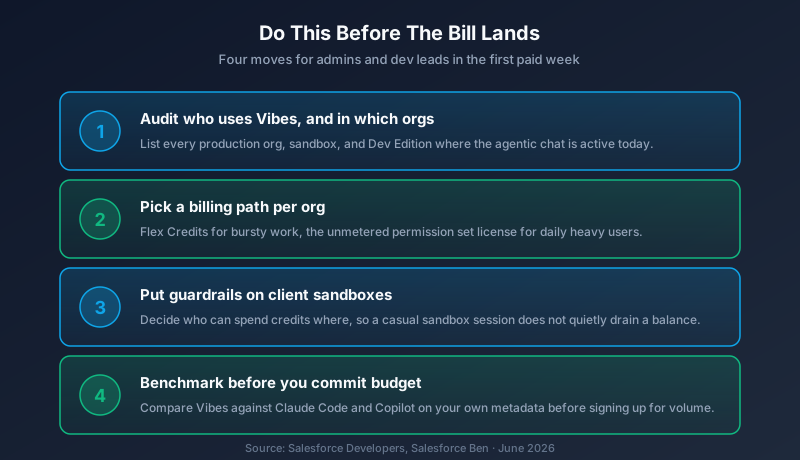
Start with an audit. List every org where Vibes is in active use, split by type: production, sandbox, Developer Edition. You cannot price a path until you know where usage actually lives, and most teams discover it is concentrated in a handful of orgs and a handful of people.
Then assign a path per org. Flex Credits for the bursty and occasional, the unmetered permission set license for the daily heavy users. Resist the urge to pick one model for everything. The whole point of having two is that they fit different usage shapes.
If you are a partner, put explicit guardrails on client sandboxes before anyone gets surprised. Decide who is allowed to spend credits in which org, and make sure the people doing the work know whose balance they are touching. A short policy now is cheaper than an awkward conversation about a depleted credit pool later.
Finally, benchmark. Run Vibes against Claude Code and Copilot on your own metadata, on the kind of tasks your team actually does, before you commit volume budget. The tool was free, so nobody compared it to anything. Now that it costs money, the comparison is the responsible thing to do, and you may well conclude Vibes wins for platform-specific work. Either way, decide with evidence rather than habit.
The free era of Agentforce Vibes lasted long enough to make it a default. The paid era starts with a simple question for every team: is the platform-aware coding assistant worth what Salesforce now charges for it? You have a week of usage data already. Pull it, price your two paths, and answer it deliberately instead of letting the meter answer for you.
About the Author
Dipojjal Chakrabarti is a B2C Solution Architect with 29 Salesforce certifications and over 13 years in the Salesforce ecosystem. He writes and edits salesforcedictionary.com, published by KineticBit Inc., to help admins, developers, architects, and cert/interview candidates sharpen their fundamentals. More about Dipojjal.
Share this article
Sources
- Agentforce Vibes No Longer Free from June 2026 (Salesforce Ben)
- Agentforce Vibes Pricing (Salesforce)
- Salesforce Agentforce Vibes Paid Tier, June 2026 (SFDC Developers)
- Agentforce Vibes Is Moving to a Paid Model (Hamza Siddiqui)
- Salesforce Agentforce Credits & Cost Model: Complete Guide 2026 (Jitendra Zaa)
Related dictionary terms
Practise it
Five questions on Agentforce Specialist
Exam-style questions with an explanation after each one. No account needed, and your answers build a weak-topic map once you have one.
More news
Agent Broker Hits GA, June 2026
Salesforce moves Agent Broker to GA in June 2026, shipping the visual authoring canvas, Agent Script, and Salesforce-model support. Guided Determinism is the production pattern for multi-agent orchestration. Here is what changed.

Salesforce Q1 FY27: Agentforce $1.2B
Salesforce beat Q1 FY27 estimates on every major metric: $11.13B revenue, $3.88 non-GAAP EPS, $33.6B cRPO at 14% growth. Agentforce ARR crossed $1.2B at 205% growth. Then Benioff revealed engineers haven't been hired in two years.
Comments
No comments yet. Start the conversation.
Sign in to share your take on this article. Your account works across every page.