
CRM's Rally Meets a Bearish Chart
Salesforce shares closed near $170.60 on July 13, up as much as 5% intraday on renewed enterprise wins. The chart underneath that move still shows a stock 18.7% below its 200-day average, and Benzinga's own scorecard calls the bounce technical, not fundamental.
Salesforce shares closed near $170.60 on July 13, up 4.46% on the day, with some intraday snapshots showing a gain as high as 5.22%. That is the best single-day print the stock has had in weeks. Read one line further into Benzinga's own coverage of the move, and the framing changes: a bounce within a larger downtrend, driven by stock-specific buying while the broader technology sector fell, and a fundamentals scorecard too weak to call it the start of anything.
The Numbers Behind the Bounce
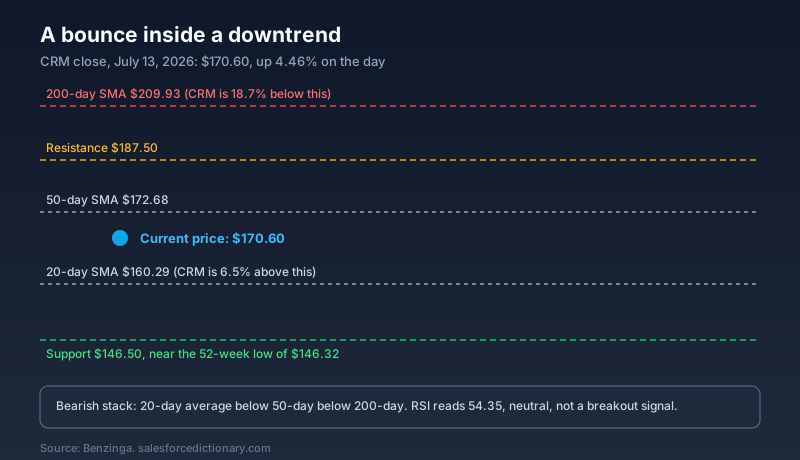
Start with where the stock actually sits. At $170.60, Salesforce is trading 6.5% above its 20-day moving average of $160.29, but still 1.2% below its 50-day average of $172.68, and 18.7% below its 200-day average of $209.93. That last figure is the one worth sitting with. A stock can have a great week and still be deep inside a year-long downtrend, and CRM is both of those things at once on July 13.
The moving averages themselves tell the same story in shorthand: 20-day below 50-day below 200-day, the textbook bearish stack. Relative Strength Index sits at 54.35, which is neutral, not the reading you would expect from a stock making a real breakout. Resistance sits at $187.50, support at $146.50, close to the 52-week low of $146.32. Salesforce would need to climb roughly 10% from Friday's close just to test that resistance level, let alone clear it.
Reading the Chart Terms, in Plain English
You do not need a trading desk to follow the rest of this, so a quick translation before the jargon piles up. A moving average is just the stock's average closing price over a stretch of days, smoothed out so a single wild session does not distort it. When the short-term average (20-day) sits above the medium-term one (50-day), which sits above the long-term one (200-day), that ordering is bullish. Here it runs the other way, 20-day under 50-day under 200-day, which is the standard definition of a stock still in a downtrend even while it is bouncing inside it.
RSI, the Relative Strength Index, measures how hard and how fast a stock has been bought or sold recently, on a scale of zero to 100. Above 70 usually signals overbought, below 30 oversold, and anything near the middle, like CRM's 54.35, says the recent move has not been extreme in either direction. Support and resistance are simply the price floors and ceilings the stock has struggled to break in either direction recently. None of these numbers predict the future. They describe the present more precisely than "the stock went up" does, which is the whole reason to look at them before repeating whatever explanation a headline gives you.
Why Benzinga Calls This a Technical Bounce, Not a Rally
The distinction matters, and it is worth being precise about what each word means. A rally implies buyers across a sector or the market broadly deciding something has changed. A technical bounce is narrower: a specific stock catching a bid off an oversold level, independent of what is happening around it.
Benzinga's read leans hard toward the second explanation. On the day Salesforce gained 4.46%, the broader technology sector fell 2.5%, and market breadth actually favored defensive sectors, with Energy up 3.30%. A stock rising while its own sector drops is not sector strength lifting it. It is buying specific to Salesforce, and buying specific to one name after a steep decline is exactly what a technical bounce looks like before anyone knows whether it holds.
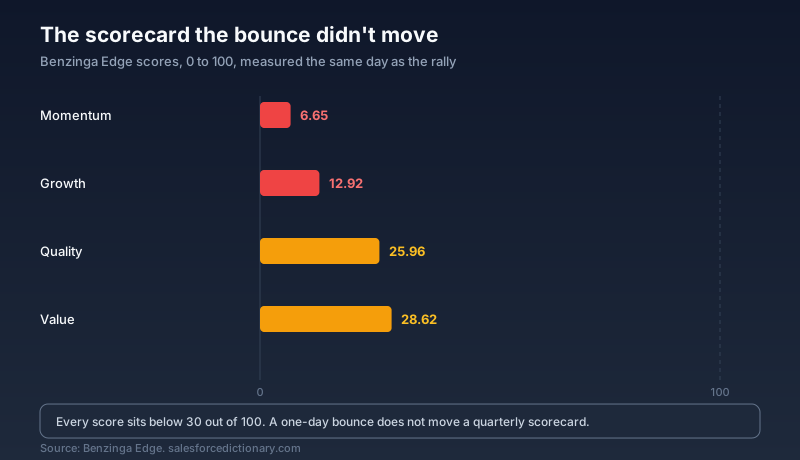
The fundamentals side of Benzinga's own scorecard makes the same case more bluntly. Momentum scores 6.65 out of 100. Growth scores 12.92. Value scores 28.62. Quality scores 25.96. Every one of those readings sits in weak territory, and none of them moved because of a single good trading day. A stock does not earn a growth re-rating from a 4% bounce. It earns one from quarters of evidence, which is precisely what Tuesday did not provide.
What Bulls Are Actually Pointing To
None of this means the bulls have nothing. They have three real threads, and treating them fairly means separating what is new from what is a restated older story.
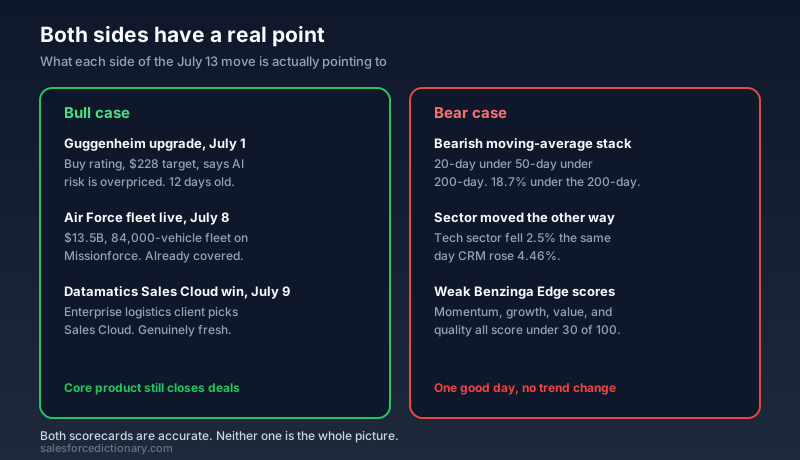
The oldest thread is the analyst call. Guggenheim upgraded Salesforce to Buy on July 1, arguing the market had overpriced the risk that agentic AI guts software demand. That call is now twelve days old, and it is the single most-cited reason aggregators give for July's price action, recycled into nearly every market-mover roundup since. It is real, but it is not news this week.
The second thread is public-sector momentum, specifically the U.S. Air Force's 441st Vehicle Support Chain Operations Squadron running its 84,000-vehicle, $13.5 billion fleet on Missionforce National Security. That went live on July 8 and has already had its own coverage here. Citing it again as a July 13 catalyst is technically true and also a week late.
The genuinely fresh piece is smaller and less dramatic: on July 9, Datamatics Global Services, a Salesforce Platinum Partner with a 4.9-star rating in the partner ecosystem, announced it is implementing an enterprise-wide Sales Cloud platform for a major North American transportation and logistics company. The scope is a full rebuild, not a bolt-on: a consolidated account hierarchy, executive dashboards for real-time visibility into customer relationships, migration of complex legacy records under what the release calls a governance-led approach, and integration with the client's core enterprise applications to create what Datamatics describes as an AI-ready digital ecosystem for real-time data exchange. Datamatics Vice Chairman and CEO Rahul Kanodia framed it as proof of "deep domain expertise" positioning the firm to "successfully implement Salesforce CRM solutions that drive operational excellence," the kind of phrase every systems integrator reaches for in a press release.
Read past the marketing language and the substance holds up. This is one mid-size implementation, not a headline contract, and it will not move revenue guidance. But it is a real, dated, uncovered data point that Salesforce's core CRM product, the boring Sales Cloud product nobody writes analyst notes about anymore, is still winning competitive enterprise deals in July 2026 against whatever a transportation and logistics company's other options were. That is exactly the question the bear case keeps asking, and one deal does not settle it, but it is evidence, not narrative.
The Honest Middle
Hold both facts at once, because both are true. Salesforce had a genuinely good trading day, and the stock remains, by its own chart, deep inside a downtrend that a single session does not repair. The Datamatics win is real evidence the core product still closes enterprise deals. It is not evidence the AI-monetization question KeyBanc raised on July 9 has been answered, and one implementation announcement from a mid-size systems integrator was never going to answer it.
If you are inclined to read every green day as vindication for whichever side of the Guggenheim-versus-KeyBanc argument you already favored, July 13 will not cooperate. The bulls get a real deal and a decent tape. The bears get a stock still 18.7% under its 200-day average with a growth score in the bottom quintile of Benzinga's own scale. Both scorecards are accurate. Neither one is the whole picture, and that is worth remembering the next time a single day's percentage move shows up in your feed as proof of anything.
What to Watch Next
Two levels and one date matter more than today's headline percentage.
- Watch $187.50. That is the resistance Benzinga flags. A push toward it on rising volume would be the first sign this bounce has legs beyond one session. A stall well short of it, on the other hand, keeps the bearish moving-average stack intact.
- Watch $146.50. That is the support level, sitting almost exactly at the 52-week low of $146.32. If the bounce fails, that is the floor the bears are watching, and a break below it would matter more than any single up day above it does.
- Track deal flow, not just ratings. The Datamatics announcement is one data point. If more mid-market implementation wins like it surface over the next few weeks, that is a more durable signal for Sales Cloud demand than another analyst note flipping a rating for the third time this quarter.
If you hold the stock, advise clients on it, or just track it because you build on the platform, treat July 13 as one data point in a longer chart, not a verdict. Check where CRM sits against that $187.50 level before you draw a conclusion from a single green candle.
About the Author
Dipojjal Chakrabarti is a B2C Solution Architect with 29 Salesforce certifications and over 13 years in the Salesforce ecosystem. He writes and edits salesforcedictionary.com, published by KineticBit Inc., to help admins, developers, architects, and cert/interview candidates sharpen their fundamentals. More about Dipojjal.
Share this article
Sources
- Salesforce Stock Is Testing a Level That Could Define the Next Move (Benzinga)
- Salesforce Inc Stock (CRM) Moved Up by 5.22% on Jul 13: Drivers Behind the Movement (TradingKey)
- CRM Stock Juggles Defense Wins, AI Risks, And Analyst Split (StocksToTrade)
- A Leading North American Transportation and Logistics Provider Selects Datamatics to Implement Salesforce CRM (PR Newswire)
Related dictionary terms
Practise it
Five questions on Agentforce Specialist
Exam-style questions with an explanation after each one. No account needed, and your answers build a weak-topic map once you have one.
More news
Wall Street Splits on Salesforce
Within one trading week, Phillip Securities downgraded Salesforce to Neutral and Guggenheim upgraded it to Buy, using the same facts. Here is what that split tells Salesforce professionals.
KeyBanc Downgrades Salesforce
KeyBanc cut Salesforce to Sector Weight on July 9 and pulled its price target, saying customer checks found no Agentforce acceleration. Shares fell near 5%, eight days after Guggenheim upgraded the same stock.

CRM's 13-Day Slide to a 3-Year Low
Salesforce fell 13 sessions in a row to a 3-year low of $149.78, its longest losing streak ever. Here is what caused it and where CRM trades now.
Comments
No comments yet. Start the conversation.
Sign in to share your take on this article. Your account works across every page.