
Salesforce Cuts Agentforce AI Costs
Salesforce's AI engineering chief revealed on July 8 that Agentforce quietly stopped running everything through one rented frontier model. It now routes work across five specialized models, and the numbers explain why your token bill has not exploded the way the doom math predicted.

Every Agentforce request used to make the same trip. It left your org, hit one rented frontier model, and came back with an answer, whether the job was "detect if this message is toxic" or "reason through a six-step refund dispute." Salesforce paid frontier prices for both. On July 8, Jayesh Govindarajan, the company's EVP of Software Engineering for AI, admitted that math never worked and described what replaced it: five specialized models doing the small jobs, with a frontier model reserved for the one job that actually needs it.
This is not a feature announcement. It is Salesforce explaining, in public, why its own AI bill was not sustainable, and what it built instead. Here is the architecture, the numbers behind it, and what it means for anyone building on Agentforce or watching whether the platform's economics hold up.
The problem: one model, every job
Govindarajan's post put a number on the old approach without dressing it up. Eighteen months ago, Agentforce ran entirely on a single rented model, and the token bill grew linearly with traffic. More usage meant more cost, in a straight line, with no ceiling. Salesforce could have solved that the easy way, by passing the increase to customers. It chose to rebuild the stack instead.
The reasoning is blunt: a general-purpose frontier model can do almost any task you throw at it, but for the narrow, repetitive jobs inside an agent's loop, that is a bad trade. It performs those jobs "more slowly, more expensively, and less precisely" than a model built for exactly that job. Classifying intent, screening for toxicity, catching a prompt injection attempt, none of that needs a model that can also write a sonnet or debug Apex. It needs a model that does one thing fast and gets out of the way.
What actually shipped
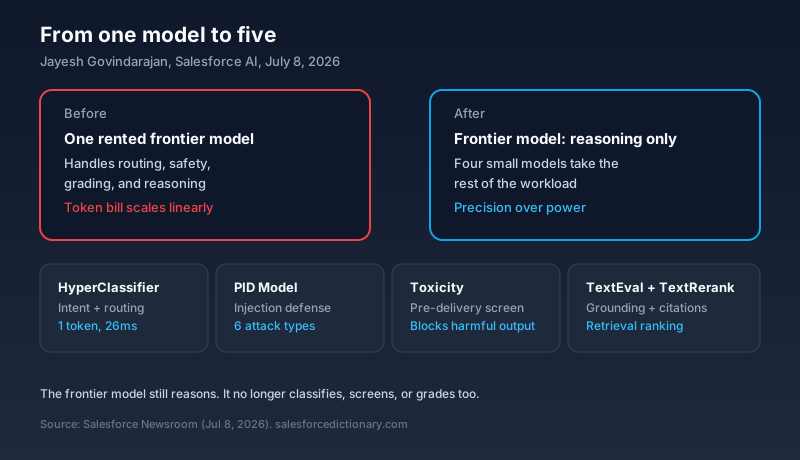
The rebuilt stack keeps a frontier model in the loop, but only for core multi-step reasoning, the part of an agent's job that genuinely benefits from broad, flexible intelligence. Everything else routes to purpose-built models:
- HyperClassifier handles intent detection and routing. It is fine-tuned from GPT-OSS-20B, OpenAI's open-source mixture-of-experts model, and predicts a single token that represents a classification instead of generating free-form text. That is the trick: constant-time inference, because the model always emits one token regardless of how long the category name is. It went generally available in Spring '26 and is now the default router for Agentforce Service and Employee Agent templates.
- Prompt Injection Defense screens for six attack patterns, including role-play manipulation, prompt leakage, privilege escalation, encoding tricks, privacy attacks, and malicious code generation. It is rolling out through Summer '26.
- Toxicity screens generated responses for violent, explicit, hateful, or otherwise harmful content before anything reaches a user.
- TextEval, a 20-billion-parameter model also fine-tuned from GPT-OSS-20B, grades whether an agent's answer is grounded in the customer's actual data, whether it cites sources correctly, whether it followed instructions, and whether it resolved the task.
- TextRerank handles high-throughput retrieval reranking, deciding which retrieved content is worth showing the reasoning model before it ever gets there.
None of this touches the customer-facing behavior of an agent. It touches everything happening underneath it: the routing decision, the safety check, the grading pass, the retrieval step. Salesforce calls the philosophy "precision over power." The frontier model stays for the parts of the job that need it, and gets relieved of the parts that do not.
The numbers behind the pitch
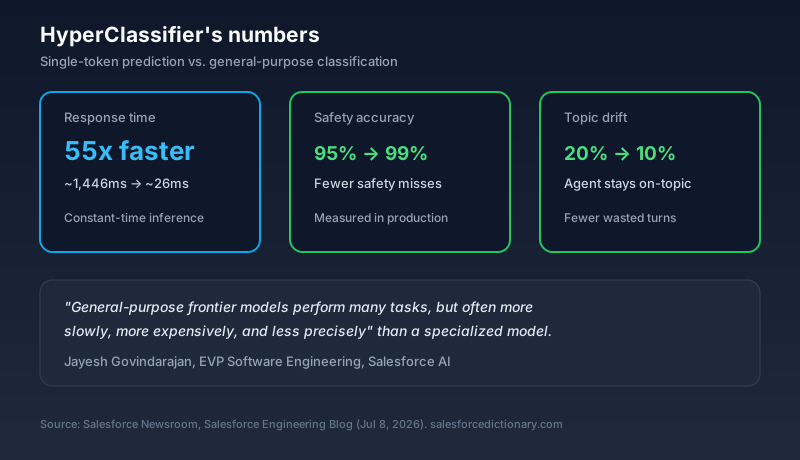
Salesforce's engineering blog gets specific about HyperClassifier, and the gap is not subtle. Single-token prediction responds in roughly 26 milliseconds, against roughly 1,446 milliseconds for a general-purpose model doing the same classification job, a 55x difference in Govindarajan's framing and a 30x figure in the original engineering deep dive, depending on which benchmark run you cite. Either number describes the same shape: a full second shaved off the time before an agent's response even starts generating.
The accuracy side moved too. Safety classification accuracy rose from 95% to 99%. Topic drift, meaning the agent wandering off the subject it was asked about, dropped from 20% to 10%. And the model reportedly does this at 1 to 2 percent better accuracy than the baseline general-purpose approach it replaced, so the speed gain did not cost precision. That combination, faster and more accurate at the same time, is the part worth sitting with. Usually you trade one for the other.
Why Salesforce is telling you this now
There is a strategic reason behind this specific disclosure, beyond engineering pride. A routing layer built around swappable specialized models means Salesforce is no longer locked to one foundation model vendor for the bulk of Agentforce's workload. If a cheaper or better model shows up for intent classification next quarter, Salesforce can swap it in without re-architecting the product. That is a hedge, not just an optimization, and it lines up with the multi-model reality Agentforce already lives in: OpenAI's GPT-OSS underneath the specialized models, Anthropic's Claude available through Bedrock for regulated industries, Google's Gemini as another option inside the platform. Betting the entire cost structure on any single one of those relationships would be a strange thing to do in 2026.
CX Today's Nicole Willing framed the underlying industry pressure well on July 9, the day after Govindarajan's post went up. Rebecca Wettemann, an analyst quoted in the piece, described the fear driving this shift at the board level: companies worry about "AI running off in the middle of the night and doing something deleterious, or waking up in the morning and finding that they have a huge token bill that they didn't expect." Ashish Nagar, founder of Level AI, put the logic in a single line: "If I want to go from Mountain View to San Francisco Airport, I don't want to take a Boeing 747, I just want to take an Uber." Most of what an agent does, moment to moment, is the Uber trip. Salesforce built the Uber.
Willing's piece is fair to the limits of the argument too. It leans heavily on vendor voices, Salesforce's own and Level AI's, and does not dig into the cases where a frontier model's broader reasoning genuinely earns its cost. It also does not address whether a company without Salesforce's engineering headcount could build the same system. Mick Costigan's point in the same piece is the honest caveat: organizations still need two tracks running at once, immediate savings from right-sized models and continued exploration of frontier capability for the harder problems that have not been solved yet.
The timing nobody at Salesforce chose on purpose
One day after this post, KeyBanc's Jackson Ader downgraded Salesforce stock and pulled his price target, citing customer checks that found no evidence of Agentforce's adoption momentum. Bernstein made a similar call the same week. Neither downgrade mentioned inference architecture. That is the point worth separating clearly: whether Agentforce is cheap to run and whether enterprises are actually buying it in the numbers Salesforce needs are two different questions, and this week answered one of them favorably while leaving the other one open.
An efficient backend does not sell software. It protects margin on the software that does sell. If KeyBanc is right that adoption is softer than management describes, a leaner cost structure means Salesforce loses less money proving that out. If Guggenheim's more bullish read from earlier in July turns out closer to reality, the same architecture means more of each new dollar of Agentforce revenue drops to the bottom line instead of getting eaten by inference costs. Either way, this was a good week to have shipped it.
What this means if you build on Agentforce
If you are an architect or admin, the disclosure itself changes little about your day-to-day work. Salesforce is not asking you to configure HyperClassifier or pick a reranking model. But it does tell you something concrete about where the platform is headed, and that is worth folding into your planning.
- Stop assuming "Agentforce" means one model. When you scope a build, remember the reasoning step and the routing/safety/evaluation steps underneath it are handled by different models with different behavior. If an agent's classification or safety check misfires, the fix may not be a prompt tweak on the reasoning model at all.
- Watch the BYOLLM story for a signal, not a checkbox. Salesforce building its own swappable-model system internally is a strong tell about where Bring Your Own LLM tooling is headed for customers who want the same flexibility with their own model choices.
- Read consumption reports with this architecture in mind. If your org's Data Cloud or Digital Labor Unit consumption looks different than a quarter ago, part of the explanation may be Salesforce's own backend getting more efficient, not just your usage patterns changing.
- Keep the skepticism about adoption separate from skepticism about cost. KeyBanc's checks and this architecture post are answering different questions. Do not let one settle the other in your own evaluation of the platform.
The actionable step is small but concrete: the next time you review your org's Agentforce consumption or a vendor pitch cites "AI cost efficiency" as a reason to trust a platform's roadmap, ask which layer they are talking about. Routing and safety costs are not the same line item as reasoning costs, and increasingly, neither is the vendor relationship behind them.
About the Author
Dipojjal Chakrabarti is a B2C Solution Architect with 29 Salesforce certifications and over 13 years in the Salesforce ecosystem. He writes and edits salesforcedictionary.com, published by KineticBit Inc., to help admins, developers, architects, and cert/interview candidates sharpen their fundamentals. More about Dipojjal.
Share this article
Sources
- How We Cut Inference Spend by Right-Sizing Our Models (Salesforce Newsroom)
- Solving Real-Time AI Classification for Agentforce (Salesforce Engineering Blog)
- Frontier AI Is Getting More Powerful But CX May Need an Uber, Not a Boeing (CX Today)
- KeyBanc Downgrades Salesforce Stock Rating on AI Product Concerns (Investing.com)
- Supported Models: Agentforce Developer Guide (Salesforce Developers)
Related dictionary terms
Practise it
Five questions on Agentforce Specialist
Exam-style questions with an explanation after each one. No account needed, and your answers build a weak-topic map once you have one.

Comments
No comments yet. Start the conversation.
Sign in to share your take on this article. Your account works across every page.