
Salesforce's OpenAI Boomerang
Peter Doolan is the second OpenAI go-to-market leader in two weeks to return to Salesforce, four months after joining. The Information reports 22 more former Salesforce employees at OpenAI are in active talks to do the same. It lands two days after a record quarter and the second-best trading day in company history, and it says more about OpenAI's commercial layer than about either company's stock.
Peter Doolan joined OpenAI in April as its global head of AI transformation for go-to-market. Four months later he is going back to Salesforce.
He is the second OpenAI sales leader to make that return trip in a fortnight. Kaylin Voss, OpenAI's vice president of Americas sales, resigned in mid-August after roughly five months and rejoined Salesforce, with Marc Benioff posting the news himself.
Two names is a coincidence. The number sitting underneath them is not. The Information reports that 22 more former Salesforce employees currently at OpenAI are in active talks to return.
Three Round Trips, All Short
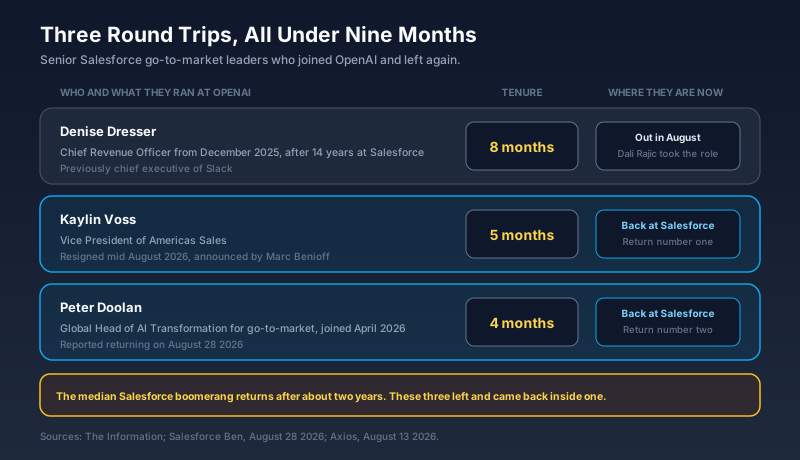
Start with Denise Dresser, because she set the pattern. She ran Slack, after fourteen years inside Salesforce, and became OpenAI's chief revenue officer in December 2025. The move was covered at the time as a senior operator trading a chief executive title for a seat at the frontier. She left in August, eight months in. Dali Rajic replaced her, the fifth change in that role inside a year.
Voss lasted about five months. Doolan about four.
Salesforce has a well-documented alumni pipeline, and the median returner comes back after roughly two years. Two years is long enough to have actually done the other job. Four months is long enough to have finished onboarding.
That is the detail to read carefully. These are not people who built a chapter of a career elsewhere and came home with it. They are people whose new role ended before it started producing anything they could put on a slide.
The Outflow Was Bigger, And It Came First
Anyone reading this as a Salesforce victory lap should look at the other column first.
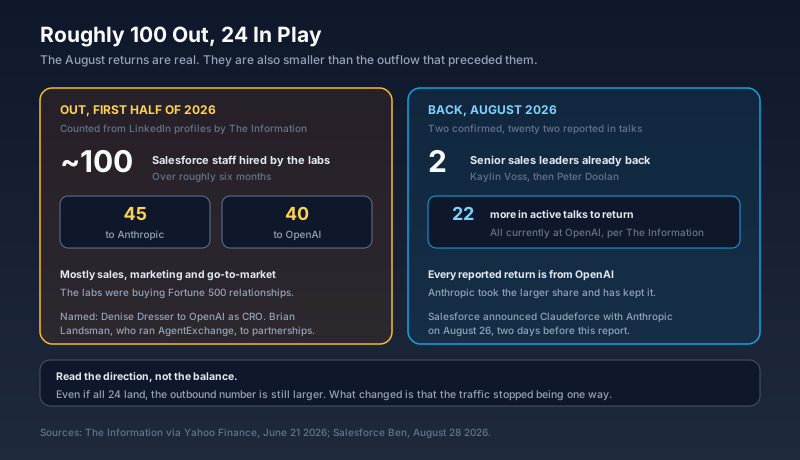
The Information counted roughly 100 Salesforce employees hired by the two frontier labs across about six months of this year, tracked through LinkedIn profiles, with about 45 identified at Anthropic and about 40 at OpenAI. The roles clustered in sales, marketing and go-to-market. The stated reason was blunt: the labs were buying relationships with Fortune 500 buyers, not model expertise.
Dresser was the loudest name in that group. She was not the only one. Brian Landsman, who ran AgentExchange, left to become OpenAI's vice president of global partnerships.
So the honest framing is not that Salesforce won a talent war. Around 100 people left. Two have come back and 22 are reported to be talking. Even if every one of those conversations closes, the outbound column stays larger.
What changed is that the road stopped being one way.
One asymmetry is worth holding onto. Every reported return is from OpenAI. Anthropic hired the larger share and has given none of it back, at least not publicly. Salesforce announced Claudeforce with Anthropic on Wednesday, two days before the Doolan report. The company is deepening its partnership with the lab that took more of its people while re-hiring from the one that took fewer, and both of those things are working.
What The Returners Are Walking Away From
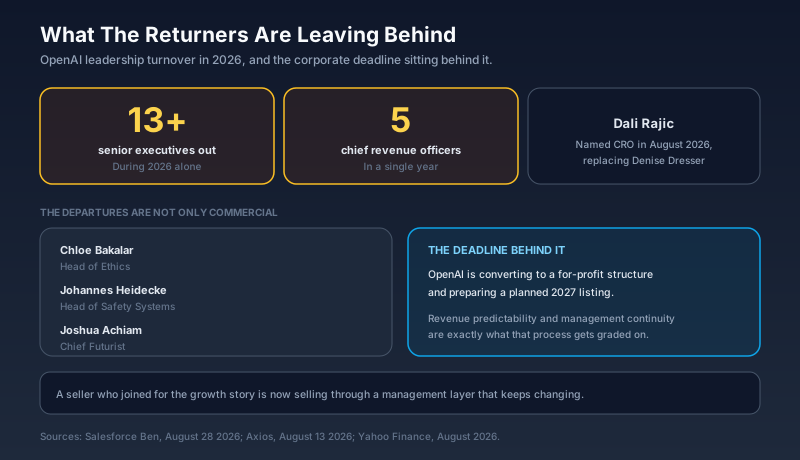
More than a dozen senior OpenAI executives have left during 2026. The commercial layer took the worst of it. Five chief revenue officers in a year is not a reorganisation, it is an unresolved argument about who owns enterprise revenue, running in public.
The churn reaches past sales. Chloé Bakalar, head of ethics. Johannes Heidecke, head of safety systems. Joshua Achiam, chief futurist. Different functions, same signal about how settled the org chart is.
Behind all of it sits a deadline. OpenAI is converting to a for-profit structure and preparing a listing pencilled in for 2027. Prospective investors grade two things hard in that process: whether revenue is predictable, and whether the people producing it stay. Every senior go-to-market exit makes both harder to answer.
Put yourself in the seat for a second. You left a company where you knew the buyer, the comp plan and the product cycle, for a company selling the most talked-about product in enterprise software. Then your CRO is replaced, and the replacement's replacement is named, and the number you carry is still ramping. There is a rational, unglamorous reason to take the return call, and it has nothing to do with anybody's mission statement.
The Timing Is Not Coincidental, But It Is Not The Cause
Salesforce reported second-quarter fiscal 2027 results on Wednesday. Revenue of $11.35 billion, up 11% year over year. Adjusted earnings per share of $5.90 against a Street estimate near $3.28. Full-year guidance lifted to $46.1 to $46.4 billion. Agentforce annual recurring revenue past $1.5 billion, and past $3.9 billion combined with Data 360.
On Thursday the stock closed at $252.10, up 22.6%, the second-best day in company history behind a roughly 26% move in August 2020.
One caveat belongs next to that earnings-per-share number, because it flatters the beat. Around $2.53 of the $5.90 came from investment gains rather than operations, much of it the mark on Salesforce's own stake in Anthropic. The operating quarter was genuinely strong. The headline was better than the operating quarter.
Now line the dates up. Voss resigned in mid-August, well before the print. Doolan's move surfaced two days after it. Conversations with 22 more people do not start on a Thursday afternoon because a stock rose that morning.
The earnings did not cause the returns. What a 22.6% day does is make the recruiting call much easier to place, and make the equity slide in that call much easier to read. Salesforce shares are liquid and marked every day. Pre-listing paper at a lab targeting 2027 is neither of those things, however large the headline number.
Salesforce Was Already Built To Take Them Back
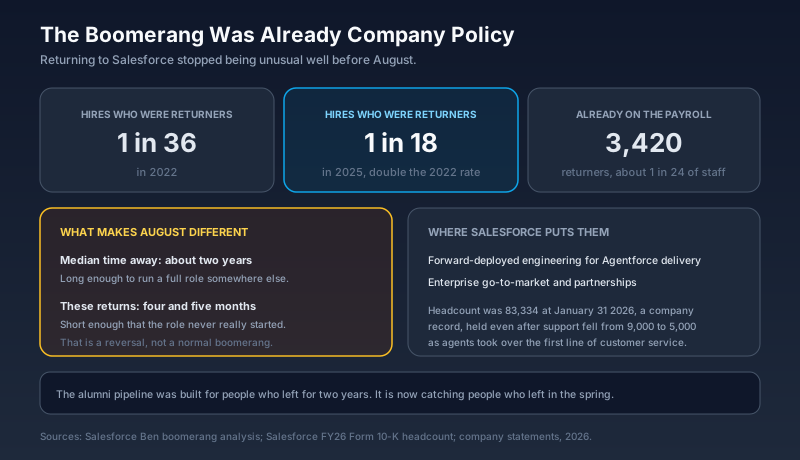
None of this machinery was built last week. The rate of boomerang hires at Salesforce doubled between 2022 and 2025, from one in every 36 hires to one in every 18. About 3,420 current employees have worked there before, roughly one in 24 of the workforce. This is a company that runs its alumni list as a recruiting channel and has done for years.
Where those people land has shifted, though. Salesforce has been staffing forward-deployed engineering for Agentforce delivery since May, and senior enterprise go-to-market is the other half of the same push. A sales leader who spent five months inside a frontier lab is unusually well positioned to sell agents to a board that has spent the year hearing about frontier labs. That is almost certainly the actual pitch, and it is a good one.
The headcount context matters too. Salesforce employed 83,334 people at January 31, 2026, a company record, and it held that record through a support reorganisation that took support from 9,000 people to 5,000 as agents absorbed the first line of customer service. The company is not hiring less. It is hiring differently, and the difference favours people who can sell and deploy agents rather than administer seats.
What It Changes If You Work In The Ecosystem
Directly, very little. These are corporate go-to-market executives whose compensation, risk and optionality look nothing like an admin's, a developer's or a consultant's.
The signal is still useful in two ways.
The first is about the labs as an employer. A quarter of Salesforce professionals told this year's salary survey they are looking at roles outside the ecosystem, and for some of them the frontier labs are the destination they have in mind. The last fortnight is one data point on what those jobs look like at the senior end: fast, unsettled, and in three documented cases short. Treat it as an input, not a verdict, and remember that a vice president's experience of a company is not an engineer's.
The second is about where enterprise selling actually happens. The labs hired go-to-market people specifically to reach Fortune 500 buyers, and those buyers still transact through the incumbent platform and its channel. That is the same mechanism running under this week's partner revenue gap: the money moves through the platform even when the story is about the model. A model is easy to switch. A renewal, a data model and eleven integrations are not.
Also This Week
The Winter '27 sandbox preview window opened. The create-or-refresh deadline was Wednesday at 5 p.m. Pacific, sandboxes on preview instances upgrade across this weekend, and testing opens Sunday, August 30. Production instances upgrade on September 4, October 2 and October 9 depending on your instance.
Dreamforce runs September 15 to 17 in San Francisco. Salesforce confirmed this week that Usher and Gwen Stefani headline Dreamfest on September 16 at Oracle Park, with proceeds going to UCSF Benioff Children's Hospitals. Tickets start at $1,500.
What To Do Next
The concrete action this week is the sandbox one, not the talent one. Log into your preview sandbox on Sunday and confirm it actually came up on Winter '27 before you plan a single test cycle around it. A sandbox that missed Wednesday's 5 p.m. cutoff is still on Summer '26 and will stay there until October, and finding that out on September 10 is a bad way to find it out.
If you are weighing an offer from an AI lab, ask two questions that the last fortnight makes obvious: who the role reports to, and how long that person has held their own job. Five chief revenue officers in a year is a fact you are allowed to raise in an interview.
And if you recruit for a partner or an ISV, go work your own alumni list this month. Salesforce has been quietly proving the returns on that at one-in-eighteen since 2022, and the people who left your practice for an AI-adjacent role in the spring are exactly the cohort now taking calls.
About the Author
Dipojjal Chakrabarti is a B2C Solution Architect with 29 Salesforce certifications and over 13 years in the Salesforce ecosystem. He writes and edits salesforcedictionary.com, published by KineticBit Inc., to help admins, developers, architects, and cert/interview candidates sharpen their fundamentals. More about Dipojjal.
Share this article
Sources
- Why More Than 20 Employees Are Returning to Salesforce from OpenAI (Salesforce Ben, August 28 2026)
- OpenAI's executive churn continues as another returns to Salesforce (Proactive Investors, August 2026)
- Exclusive: Second OpenAI Sales Exec to Return to Salesforce (The Information, August 2026)
- OpenAI is replacing chief revenue officer Denise Dresser (Axios, August 13 2026)
- OpenAI, Anthropic Poach Approximately 100 Salesforce Employees This Year (Yahoo Finance, June 2026)
- Salesforce's Hiring Boomerang: Why Are Ex-Employees Coming Back Now? (Salesforce Ben)
- Salesforce rockets 22% for second-best day ever, leading software rally (CNBC, August 27 2026)
- Salesforce Delivers Record Second Quarter Fiscal 2027 Results (Salesforce, August 26 2026)
- Usher and Gwen Stefani to perform at Salesforce Dreamfest concert in San Francisco (KTVU, August 2026)
Related dictionary terms
Practise it
Five questions on Agentforce Specialist
Exam-style questions with an explanation after each one. No account needed, and your answers build a weak-topic map once you have one.
More news
Partners See No Agentforce Revenue
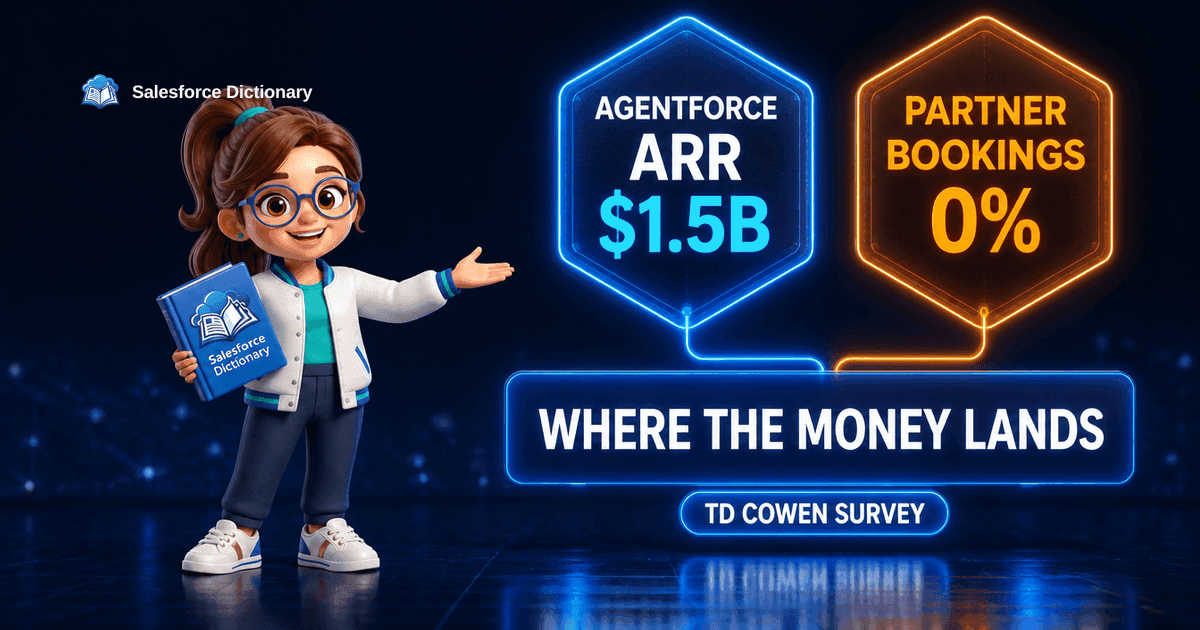
Salesforce reported Agentforce ARR past $1.5 billion this week. A TD Cowen partner survey found zero partners crediting Agentforce for bookings. Here is why both numbers are true and what it changes for the channel.

Salesforce Pros Are Going Agnostic
A quarter of respondents to Salesforce Ben's 2025-26 salary survey are looking at non-Salesforce tech roles and 11 percent are weighing an exit from tech. Demand grew 8 percent last year. Supply grew 27 percent. The gap is the whole story.
Salesforce FDE Partner Network
Salesforce's FDE Partner Network added TTEC Digital and Bridgenext this week, bringing the count past 30 firms. FDE partners have driven one-third of all production Agentforce deployments. Here is what to ask before signing a SOW.

Salesforce's $5B Anthropic Windfall
Bloomberg valued Salesforce's Anthropic stake at about $5 billion on June 1, after Anthropic raised $65 billion at a $965 billion valuation and filed confidentially for an IPO. CRM jumped nearly 10 percent on a roughly 100x paper return.
Comments
No comments yet. Start the conversation.
Sign in to share your take on this article. Your account works across every page.