
Salesforce Trailhead: The Complete 2026 Guide for Admins, Developers, and Architects
How Trailhead works in 2026: ranks, badges, superbadges, Agentblazer status tiers, playgrounds, Trailhead Academy, and the actual path from your first module to a paid certification.

You open your laptop, decide today is the day you start the Admin certification, and twenty minutes later you are nine tabs deep, scrolled past three trails, and the only thing you have actually finished is a half-typed reply to a coworker. Trailhead does that to people. Nine thousand-plus modules, six rank tiers, three Agentblazer levels, a dozen superbadges per certification, and a playground system that nobody explains until you fail your first challenge. This guide is the map nobody handed you on day one.
Trailhead is Salesforce's free, gamified learning platform. It launched in 2014 under Sarah Franklin and has since taught more than nineteen million people some flavor of Salesforce. It is also the official prep environment for every Salesforce credential, the hosting platform for Agentblazer status, and the entry point for instructor-led training through Trailhead Academy. If you work on the platform in 2026, you will end up here.
This post walks through every part of the system: how badges, projects, and superbadges differ, how the Trailblazer rank ladder actually works, what the new Agentblazer status tiers test, the difference between a Trailhead Playground and a Developer Edition org, and the realistic path from your first badge to a paid certification.
What Trailhead actually is
Trailhead is three things wearing the same trail-marker logo:
- A free self-paced learning platform with modules, projects, trails, and trailmixes. This is the public Trailhead at
trailhead.salesforce.com. - A paid instructor-led training and certification scheduling platform called Trailhead Academy. This is where you book a $200 exam, an expert-led course, or a private bootcamp.
- A credential program that issues the actual Salesforce certifications. The cert lives in your Trailhead profile, expires every release if you skip maintenance, and shows up in your verifiable credential URL.
Most people mean the first one when they say "Trailhead". When a hiring manager asks for your Trailhead profile, they are looking at the public profile that aggregates all three: badges, ranks, and certifications.
The platform is free. Always has been. The original pitch in 2014 was that Salesforce had a skills shortage, the ecosystem was growing faster than the hiring pool, and a free training platform would widen the funnel. It worked. The current ecosystem hires aggressively from Trailhead profiles that show consistent activity and a few superbadges, even when the candidate has no Salesforce work experience.
Badges, projects, modules, trails, trailmixes
The vocabulary trips up new users because Trailhead invented half of it.
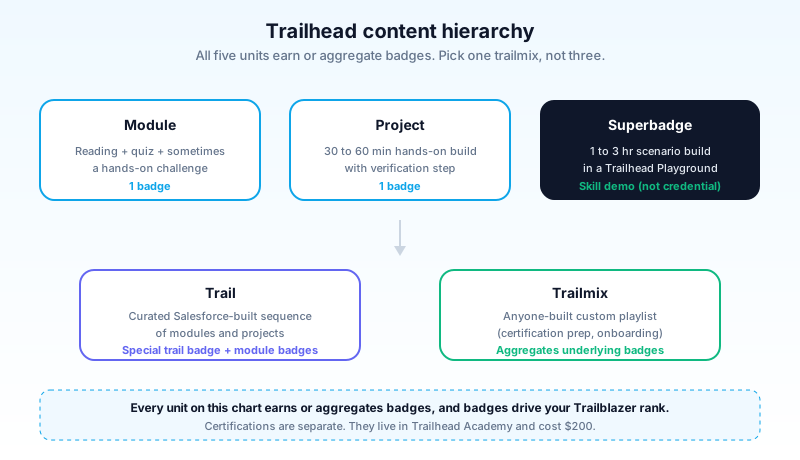
- Module: a self-contained lesson on one topic. Reading, multiple-choice quizzes, sometimes a hands-on challenge. Earns one badge.
- Project: a step-by-step hands-on build, usually thirty to sixty minutes, with a verification step at the end. Earns one badge.
- Trail: a curated sequence of modules and projects on a theme. Completing the trail awards a special trail badge plus the underlying module badges.
- Trailmix: a custom playlist anyone can build. Hiring managers build trailmixes for new hires. Cert candidates build trailmixes for exam prep. The official "Administrator Certification Prep" trailmix mirrors the exam blueprint.
- Superbadge: a longer, performance-based assessment. You implement a real business scenario in a Trailhead Playground, and the verification step checks your actual configuration. Three of these stacked together used to count toward the Platform Developer II credential.
The 2026 shift on superbadges is worth flagging: Salesforce trimmed the typical superbadge from a half-day exercise to one-to-three hours, and they explicitly demoted superbadges from credentials to skill demonstrations. They still appear on your profile. They no longer act as a stand-in for a certification.
Module badges, project badges, and superbadge credit all count toward your Trailblazer rank.
The Trailblazer rank ladder
The rank system is gamification done right. Every badge earns points. Every rank threshold is a clean number you can plan against.
| Rank | Badges | Points |
|---|---|---|
| Scout | 0 | 0 |
| Hiker | 1 | 200 |
| Explorer | 5 | 3,000 |
| Adventurer | 10 | 9,000 |
| Mountaineer | 25 | 18,000 |
| Expeditioner | 50 | 35,000 |
| Ranger | 100 | 50,000 |
| Double Star Ranger | 200 | 100,000 |
| Triple Star Ranger | 300 | 150,000 |
| Four Star Ranger | 400 | 200,000 |
| Five Star Ranger | 500 | 250,000 |
| All Star Ranger | 600 | 300,000 |
Ranger is the rank most candidates target before applying for their first Salesforce role. It typically takes a hundred badges spread across admin, developer, and integration topics, plus around fifty thousand points. A focused learner can reach Ranger in three to four months working evenings and weekends. The post-Ranger star ranks were introduced in 2022 and added a competitive long-tail for the small slice of the community that wanted to keep climbing.
You will notice these are badge counts, not module counts. A single trail completion can bump you past two ranks if it bundles enough underlying modules. The point system is weighted, so a five-step project worth 1,000 points moves the needle faster than five quick modules worth 100 each.
The rank shows up in the chevron next to your profile name. It is decorative, not gating. No exam requires a specific rank to attempt. Recruiters scan for it because consistent activity is a proxy for self-driven learning, and Ranger is the public signal that someone has been building for at least a season.
Agentblazer status: the new yearly cert-adjacent layer
In 2024 Salesforce launched Agentblazer status. In 2026 they renamed it to a yearly designation and split it into three explicit tiers. This matters because it is the only part of Trailhead that resets every year, the only part Salesforce markets through partner channels alongside paid certifications, and the only part that targets Agentforce skill specifically.
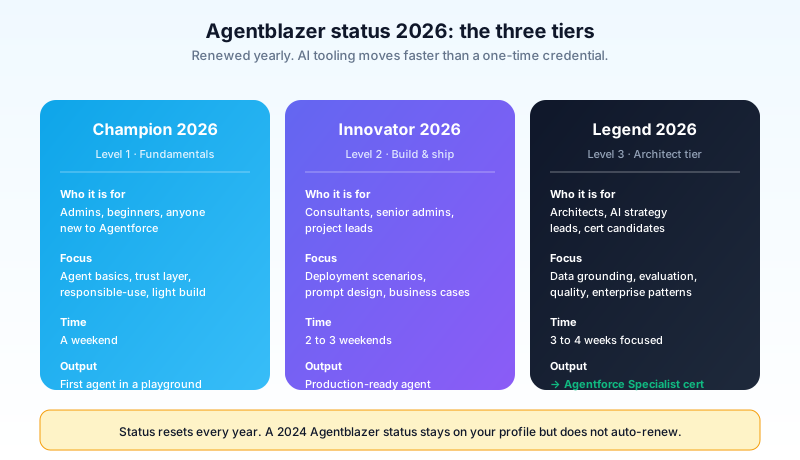
The three tiers:
Agentblazer Champion 2026 is the entry level. The 2026 refresh added an introductory module and dropped the earlier data-connection requirement, which means the gate is now fundamentals: what an agent is, how the trust layer works, what responsible-use looks like, and a light hands-on build in your playground. Most admins can complete it in a weekend.
Agentblazer Innovator 2026 goes deeper. New modules cover deployment scenarios, prompt design, and the business cases where agents create measurable lift. The Innovator trail prepares you to scope, build, and ship a production-ready agent. Consultants and senior admins who run Agentforce projects sit here.
Agentblazer Legend 2026 is the highest tier and the one that maps most closely to a real architect role. Legend 2026 expanded significantly. It now covers data-grounding, connecting Agentforce to enterprise data sources, responsible agent design, evaluation patterns, and best practices for building higher-quality agents. The Legend trail culminates in prep for the Agentforce Specialist certification.
The 2026 model is yearly. The status earned in 2025 still appears on your profile as "Agentblazer Champion 2025" but does not auto-roll forward. Salesforce explicitly says this is because the underlying AI tooling moves faster than a one-time credential can keep up with. If you want the current-year badge on your profile, you complete the current-year modules.
This yearly cadence is the right call. Agent tooling in May 2026 looks different from January 2026. A 2024 Agentforce credential without yearly refresh would be misleading. The annoying part is that recruiters who do not track the calendar will see a 2024 Champion status and assume it is current. Renew if you are job-hunting in the AI track.
Playgrounds, Developer Edition orgs, and sandboxes
You cannot complete a hands-on challenge without an org to run it in. Trailhead handles this for you but it confuses everyone the first time.
A Trailhead Playground is a free, never-expiring Developer Edition org pre-installed with the Trailhead helper package and seeded with Trailhead-specific sample data. You get up to ten active playgrounds per Trailhead account. Most learners use one or two. You spin up a fresh playground whenever a challenge needs a clean slate.
A Developer Edition org is the same underlying SKU without the Trailhead seed data and helper package. You sign up for one at developer.salesforce.com/signup with a unique email. It also never expires. It has fifteen users, 5 MB of data storage, and the full feature set of Enterprise Edition for testing. This is what you use for your own side projects, MVP demos, and exam practice when the cert blueprint diverges from Trailhead's sample data.
A sandbox is something else entirely. It is a copy of a real production org, used for development and testing in a real customer environment. You cannot spin up a sandbox from a playground or a Developer Edition org. Sandboxes only fork from production. If a Trailhead module mentions a sandbox, it means in a real customer org, not in your playground.
The practical rule: use a Trailhead Playground for every challenge that has a verification step. Use a Developer Edition org for exam study patterns that need a clean canvas. Save sandbox knowledge for the certification's deployment chapter.
Playgrounds occasionally drift. If a challenge fails verification and you are sure the config is right, spin up a fresh playground and try again. The helper package on older playgrounds sometimes lags the verification script.
How Trailhead maps to certifications
This is the question candidates ask first, and the part Trailhead does not advertise loudly.
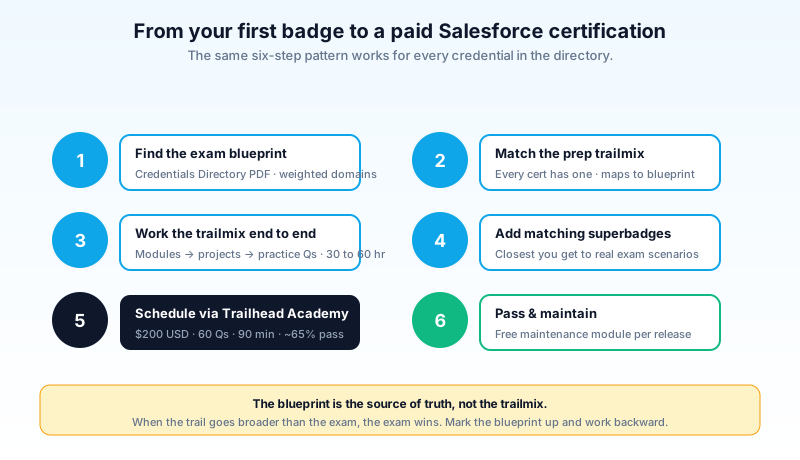
The pattern is consistent across every credential:
- Find the certification's exam guide on the Salesforce Credentials Directory. Each cert has a PDF blueprint that lists every domain and its weight on the exam. Print it. Mark it up.
- Locate the matching "Certification Prep" trailmix. Every credential has one. The Administrator exam, for example, has "Administrator Certification Prep" with a topic-by-topic walkthrough that matches the blueprint domains and their weights.
- Work the trailmix end to end. Modules first, then projects, then practice questions. The official trailmix takes thirty to sixty hours depending on prior experience.
- Add the corresponding superbadges. Even though superbadges no longer act as credentials in 2026, they remain the single best practice exercise for the exam scenarios. The Admin superbadge "Lightning Experience Reports & Dashboards Specialist" is closer to the exam than any video course.
- Schedule the exam through Trailhead Academy. $200 USD for most certifications. Online proctoring or in-person at a Kryterion testing center. Sixty multiple-choice questions, ninety minutes, around 65% passing.
- Pass, fail, retake. Retake fees are 50% of the original. Maintain the cert with the free per-release maintenance module on Trailhead every Spring, Summer, and Winter release.
The blueprint is the source of truth, not the trailmix. Trailhead trails go broader than the exam to teach concepts. The exam tests the blueprint. When the two disagree, the blueprint wins.
For the deeper sequencing and the full set of forty-plus exams, see the Salesforce certifications roadmap 2026, which maps every cert by role with study time and prerequisites.
Trailhead Academy: the paid side of the platform
Trailhead Academy is the part of the platform most learners never see. It bundles three things:
- Expert-led, instructor-taught classes ranging from one-day deep dives to multi-day immersive workshops. Most run between $1,000 and $2,000 depending on duration.
- Certification exam scheduling and proctoring. This is where the $200 exam fee lives.
- Private bootcamps for enterprise customers who want to certify a cohort of admins or developers at once. These run $3,000 to $6,000 per learner and typically include the exam voucher, a retake voucher, and a job-placement guarantee in the bootcamp variants.
The pitch for instructor-led training is that you compress two months of solo study into one focused week. It works if you are funded by an employer or you genuinely cannot find time to self-pace. If you are budget-constrained, the free Trailhead trails plus a paid practice-exam product (FocusOnForce or Salesforce Ben's exam guides) cover ninety percent of the same ground for under $100.
The 2026 consolidation moved every Salesforce credential into Trailhead Academy. The old Webassessor portal still handles the underlying test delivery for now, but the booking flow, the credential listing, and the maintenance reminders all run through Trailhead Academy.
The pieces of Trailhead that fail
Calling out what is bad on the platform, with grounded reasoning, because the rest of this post does not pretend everything is great.
The search experience is mediocre. Search for "permission set" and the top result is often a 2018 module that does not mention the permission set group changes from 2022 onward. Trailhead's own internal release-version tagging is inconsistent. Until that fixes, the workaround is to find a current trailmix for your topic and ignore search.
Older modules drift out of date faster than they get retired. A module written for Spring '21 will still award a badge in 2026 even if half the UI it references no longer exists. Salesforce does refresh popular modules, but the long tail of niche content rots. Check the last-updated date on every module before treating it as current.
Verification challenges occasionally break. A new Trailhead Playground sometimes has a stale helper package version that rejects a correct answer. The official guidance is "spin up a new playground", which is fine, except the failure modes look identical to a real wrong answer. Newer learners blame themselves and waste hours debugging the wrong thing. Always retry with a fresh playground before assuming your config is wrong.
Superbadges-as-credentials being demoted in 2026 was the right call but it stranded a generation of profiles that listed superbadges in the "credentials" slot. Salesforce moved them to a "skills" section without much fanfare. If your resume references a 2023 superbadge as a credential, update the language to call it a skill demonstration.
None of these are dealbreakers. The platform is still the best free training resource any enterprise software vendor has shipped. They are the rough edges to plan around.
Building a Trailhead routine that survives the first month
Most people start strong, burn out around badge thirty, and then drift. The pattern that lasts looks different.
Pick one trailmix that maps to a real goal. Either the certification prep trailmix for the cert you intend to take, or the Agentblazer trail for the tier you intend to earn this year. One trailmix, not three.
Block thirty minutes a day. Not two hours on weekends. The hands-on challenges have verification steps that punish rushed work, and your retention drops sharply past forty-five minutes per session. Thirty minutes a day, five days a week, lands you at a hundred badges in roughly four months and at the Administrator certification in five to six.
Keep one playground for the current trailmix and a second for experiments. Resist the urge to spin up a new one per challenge unless verification fails. Your saved customizations across modules add up and start teaching you cumulative patterns.
Write what you learn in your own words after every project. Not in a Trailhead comment. In a notebook or a private repo. The Trailhead badge proves you finished. The notes prove you understood. Six months in, the notes are what carry you into the exam, not the badges.
When you hit the rank you planned for (Ranger, Champion, Innovator), pause and apply. Apply for the certification exam. Apply for a junior role if you are job-hunting. Apply your skills to a real org if you are already employed. The badge is the byproduct of the work, not the work itself.
What to do next
Open trailhead.salesforce.com, sign in with the email you actually check, and bookmark the Credentials Directory at trailhead.salesforce.com/credentials. Pick one certification you want to earn in the next six months. Find its certification-prep trailmix, save it to your profile, and start the first module today. Thirty minutes. That is the entire opening move.
If you already have a Trailhead account and you are unsure where the cert track sits relative to your current Agentblazer status, work backward from the Agentforce Specialist exam: complete Agentblazer Legend 2026, schedule the exam through Trailhead Academy, and book the retake date in advance so a fail does not stall you.
The platform is free. The path is the same every time. The cost is hours, not dollars. Start one trailmix this week.
About the Author
Dipojjal Chakrabarti is a B2C Solution Architect with 29 Salesforce certifications and over 13 years in the Salesforce ecosystem. He writes and edits salesforcedictionary.com, published by KineticBit Inc., to help admins, developers, architects, and cert/interview candidates sharpen their fundamentals. More about Dipojjal.
Share this article
Sources
Related dictionary terms
Practise it
Five questions on Platform Developer I
Exam-style questions with an explanation after each one. No account needed, and your answers build a weak-topic map once you have one.
Keep reading
Agentforce Specialist Certification: Complete 2026 Study Guide & Exam Strategy
The Agentforce Specialist exam tests how you build, ground, and operate agents on the Salesforce Platform. Here's the 2026 study plan, the gotchas, and the strategy that gets you to 70%+ on practice tests.

The Salesforce Career Path in 2026: From Admin to CTA (with Salaries & Timelines)
The complete Salesforce career roadmap from Admin to CTA - realistic timelines (5–10 years), 2026 salary bands by region, and the difference between cert collecting and getting promoted.

Salesforce Certifications Roadmap 2026: All 40+ Exams Mapped (Admin · Developer · Architect · Marketer · Cloud)
The complete 2026 Salesforce certification roadmap - all 40+ exams mapped by role, with study time, prerequisites, exam format, and recommended sequencing for Admin, Developer, Architect, Marketer, and Cloud Specialist tracks.
Comments
No comments yet. Start the conversation.
Sign in to join the discussion. Your account works across every page.