
Agentforce Specialist Certification: Complete 2026 Study Guide & Exam Strategy
Exam structure, weighting, the four superbadges that matter, an 8-week plan, sample questions, and the gotchas that fail otherwise-prepared candidates.
The Agentforce Specialist credential is Salesforce's primary "you can build production agents" stamp. Since Agentforce 360 launched, demand for certified specialists has outrun supply - and the exam itself has gotten harder as the platform's surface area has grown.
This guide gives you a concrete study plan: the blueprint and weighting, the four areas where most candidates lose points, an 8-week schedule, sample questions in each domain, and the maintenance requirements that catch certified people off guard a year later.
Exam structure
| Item | Value |
|---|---|
| Format | Multiple-choice (60 questions) |
| Time | 105 minutes |
| Pass threshold | ~65% (Salesforce doesn't publish exact; expect 39+ correct) |
| Cost | $200 first attempt; $100 retake |
| Languages | English only at launch |
| Delivery | Webassessor (online proctored) or test center |
| Prerequisites | Two superbadges (see below) |
| Validity | 1 year, with a maintenance module each release |
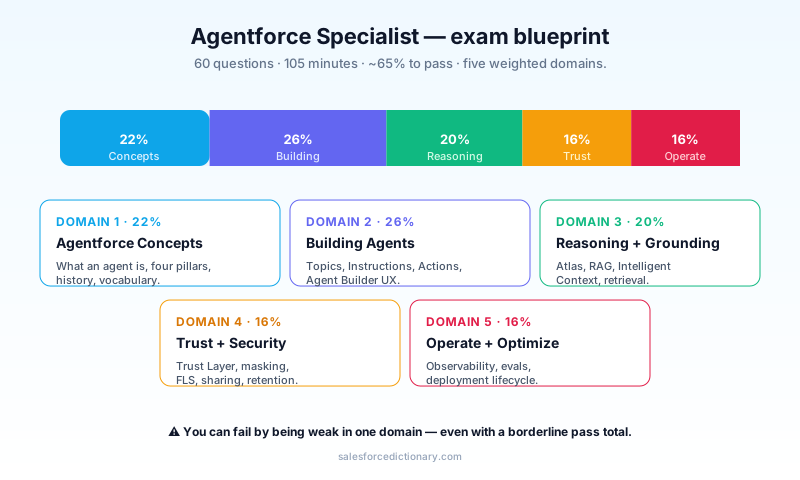
The 60 questions are spread across five weighted domains. The weighting matters because half-prepped candidates often skip a domain that's "small" and lose pass-by-domain margin.
| Domain | Weighting |
|---|---|
| 1. Agentforce Concepts (what an agent is, how it differs from a chatbot, the four pillars) | ~22% |
| 2. Building Agents (Topics, Instructions, Actions, Agent Builder UX) | ~26% |
| 3. Reasoning + Grounding (Atlas Reasoning Engine, RAG, Intelligent Context) | ~20% |
| 4. Trust + Security (Einstein Trust Layer, masking, FLS, sharing) | ~16% |
| 5. Operate + Optimize (Observability, evals, deployment lifecycle) | ~16% |
You can fail by being weak in any single domain, even if your total score is borderline pass. Don't skip domains.
Prerequisites: the two superbadges
The credential requires you to complete two hands-on superbadges on Trailhead before you can sit for the exam. These are not theoretical - you build real agents in scratch orgs, and the auto-grader checks your work.
Superbadge 1: Apex for Agentforce
Tests your ability to expose Apex classes as Agentforce Actions. You'll write @InvocableMethod classes, handle bulk requests, write test classes, and wire them into a working agent. Plan ~12 hours.
Superbadge 2: Advanced Flow for Agentforce
Tests Flow-as-Action skills: orchestration patterns, screen flows surfaced as agent actions, error handling, and using a Subflow for reusable steps. Plan ~10 hours.
Don't skip these or treat them as a checkbox. They map directly to ~30% of exam questions.
The 8-week study plan
This timeline assumes you're a working Salesforce pro spending ~5 hours per week. Adjust if you have less Salesforce background.
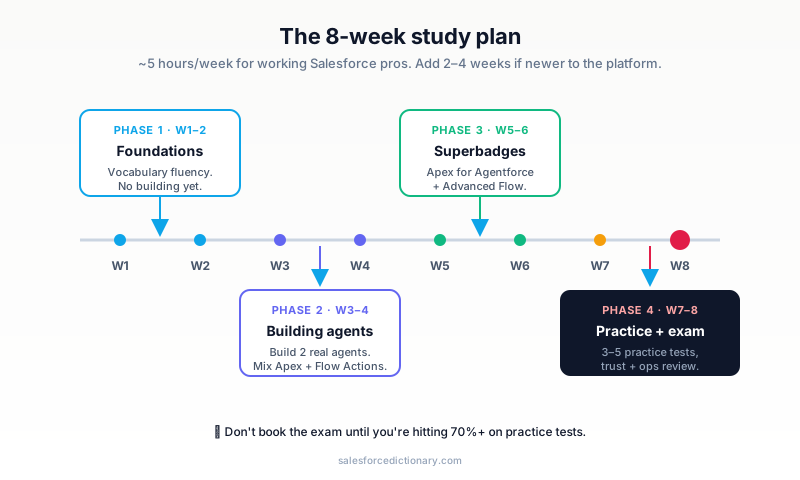
Weeks 1–2: Foundations
Read everything about Agentforce end-to-end. Don't try to build yet. The goal: vocabulary fluency.
- Read our What Is Agentforce 360? guide.
- Take the Agentforce Basics trail on Trailhead.
- Build a 5-page glossary of terms you can recite: Topic, Action, Instructions, Plan, Reason, Ground, Atlas, Trust Layer.
- Outcome: can explain an agent request flow to a non-technical colleague.
Weeks 3–4: Building agents
Hands-on. Spin up a Developer Edition org, enable Agentforce, build two real agents.
- Build agent #1: a basic Q&A agent with 3 Topics and 5 standard Actions.
- Build agent #2: a service-appointment-rescheduling agent that hits an Apex Action and a Flow Action.
- Take the Get Started with Agent Builder trail.
- Outcome: can build a working agent with mixed Apex + Flow actions in under 4 hours.
Weeks 5–6: Superbadges
Knock out Apex for Agentforce (week 5) and Advanced Flow for Agentforce (week 6). Don't peek at solution videos until you've genuinely struggled - the struggle is what teaches the patterns.
Week 7: Trust, Reasoning, Operations
Three smaller topics that together cover the back third of the exam.
- Read the Einstein Trust Layer glossary entry and the official Salesforce Architects decision guide.
- Read the Atlas Reasoning Engine entry and walk through the request lifecycle.
- Set up Agentforce Observability in your DE org. Generate ~20 traces. Read them.
- Outcome: can describe what the Trust Layer protects, name all four Atlas stages, and read an Observability trace.
Week 8: Practice + final review
The last week is purely test-prep.
- Take 3–5 practice exams (Trailhead practice + community quizzes).
- Re-do any superbadge step you struggled on.
- Review your domain-by-domain accuracy. Spend Friday on your weakest two domains.
- Sit the exam Saturday. Don't cram the morning of.
The four areas that fail otherwise-prepared candidates
Across hundreds of candidates I've helped, the same four pitfalls show up over and over. Watch for these.
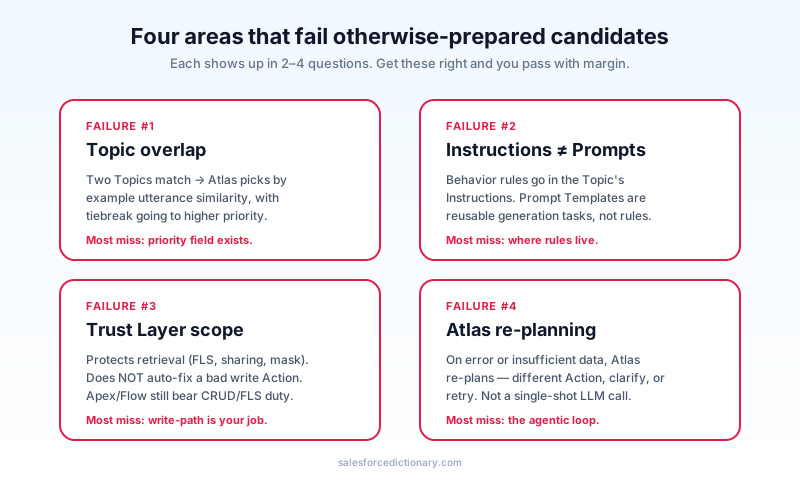
1. Topic overlap
Question pattern: "An agent has Topics A, B, and C. Both A and B can match user input X. What happens?"
The instinctive answer is "Atlas picks the best one." The correct answer involves the routing classifier picking by example-utterance similarity, with a tie-break going to the higher-priority Topic. Many candidates miss the priority field exists and that example utterances drive routing.
2. Instructions are not prompts
Question pattern: "Where should the rule 'Always ask for the customer's account number first' live?"
Wrong answer: in a Prompt Template called by the agent.
Right answer: in the Topic's Instructions. Instructions live with the Topic and govern the agent's behavior across all conversations. Prompt Templates are reusable templates for specific generation tasks, not behavior rules.
3. Trust Layer scope confusion
Question pattern: "Will the Trust Layer prevent an agent from updating a record the running user shouldn't be able to see?"
Wrong answer: yes - the Trust Layer covers all data security.
Right answer: yes for retrieval paths (fetched data is filtered by FLS and sharing) - but the agent's write actions are still gated by the standard CRUD/FLS checks of the Action implementation. If your Apex Action runs with sharing or honors FLS, you're safe. The Trust Layer doesn't auto-fix a bad Action.
4. Atlas re-planning
Question pattern: "An action returns an error or insufficient data. What does Atlas do?"
Wrong answer: returns a generic error to the user.
Right answer: Atlas can re-plan - try a different Action, ask a clarifying question, or retry. This "agentic loop" is what distinguishes an agent from a single-shot LLM call. Many candidates miss this concept.
Sample questions (with explanations)
Sample 1 (Domain 2: Building)
An admin creates an agent with three Topics: "Reset password," "Check order status," and "Reschedule appointment." They forget to add example utterances to "Reschedule appointment." What happens when a user types "I want to change my appointment time"?
- (A) The agent routes to "Reset password" by alphabetical fallback.
- (B) The agent fails to route to any Topic and returns the default behavior.
- (C) The agent routes to "Reschedule appointment" using the Topic name.
- (D) Atlas auto-generates example utterances on the fly.
Answer: B. Without example utterances, the routing classifier can't reliably match. Topic names alone are not enough. The agent falls back to its default behavior (which usually means a "I'm not sure I can help with that" response).
Sample 2 (Domain 3: Reasoning)
An agent grounded in Data Cloud returns inaccurate customer data. The data appears correct in Data Cloud directly. What's the most likely cause?
- (A) The Trust Layer is misconfigured.
- (B) Atlas is using cached responses.
- (C) Identity resolution is incomplete, so the agent retrieves a fragmented profile.
- (D) The foundation model is hallucinating.
Answer: C. Identity resolution gaps are the most common cause of "agent feels dumb" symptoms. The data exists; the unified profile assembly is wrong.
Sample 3 (Domain 4: Trust)
Which of the following does the Einstein Trust Layer NOT do automatically?
- (A) Mask configured PII fields before they leave the org.
- (B) Enforce zero data retention with foundation-model providers.
- (C) Prevent an Apex Action from updating a record the running user shouldn't be able to see.
- (D) Detect toxic content in model responses.
Answer: C. This is the most-missed question pattern. The Trust Layer protects data flow - masking, retention, retrieval-time security. It does not auto-fix a poorly-written Action that bypasses CRUD/FLS on writes.
Maintenance
The credential is valid for one year. Each release (Spring, Summer, Winter), Salesforce ships a maintenance module on Trailhead. You complete it (free, ~30 minutes) and your certification rolls forward.
If you skip a maintenance, your cert lapses and you have to retake the full exam - at full price. Set a recurring quarterly calendar reminder.
Common mistakes when scheduling the exam
- Booking too soon after the last superbadge. The superbadges teach mechanics; the exam tests recall. Give yourself a week of practice tests after finishing the second superbadge before booking.
- Online-proctored on a flaky internet connection. This fails more candidates than knowledge gaps. Test your connection beforehand or just go to a test center.
- Forgetting that questions are situation-based. Memorizing definitions doesn't work. Almost every question is a scenario; you're picking the best answer, not the textbook one.
Frequently asked questions
Do I need Apex and Flow experience to pass? Yes - the two superbadges require both. If you've never written Apex, plan extra weeks for foundations.
Is Einstein Copilot on the exam? Only as historical context. Active questions are on Agentforce / Atlas. Know the rebrand chronology.
How realistic are practice tests? The official Trailhead practice exam is the most accurate. Community quiz sites vary wildly in quality.
What if I fail by 1 or 2 questions? Schedule a retake within 2 weeks while context is fresh. Pay the $100. Don't restart studying from scratch - fix the weak domain only.
Will the exam evolve as Agentforce 360 grows? Yes. Watch the Trailhead credential page each release for blueprint changes. Material added in a release usually lags 60–90 days before appearing on the exam.
What to read next
- What Is Agentforce 360? - the conceptual foundation; covers ~30% of the exam blueprint.
- Atlas Reasoning Engine and Einstein Trust Layer - the two glossary entries you must read cover-to-cover.
- Topic, Agent Builder, Prompt Builder - the building blocks.
- Trailhead credential page - book the exam from here.
If you only do one thing: build a real agent end-to-end in a DE org before sitting the exam. The questions are written by people who build agents, not people who memorize specs. The gap shows.
About the Author
Dipojjal Chakrabarti is a B2C Solution Architect with 29 Salesforce certifications and over 13 years in the Salesforce ecosystem. He writes and edits salesforcedictionary.com, published by KineticBit Inc., to help admins, developers, architects, and cert/interview candidates sharpen their fundamentals. More about Dipojjal.
Share this article
Sources
Related dictionary terms
 Our appAdWake up sharp. Not just awake.The alarm that rings through Silent and DND — free on iOS & Android.Get WakeSharp →
Keep reading

Data Cloud Is Now Data 360: What Actually Changed (and Why It Matters)
Data Cloud became Data 360 in October 2025. Beyond the rename: Zero-Copy Federation, Tableau Semantics, the Lakehouse, and a new credit model. Here's the full picture.

What Is Agentforce 360? The Complete 2026 Guide for Salesforce Admins, Developers & Architects
Agentforce 360 is Salesforce's 2025 rebrand of its agentic-AI platform - built on the Atlas Reasoning Engine, Einstein Trust Layer, and Data 360. Here's the complete admin + dev + architect guide.


Comments
No comments yet. Start the conversation.
Sign in to join the discussion. Your account works across every page.