
Salesforce Technical Debt in the Vibe-Coding Era: The 2026 Cleanup Playbook
AI builders now ship automation faster than any team can review it, and Agentforce turns that backlog of debt into live incidents instead of slow-burn annoyances.

You type a sentence into a natural-language Flow builder, it hands you a working lead-routing automation in ninety seconds, and you deploy it before your coffee gets cold. Nobody wrote a spec. Nobody documented why the routing rules are what they are. The record IDs it referenced got baked straight into the logic. Six months later an Agentforce agent reads that Flow as a trusted building block and starts routing real deals through it at machine speed. That is the moment your convenience becomes your incident.
This is the story of 2026 in the Salesforce ecosystem. Building got radically faster. Understanding what you built did not. And the gap between those two things now has a name that shows up in headlines: technical debt.
Why 2026 Is Suddenly the Year of Technical Debt
Technical debt is not new. Every org that has been live for more than a year carries some. What changed is the rate of accumulation and the cost of ignoring it.
Salesforce Ben ran a piece at the end of 2025 calling 2026 the year of technical debt, and pinning the blame on vibe-coding: AI-assisted builders that let anyone ship functional automation without necessarily understanding it. The framing is blunt and correct. Paul Battisson, a Salesforce MVP and CEO of Groundwork Apps, put it plainly in that piece: "If you can build things faster, that doesn't necessarily mean you're going to build better things faster." Speed is not quality. Speed is just speed.
The same article quotes CRM advisor Gabie Caballero on the danger of rushed AI adoption. Teams that cut corners now, she warns, will eventually have to "go back out and rehire everybody" to fix what they broke. That is the whole trap in one sentence. The corner you cut today gets paid back later at a much worse exchange rate, usually by someone who was not in the room when the shortcut was taken.
The underlying theme across the ecosystem is consistent: data quality and automation quality problems are the thing stopping companies from getting real value out of AI. You cannot point an autonomous agent at a messy org and expect clean outcomes. Vibe-coding tools accelerate development, and in doing so they quietly reward corner-cutting, because the corner you cut is invisible until something acts on it.
The Numbers Are Worse Than the Vibe
If you think this is overblown, the survey data disagrees. In Salesforce Ben's State of the Salesforce Admin Role in 2026, technical debt is the single biggest challenge admins name for the year. Not integrations. Not release management. Debt.
Here is what the responses actually said:
- 56.3% of admins identify technical debt as their biggest challenge in 2026.
- Only 2% report their org is clean and well-maintained.
- 47% describe their debt as manageable.
- 31% say it is severe enough to impede daily work.
Sit with that 2% for a second. Ninety-eight percent of admins are carrying debt they know about, and roughly a third are actively slowed down by it every day. This is not a niche problem for messy orgs. This is the median experience of running Salesforce right now.
There is also an experience gap that matters for how you staff and train. Only 13% of entry-level admins feel confident managing technical debt, compared with 44% of advanced admins. The report sums up the dynamic in a line worth taping to your monitor: "Complexity builds faster than it is cleaned up." That single sentence is the whole velocity problem.
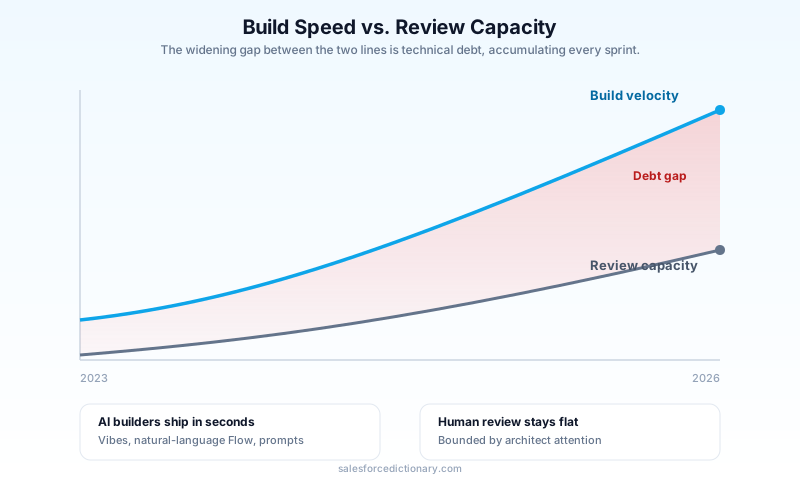
The picture is simple and uncomfortable. The line for how fast you can ship keeps climbing because the tools keep improving. The line for how fast you can review, document, and govern stays roughly flat, because it is bounded by human attention. The area between those two lines is your debt, and it grows every sprint you do not actively manage it.
Why Agentforce Changes the Math
For most of Salesforce history, technical debt was a slow-burn tax. A sprawling object model made reports slower to build. An undocumented Flow made the next admin nervous. A hardcoded ID broke a sandbox refresh. Annoying, expensive over time, rarely an emergency.
Autonomous agents end that grace period.
An Agentforce agent does not browse your org the way a cautious human does. It reads your data, your fields, and your automation as trusted inputs, then acts on them without waiting for anyone to sanity-check the result. When the underlying metadata is clean, that is a superpower. When it is not, the agent executes your debt at machine speed, across many records, before anyone notices.
Think about what that does to each classic category of debt. A duplicate account that used to cause a mildly wrong report now causes an agent to take a real action against the wrong record. A hardcoded record ID that used to fail quietly in a sandbox now sends an agent down a dead path in production. Permission sprawl that used to be an audit headache now defines what an autonomous actor is allowed to touch. The debt did not get bigger. The blast radius did.
This is exactly why clean data stopped being a reporting nicety and became an operational prerequisite. Salesforce's own Data Quality documentation frames accurate, complete, standardized records as the foundation for trusting what the system does with them. That guidance was written for humans making decisions. It matters far more when the thing making decisions never sleeps, never second-guesses a weird value, and acts in bulk. An agent is only ever as reliable as the worst record it touches.
Where the Debt Actually Hides
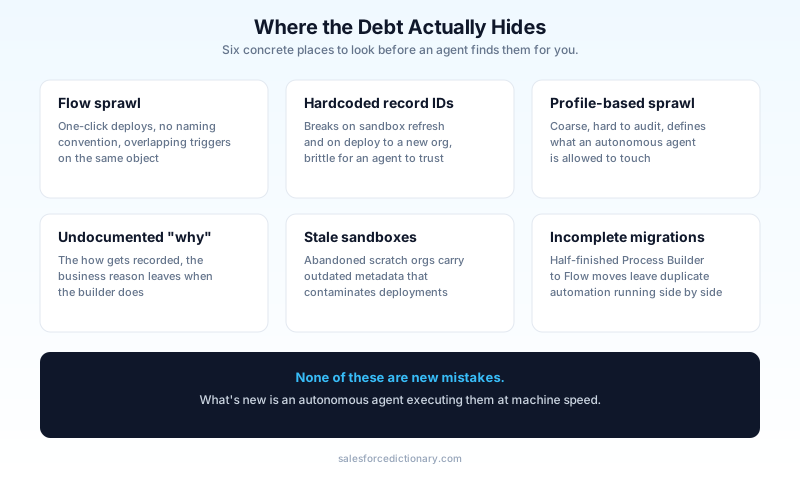
Abstract debt is easy to nod along to and impossible to fix. So let us get specific about where it actually lives in a real org in 2026.
Flow Sprawl
Flow won. After Workflow Rules and Process Builder were retired, Flow became the default automation tool, and it deploys with one click. That combination is a sprawl machine. Digital Mass made the argument sharply in a 2026 piece: Flow is probably the right tool for roughly 70% of automation use cases, and the remaining 30% might genuinely need Apex or another approach. Forcing that last 30% into Flow because it is the path of least resistance is not a convenience. It is a debt-creation pattern with a friendly UI.
You will feel this the first time you open an org with two hundred active Flows and no naming convention. Which ones fire on Account update? Which overlap? Which one is the agent about to trust? Nobody knows without a spelunking expedition.
Hardcoded Record IDs
This is the oldest mistake in the book and vibe-coding tools reintroduce it constantly, because pasting a literal ID is the shortest path to a working demo. Hardcoded IDs break on sandbox refresh, break on deployment to a new environment, and give an autonomous agent a brittle reference that points at nothing the moment data moves.
Profile-Based Permission Sprawl
If your access model still leans on Profiles rather than Permission Sets and Permission Set Groups, you have debt that is now a security surface. Profiles are coarse and hard to audit. When an agent acts on behalf of a user, the permission model decides the boundary of what that agent can do. Coarse, undocumented access is a bad thing to hand an autonomous actor.
Undocumented "Why"
Most orgs document the how, if anything, and almost never the why. A Flow named Account_Update_2 tells you nothing about the business decision it encodes. When the person who built it leaves, the reasoning leaves with them, and every future change becomes a guess.
Stale Sandboxes and Scratch Orgs
Old sandboxes and abandoned scratch orgs carry outdated metadata that contaminates deployments and testing. They are cheap to create and easy to forget, which is precisely why they pile up.
Incomplete Migrations
Half-finished Process Builder to Flow migrations leave duplicate, overlapping automation running side by side. Two automations firing on the same trigger, doing subtly different things, is a bug waiting for the right record to expose it.
The Real Risk of Vibe-Coding Is Not Bad Logic
Here is the part people get wrong. The danger of AI-generated automation is not that the AI writes bad logic. Modern builders often write perfectly reasonable logic. The danger is that they let a person ship without anyone being forced to understand or document what shipped.
Every traditional build had friction that doubled as a checkpoint. Writing the Apex made you understand it. Clicking through the Flow made you reason about each element. That friction was annoying, and it was also where comprehension happened. Vibe-coding removes the friction, and with it removes the moment where a human was quietly forced to think.
Review capacity does not scale at the rate build velocity does. One architect can review a fixed amount per week no matter how fast the tools get. So the more you lean on natural-language builders without a gate, the more undocumented automation you ship past a review function that was already at capacity. Treat AI as a co-pilot, not an autopilot. The co-pilot drafts. A human still has to understand what gets committed.
The 2026 Cleanup Playbook
Enough diagnosis. Here is the concrete work, drawn from the ecosystem's best current guidance and reframed as steps you can actually run.
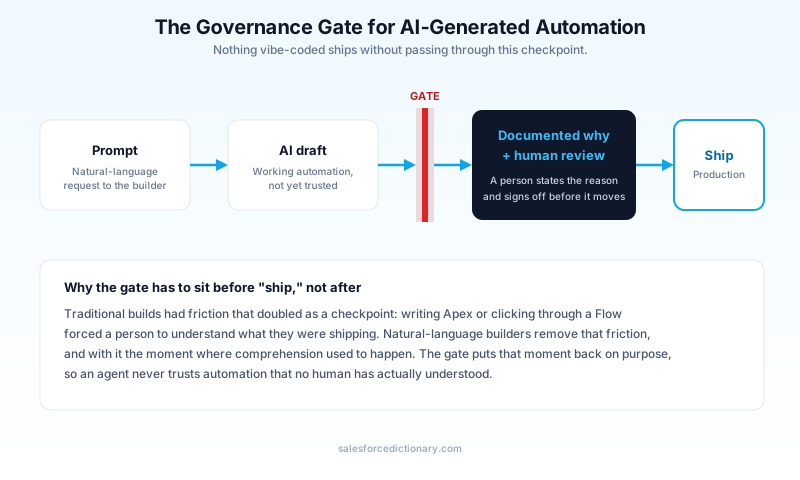
- Put a gate between AI draft and production. Nothing vibe-coded ships without passing through documented reasoning and a human review. Prompt produces a draft. The draft gets a written why. A person reviews it. Only then does it ship. The gate is the whole point.
- Document the why, not just the how. For every automation, record the business reason it exists in a place the next admin will find. If you cannot state why it exists, that is a candidate for deletion, not preservation.
- Ban hardcoded record IDs. Replace every literal ID with a dynamic lookup, a Custom Metadata Type, or a Custom Setting. This alone removes a whole class of environment-specific breakage.
- Migrate from Profiles to Permission Sets. Move to Permission Sets and Permission Set Groups for granular, auditable access. Do this before you widen what agents can act on, not after.
- Run sandbox and scratch org hygiene. Delete stale sandboxes and abandoned scratch orgs on a schedule so outdated metadata cannot contaminate real deployments.
- Choose the tool on fit, not on speed. Evaluate Flow versus Apex versus an AgentExchange solution on what the problem actually needs. Do not default to whatever is fastest to click together. Remember the 70/30 split.
- Finish your migrations. Hunt down duplicate and overlapping automation left over from incomplete Process Builder to Flow moves, and retire the redundant one.
- Book dedicated maintenance time. Allocate real, recurring capacity to cleanup instead of only shipping new features. Debt you never schedule is debt you never pay.
Work that list top to bottom and you will already be ahead of the 98% of orgs that admit they are not clean.
My Take, and What to Do This Week
I think 2026 is the year the bill comes due, and I think that is a good thing. For years technical debt was a problem everyone acknowledged and nobody was funded to fix, because it never quite became an emergency. Agentforce removes that excuse. When an autonomous agent can turn a sloppy Flow into a customer-facing action in seconds, the business finally has a reason to care about the plumbing. Use that. The urgency is your budget.
So this week, do one small, concrete thing. Open your org, sort your Flows by last modified date, and pick the five oldest active ones that still fire on your most important objects. For each one, answer a single question in writing: why does this exist, and what happens if an agent trusts it tomorrow. If you cannot answer, you just found your first debt to pay down. Start there, before an agent finds it for you.
About the Author
Dipojjal Chakrabarti is a B2C Solution Architect with 29 Salesforce certifications and over 13 years in the Salesforce ecosystem. He writes and edits salesforcedictionary.com, published by KineticBit Inc., to help admins, developers, architects, and cert/interview candidates sharpen their fundamentals. More about Dipojjal.
Share this article
Sources
Related dictionary terms
Practise it
Five questions on Platform Developer I
Exam-style questions with an explanation after each one. No account needed, and your answers build a weak-topic map once you have one.
Keep reading

Process Builder to Flow Migration: The Complete 2026 Playbook
Salesforce retired Process Builder and Workflow Rules. Here is the 2026 migration playbook: audit your processes, map them to the right flow type, handle every gotcha, and test before the cutover.

Agentforce Vibes and React on Salesforce
Agentforce Vibes 2.0 and the Multi-Framework runtime let you build native React apps on Salesforce from natural language. Here is how the workflow, the SDK, and the beta limits actually work in 2026.

Salesforce DevOps Tools Compared: DevOps Center vs Gearset vs Copado vs AutoRabit (2026)
DevOps Center, Gearset, Copado, and AutoRabit all ship Salesforce metadata. They're not interchangeable. Feature matrix, pricing, decision tree, and the migration paths between them.

Salesforce Governor Limits Explained: The 2026 Cheat Sheet (with Examples)
The canonical 2026 cheat sheet: SOQL/DML/CPU/heap limits, sync vs async, the most-hit limits in production, and 10 patterns to keep your org out of the red.
Comments
No comments yet. Start the conversation.
Sign in to join the discussion. Your account works across every page.