
Salesforce Revenue Cloud: The Complete 2026 Guide (RCA, Agentforce Revenue Management & Quote-to-Cash)
The RCA architecture, Product Catalog Management, Pricing Procedure, Transaction Line Items, the legacy CPQ migration path, and the Spring '26 Promotions Engine.
You open the legacy CPQ quote, click Calculate, and the spinner sits for fourteen seconds before a Visualforce timeout drops you back to the Quote header with no error you can act on. The quote has 412 lines, three nested bundles, and a discount schedule with tiered cumulative pricing. It worked last quarter at 380 lines. It does not work now. Your account exec needs the proposal in twenty minutes.
That is the moment a lot of Salesforce orgs hit in 2025 and 2026, and it is the moment that drives the entire Revenue Cloud rewrite.
The product you used to call Salesforce CPQ is now part of Revenue Cloud Advanced. Revenue Cloud itself is now branded Agentforce Revenue Management as of the Spring '26 release. Legacy CPQ (the managed package) is end-of-sale for new customers. The platform under it is rebuilt: native to Core, API-first, with a constraint-solver-based configurator, a new pricing engine, and Transaction Line Items that replace the old SBQQ__QuoteLine__c.
This guide covers the whole thing. The architecture, the data flow, the migration from legacy CPQ, what the Agentforce Revenue Management Agent actually does, and the implementation order for a brand-new org.
What "Revenue Cloud" means in 2026
Revenue Cloud is not a single product. It is the umbrella name for Salesforce's full revenue lifecycle stack:
- Product Catalog Management (PCM) - the shared product and pricing model
- Salesforce Pricing - the native pricing engine with Pricing Procedures
- Product Configurator - constraint-solver-based product configuration
- Quoting (Transaction Line Editor) - the modern quote experience
- Order Management - converting quotes to fulfillable orders
- Subscription Management - recurring revenue, renewals, amendments
- Billing - invoicing, payments, dunning, collections
- Revenue Recognition - automated rev-rec aligned with ASC 606 and IFRS 15
When you bought "Salesforce CPQ" three years ago, you bought a managed package that handled configure-price-quote. When you buy Revenue Cloud Advanced (RCA) today, you buy a native platform that handles all eight of the above.
The Spring '26 release renamed the bundle to Agentforce Revenue Management to signal that AI is now first-class across the entire flow. The legacy name still appears in some doc pages and partner sites. They are the same product.
What changed for legacy CPQ customers
Salesforce moved legacy CPQ to end-of-sale status for new customers in 2024. Existing CPQ orgs are still supported, but the innovation roadmap is RCA-only. If you are starting fresh in 2026, you are going on RCA. If you are on CPQ Plus today, your migration window is open but the clock is running. The CPQ pillar at salesforce-cpq-complete-2026-guide-revenue-cloud covers the legacy product in depth; this post covers the platform that replaces it.
The RCA architecture
The simplest way to see RCA is as four layers stacked over the Salesforce Core platform.
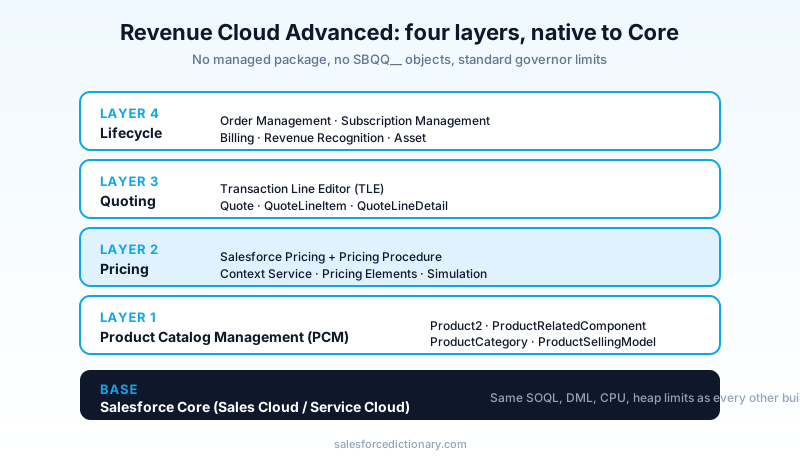
Layer 1: Product Catalog Management. PCM stores the products, bundles, attributes, and relationships. The Product2 object is still the foundation. What changed is the surrounding shape: ProductRelatedComponent defines bundle hierarchy, ProductCategory and ProductCategoryProduct define the catalog tree, and ProductSellingModel defines how a product is sold (one-time, subscription, usage). PCM is shared across Sales Cloud, Service Cloud, and Industries clouds, so a product defined once is sellable everywhere.
Layer 2: Pricing. Salesforce Pricing replaces the old CPQ price waterfall. Instead of price rules that fire in sequence with mutating state, you build a Pricing Procedure: a named, ordered list of pricing elements (List Price, Adjustment, Discount, Tax, Total) where each element takes context as input and emits a price as output. The next element consumes that output. The whole thing is declarative and inspectable.
Layer 3: Quoting (Transaction Line Editor). The Transaction Line Editor (TLE) is the modern quote UI. It replaces the legacy CPQ Quote Line Editor (QLE). Behind it sits a new data model: Quote is still the parent, but each line is a QuoteLineItem that breaks down into QuoteLineDetail records. QuoteLineDetail is the new shape that captures pricing math, quantity changes, repricing during amendments, and bundle reconfiguration deltas.
Layer 4: Lifecycle. Once a quote is accepted, it converts to an Order. Once the order is fulfilled, Assets are created. Assets drive renewals, amendments, and consumption. Billing reads assets and generates Invoices. Revenue Recognition reads orders and recognizes revenue against the right ASC 606 obligations.
Everything is on Core. No managed package. No SBQQ__ prefixed objects. No separate governor limit ceiling. You get the same SOQL limits as the rest of your Sales Cloud build.
The pricing engine in detail
The Pricing Procedure is the piece most legacy CPQ admins will spend the longest understanding, because it is fundamentally different from price rules.
A Pricing Procedure looks like this when you author it:
- List Price Element - look up the catalog list price for the product and selling model
- Volume Discount Element - apply tiered volume discount based on quantity
- Customer-Specific Discount Element - apply contract-specific override if one exists
- Promotion Element (Spring '26) - apply the highest-priority eligible promotion
- Tax Element - compute tax based on jurisdiction
- Total Element - sum everything to produce final price
Each element is a standalone unit. You can write custom elements in Apex when needed, but the out-of-the-box library covers most cases. The Context Service feeds each element the inputs it needs (product, account, contract, channel) and routes outputs to the next element. There is no shared mutable state. There is no order-of-operations bug that lives in a custom Apex price rule that runs before another custom Apex price rule.
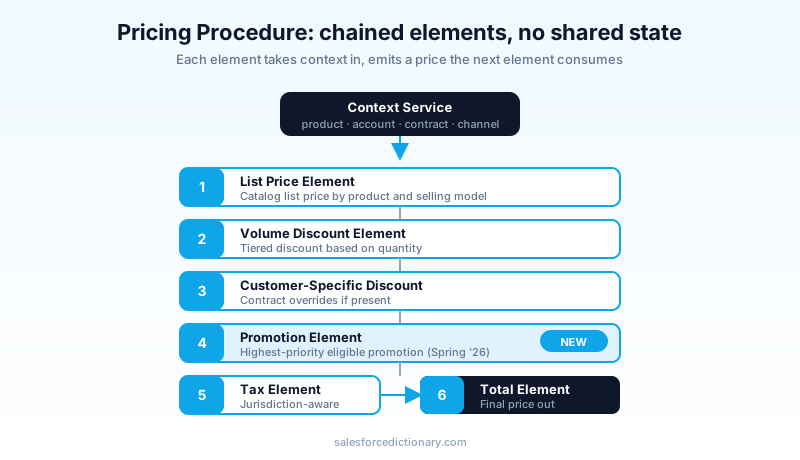
You debug a Pricing Procedure by running it in simulation mode with a sample context. The engine returns the price plus every intermediate value. The first time you migrate a complex pricing scenario and watch the engine show you exactly which element changed the price, you will feel the difference from the CPQ price waterfall.
The Promotions Engine (Spring '26)
The native Promotions Engine is the biggest functional addition in Spring '26. You define promotion eligibility (customer segment, channel, product, time window), promotion stacking rules (which promotions can combine, which override others, which are hierarchical), and the promotion math (percentage off, fixed amount off, buy-N-get-M, bundle discount). The engine evaluates eligible promotions during the Pricing Procedure run.
Before Spring '26, promotions were a hand-rolled mess of price rules, validation rules, and Apex. Now they are first-class objects with their own UI and their own audit trail.
The Quote-to-Cash lifecycle
The full data flow from opportunity to recognized revenue looks like this:
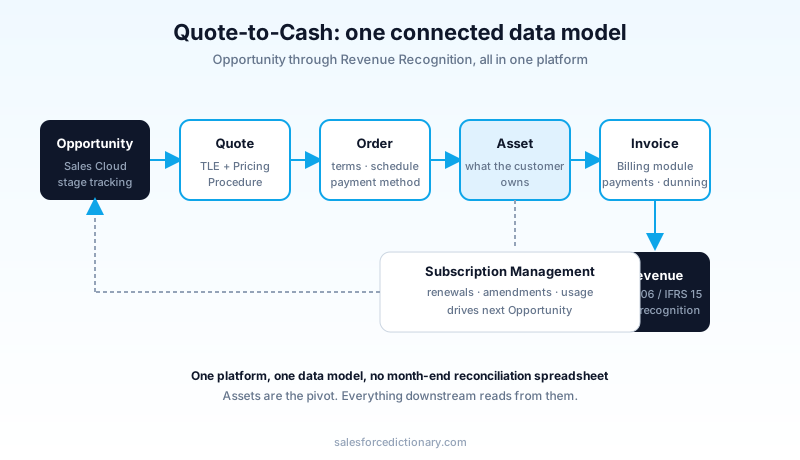
You build a quote from an opportunity. The quote runs the Pricing Procedure. The customer accepts. The accepted quote converts to an order (with terms, schedules, payment method). The order fulfills. Fulfilled lines become Assets. Assets are the thing the customer owns: a subscription, a one-time purchase, a usage entitlement.
Assets drive everything downstream. They drive renewals (Subscription Management reads them and generates renewal opportunities at the right cadence). They drive amendments (when the customer changes the subscription, you amend the asset and the new pricing flows through). They drive consumption tracking (for usage-based products, the asset accumulates usage events that bill at the end of the period).
Billing reads the assets and the consumption events, generates Invoices, applies payment terms, runs dunning if payment is late, and posts to the accounting system. Revenue Recognition reads the orders and recognizes revenue against the right performance obligations on the right schedule, in line with ASC 606 and IFRS 15.
The whole flow is one connected data model in one platform. The reason this matters is that the failure mode of the old stack was data drift: CPQ knew what was sold, but the billing system in another tool knew what was invoiced, and the rev-rec system in a third tool knew what was recognized. Three sources of truth, reconciled in a spreadsheet at month-end. RCA collapses that to one.
Performance and governor limits
The reason a 412-line legacy CPQ quote times out is structural. CPQ ran as a managed package, which meant its calculations consumed shared SOQL queries, DML rows, CPU time, and heap, all measured against the org's standard governor limits but with the package's own framework code already eating a fixed slice of each limit before your first price rule ran. Add a few custom price rules, a complex discount schedule, and a few large bundles, and the calc would run out of one of the four limits long before it ran out of lines.
RCA does not have that overhead. It is native to Core. The Pricing Procedure is structured so each element runs against a context object, and the engine can parallelize independent elements. The Context Service caches frequently used lookups (account, contract, price book) so the same SOQL does not fire ten times in the same calc. The runtime uses bulk-safe patterns by default, not as an afterthought.
The practical effect: legacy CPQ tends to start failing past around 250 to 300 lines depending on bundle complexity. RCA handles four-figure line counts in a single quote without timing out. The exact ceiling depends on what your Pricing Procedure does, but the headroom is at least 5x.
The honest caveat: governor limits still exist. If you write a custom Pricing Element that fires a SOQL query per line for 1000 lines, you will still hit the SOQL limit. The difference is that RCA's out-of-the-box elements are bulk-safe, where CPQ's were a mix.
Legacy CPQ to RCA: the migration playbook
If you are on CPQ Plus today, the migration is not a flag flip. It is a data model rewrite, a pricing logic rewrite, and a UX retraining for every sales user. Plan it like a re-implementation, not an upgrade.
Step 1: Inventory. Catalog every CPQ object you actually use. SBQQ__Quote__c, SBQQ__QuoteLine__c, SBQQ__ProductOption__c, SBQQ__PriceRule__c, SBQQ__ConfigurationAttribute__c, plus every custom field on every one. Most CPQ orgs have 200+ custom fields on QuoteLine alone. You will not migrate all of them. Decide which are load-bearing and which are crust.
Step 2: Map the data model. Legacy CPQ objects do not map one-to-one to RCA objects. SBQQ__QuoteLine__c becomes Transaction Line Items, but the structure is different: line-detail breakdown lives on QuoteLineDetail records rather than calculated fields on the line itself. Bundle hierarchy moves from SBQQ__RequiredBy__c references to ProductRelatedComponent records.
Step 3: Rebuild pricing as Pricing Procedures. This is the longest step. Every CPQ price rule, every CPQ discount schedule, every custom Apex price plug-in has to be restated as a Pricing Procedure or a custom Pricing Element. The good news: the new engine forces you to think about pricing as a chain, which usually surfaces dead price rules nobody has touched in five years.
Step 4: Rebuild configuration as constraint definitions. The legacy CPQ configurator runs configuration attributes and product rules in a fixed sequence. The RCA Product Configurator uses a constraint solver: you declare what is valid, the engine works out the rest. You will rewrite your option dependencies as constraints. The constraint-solver model is more powerful, but it is genuinely different to author.
Step 5: Migrate historical quotes. Most customers freeze historical CPQ quotes (read-only) and start new quotes on RCA. Migrating active quotes mid-flight is doable but high-risk. The standard recipe: cutover at quarter-end, freeze CPQ, run net-new on RCA, and only migrate quotes that need to convert to renewals.
Step 6: Retrain. The TLE looks and feels different from the QLE. Reps will need a working session before they trust it.
A reasonable migration timeline for a 200-rep org with moderate CPQ complexity is 6 to 9 months. Aggressive cutover is 4 months. Anyone selling you a 60-day RCA migration is selling you a future ticket queue.
Agentforce Revenue Management Agent
The Spring '26 rebrand to Agentforce Revenue Management is not cosmetic. There is a working agent inside the platform. You give it a natural-language ask, it builds the quote.
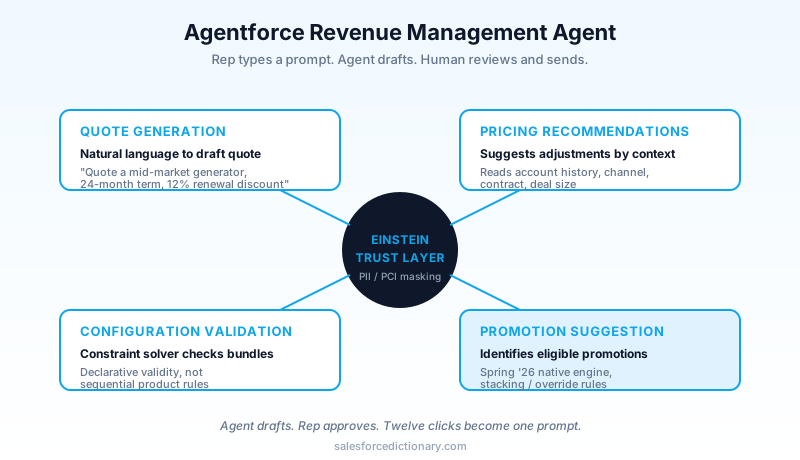
The flow looks like this in practice. A rep types "Quote a new mid-market generator with the usage-based energy pack, 24-month term, 12% volume discount for renewal customers." The agent:
- Resolves "mid-market generator" against the catalog (PCM lookup with the rep's territory context)
- Resolves "usage-based energy pack" as a child component
- Configures the bundle, validates against constraints
- Runs the Pricing Procedure with the 24-month term and the volume discount
- Checks promotion eligibility and suggests applicable promotions
- Drops the resulting Transaction Line Items into a draft quote for the rep to review
The agent does not commit anything autonomously. It drafts. The rep reviews and clicks Send. This is the right design: the agent reduces the busywork from twelve clicks to one prompt, but the human is still the one who approves the price the customer sees.
The agent runs on top of the Einstein Trust Layer, so prompts and pricing context never leave the trust boundary, and outputs are masked according to the org's PII and PCI rules.
Agentforce for Revenue is in active rollout. If you are evaluating it, ask your AE for the Revenue Events allocation and the per-user agent license cost; both are negotiable and both vary by region.
When NOT to use Revenue Cloud Advanced
RCA is not a small thing. If you sell five SKUs at fixed prices with monthly invoices that match the SKU price exactly, you do not need RCA. Use the standard Opportunity to Quote to Order flow in Sales Cloud. The annual license cost of RCA outweighs the rep-time savings until your average quote has at least one of: configurable bundles, multi-line discounts, tiered pricing, recurring schedules, or contract amendments.
Specific cases where RCA is the wrong call:
- Pure transactional B2C. If you ship physical SKUs at catalog price with no contracting, use Commerce Cloud.
- Single-line subscription. If 90% of your deals are "buy our $X/user/month SaaS for Y users for 12 months," your existing Sales Cloud opportunity plus a custom renewal flow is probably enough.
- Internal-only quoting. If quotes never leave the building (intra-company recharge models), the overhead of RCA is not worth it.
The threshold I have seen hold up: if a typical quote has more than ten lines, or any kind of bundle configuration, or any contracting that creates obligations downstream, RCA pays back. Below that, the simpler stack is faster to build and cheaper to run.
Implementation order for a brand-new RCA org
For a fresh implementation, the cleanest sequence is:
Day 1 to Day 30: Foundation. Assign permission set licenses, configure Revenue Settings, set up the catalog hierarchy in PCM, create the first ten products with selling models and price book entries. Get the catalog tree right before adding anything else. Catalog mistakes compound.
Day 30 to Day 60: Pricing. Build the first Pricing Procedure end-to-end for the simplest product. Get it working in simulation mode. Add a second Pricing Procedure for a more complex product. Resist the temptation to build the "ultimate" Pricing Procedure on day one. Build small, working procedures, then compose.
Day 60 to Day 90: Quoting. Wire up the Transaction Line Editor. Add the first configurator constraint set. Train a small group of reps on the new flow. Watch where they get stuck.
Day 90 onward: Lifecycle. Layer in Order Management, then Subscription Management, then Billing. Most orgs leave Revenue Recognition until they are confident the upstream data is clean, because rev-rec amplifies any upstream error directly into the financial statements.
The platform was originally built on OmniStudio primitives (Industries cloud lineage), so familiarity with FlexCards, OmniScripts, and DataRaptors helps when you start extending the UI. The OmniStudio guide is worth reading before you go past the out-of-the-box screens.
If you are deciding whether to stand RCA up at all, the prior decision is usually Sales Cloud vs Service Cloud, since RCA sits on top of one of them.
What to do this week
If you are on legacy CPQ today: open Setup, search "Revenue Cloud", and check whether your org has the RCA license already provisioned. Many orgs got RCA bundled into recent renewals without their admin team noticing. If it is there, spin up a sandbox and rebuild your simplest product on it. One product, one Pricing Procedure, one quote. That is your real assessment of migration effort, not a vendor estimate.
If you are starting fresh in 2026: do not buy Salesforce CPQ. It is end-of-sale. Buy RCA, plan the 90-day foundation above, and use the legacy CPQ pillar only as a historical reference for what the old model looked like.
If you are evaluating Agentforce Revenue Management Agent: get a 30-day trial allocation of Revenue Events, build one Pricing Procedure end-to-end, and let two reps use the agent for a week. The number that matters is "minutes saved per quote", and you will only learn it by running it.
About the Author
Dipojjal Chakrabarti is a B2C Solution Architect with 29 Salesforce certifications and over 13 years in the Salesforce ecosystem. He writes and edits salesforcedictionary.com, published by KineticBit Inc., to help admins, developers, architects, and cert/interview candidates sharpen their fundamentals. More about Dipojjal.
Share this article
Sources
Related dictionary terms
Practise it
Five questions on Agentforce Specialist
Exam-style questions with an explanation after each one. No account needed, and your answers build a weak-topic map once you have one.
Keep reading
OmniStudio Explained: FlexCards, OmniScripts, DataRaptors & Integration Procedures
OmniStudio is the low-code stack inside Salesforce Industries Cloud. Here's the complete pillar guide - FlexCards, OmniScripts, DataRaptors, Integration Procedures, plus when to pick it over Flow + LWC.

Salesforce Sales Cloud vs Service Cloud: Which Do You Need in 2026?
Sales Cloud and Service Cloud share a platform but solve different problems. Here is the 2026 comparison. Features, pricing, decision scenarios, and how Agentforce fits both.

Salesforce CPQ: Complete 2026 Guide (Configure, Price, Quote → Revenue Cloud)
The complete 2026 guide to Salesforce CPQ - Quote/Quote Line data model, product configuration, pricing engine, contracting, renewals, the migration to Revenue Cloud, and Agentforce for quoting.
Comments
No comments yet. Start the conversation.
Sign in to join the discussion. Your account works across every page.