
Salesforce Missionforce Explained: The National Security Unit Behind the $5.6B Army Deal
What Missionforce actually is, the Government Cloud compliance stack underneath it, how the $5.6B Army contract works, and what the defense push means for your career

A recruiter messages you about a Salesforce architect role paying well above your current band. Two lines down comes the catch: active security clearance required, on-site in the DC area, experience with Government Cloud Plus preferred. Eighteen months ago that combination barely existed as a job description. Then Salesforce built Missionforce, signed a $5.6 billion contract with the U.S. Army, and put a $13.5 billion Air Force vehicle fleet on the platform. Now the cleared Salesforce market is one of the fastest-moving corners of the ecosystem, and most practitioners still could not explain what Missionforce actually is.
This guide fixes that. What the unit does, what runs underneath it, how the contracts are structured, and what the whole defense push means if you build on Salesforce for a living.
What Missionforce actually is
Salesforce announced Missionforce on September 16, 2025 as a dedicated business unit for defense, intelligence, and aerospace customers. It is led by Kendall Collins, the CEO of Salesforce Government Cloud, who joined the company in 2023 after earlier stints as chief business officer and chief of staff to Marc Benioff. The unit concentrates on three problem areas: personnel management, logistics, and decision support.
Read that list again, because it explains the strategy. Salesforce is not trying to build targeting systems or sensor fusion. It is going after the unglamorous middle of military operations: who is available for duty, where the equipment is, which requests are stuck, and what a commander needs to know before signing off on a decision. That work looks a lot like CRM. Cases, assets, approvals, dashboards. Salesforce has sold that motion to insurance companies and telecoms for two decades. Missionforce repackages it for organizations that measure inventory in fighter squadrons.
The launch coverage gave concrete examples of what the AI layer is supposed to do in that context: model force availability, automate supply and maintenance workflows, and generate decision briefs where every claim traces back to evidence in the underlying records. That last one deserves attention. Traceability is a nice-to-have in commercial AI deployments. In a military decision chain it is the difference between a tool officers are allowed to use and one they are not.
One structural detail matters more than the branding. Defense deals run through Computable Insights LLC, a wholly owned Salesforce subsidiary dedicated to national security work. Separate legal entities like this are standard practice for classified and controlled environments because they contain personnel, facility, and data-handling requirements that a global SaaS company cannot apply to its entire workforce. When you see Missionforce contract announcements, that subsidiary is the party on the paper.
The timing is not subtle either. OpenAI, Anthropic, and Google all launched government-specific AI offerings in 2025, some priced at a dollar a year to win adoption. Palantir's commercial rise made "software company as defense prime" a viable category. Salesforce watched an entire market form around selling AI to the Pentagon and decided its agent platform, Agentforce, needed a seat at that table.
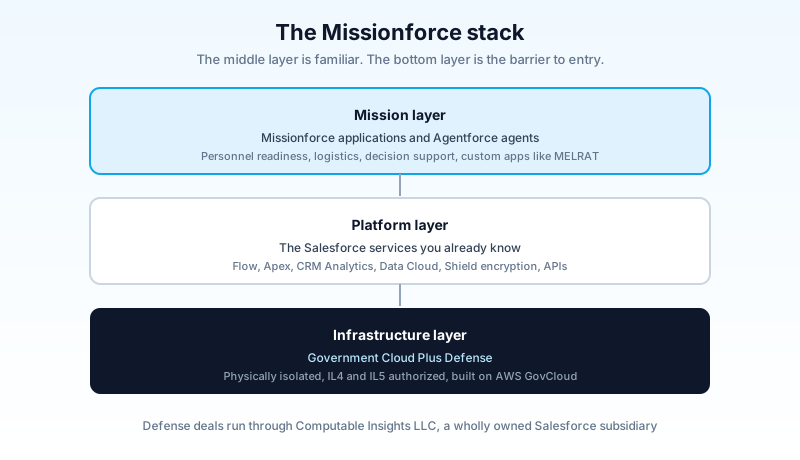
So Missionforce is best understood as three layers. At the bottom, compliant infrastructure. In the middle, the same platform services you already know. On top, mission-shaped applications and AI agents assembled for defense workflows. Nothing in the middle layer is new technology. The bottom layer is where the real barrier to entry lives.
The compliance stack that makes it possible
You cannot sell software to the Department of War from a standard commercial org. U.S. federal workloads require FedRAMP authorization, and defense workloads add DoD Impact Levels on top. This is where Government Cloud comes in, and the tiers confuse almost everyone the first time.
Government Cloud is the long-standing Salesforce environment for U.S. public sector customers, isolated from commercial infrastructure and operated to federal security baselines.
Government Cloud Plus carries FedRAMP High authorization and supports DoD Impact Level 4. FedRAMP High is the bar for systems where a breach would have severe or catastrophic effects: law enforcement data, financial systems, health records. IL4 covers Controlled Unclassified Information, the enormous category of government data that is sensitive but not classified.
Government Cloud Plus Defense is the tier Missionforce deployments actually run on. It is a physically isolated, dedicated instance of the Salesforce platform authorized for IL4 and IL5 workloads. IL5 adds higher-sensitivity CUI and Unclassified National Security Information. The infrastructure story connects to Hyperforce, the software-defined architecture Salesforce uses to run its platform on public cloud regions. Government Cloud builds on AWS GovCloud, the FedRAMP-authorized region family designed for exactly this class of workload. If the infrastructure layer is unfamiliar, the Hyperforce guide covers how the architecture works and what changed when Salesforce moved off first-party data centers.
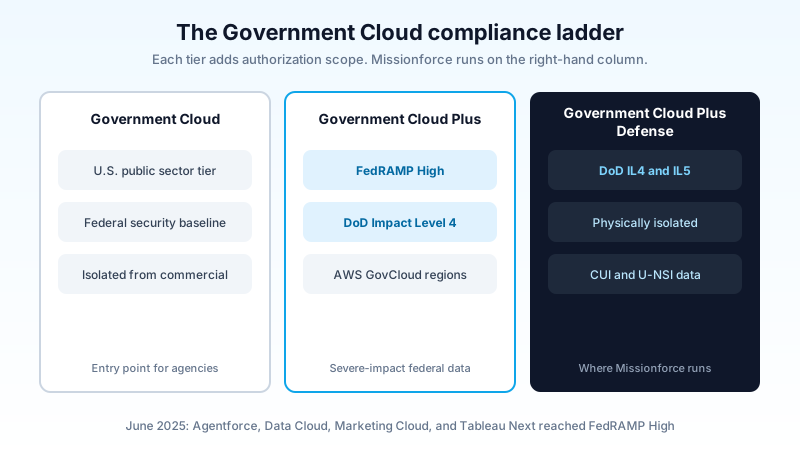
The authorization that made Missionforce commercially credible landed in June 2025, when Agentforce, Data Cloud, Marketing Cloud, and Tableau Next achieved FedRAMP High. Before that, an agency could buy Salesforce CRM at high baselines but not the AI layer, which gutted the pitch. After it, Salesforce could walk into a defense procurement and offer agents, data unification, and analytics inside one authorization boundary.
Two practitioner details hide in the fine print. First, Salesforce distinguishes between authorized products, which sit inside the FedRAMP High or IL5 boundary, and interoperable products, which are functionally tested in Government Cloud but not covered by the authorization. Architecting for a federal customer means checking every product in your design against that list, because a feature working in a demo org tells you nothing about whether it is authorized where your customer lives. Second, encryption and monitoring requirements that are optional add-ons in commercial orgs become baseline expectations here, which is why Salesforce Shield shows up in nearly every Missionforce architecture. The Shield guide explains what Platform Encryption and Event Monitoring actually do if you have never had a customer force the conversation.
The contract engine: how $5.6 billion actually works
On January 26, 2026, the U.S. Army awarded Salesforce a $5.6 billion IDIQ contract to support military modernization and Department of War readiness. Headlines treated it as a $5.6 billion sale. It is not, and understanding why tells you how the next two years of Missionforce news will unfold.
IDIQ stands for indefinite delivery, indefinite quantity. It is a contract vehicle, not a purchase. The Army's award runs ten years, structured as a five-year base ordering period plus a five-year option, with $5.6 billion as the ceiling on what can be ordered through it. The guaranteed amount is far smaller. Revenue shows up only as individual task orders are placed against the vehicle. Think of it as a pre-negotiated master agreement: the source selection, security review, and pricing arguments happen once, and then any eligible organization can buy through it without running its own competition.
That mechanism explains the speed of everything since. On May 13, 2026, the Department of the Air Force signed a $72 million enterprise license agreement covering the Air Force and Space Force, executed as a task order under the Army's IDIQ. No new procurement cycle, no fresh source selection. The DAF deal includes pilot access to Agentforce for deploying AI agents against personnel, logistics, and readiness workflows.
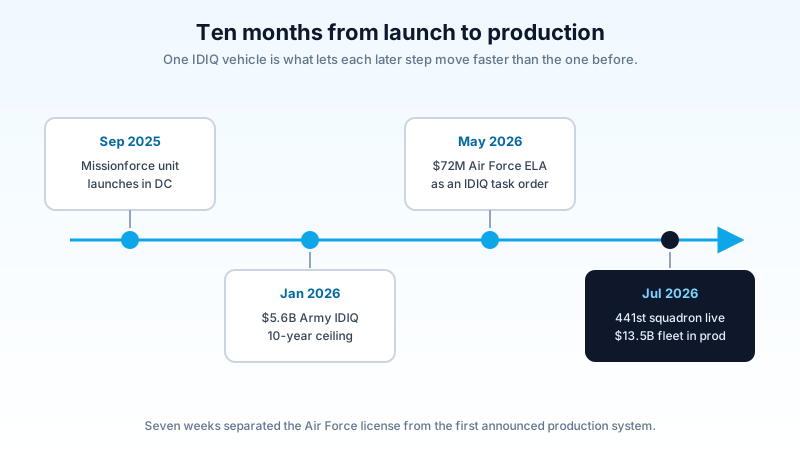
Seven weeks after that license, Salesforce announced a production system. For federal IT, where deployments are measured in years, that gap between signature and go-live is the most interesting number in the whole story.
Inside the first big deployment: a $13.5 billion fleet
On July 8, 2026, Salesforce announced that the Air Force's 441st Vehicle Support Chain Operations Squadron runs its entire ground vehicle fleet on Missionforce. The scale is worth spelling out. An 85-person squadron manages more than 84,000 vehicles worth $13.5 billion across nearly 389 locations, supporting over 7,300 personnel who work on those vehicles worldwide.
Before the migration, that job lived in aging ERP silos and a fleet management system being sunset, with data spread across systems of record like ELMS. Answering a contingency planning question, such as which vehicles could deploy to support an operation, meant days of manual data pulls. The squadron's new setup consolidates those sources into one data model on Government Cloud Plus Defense at Impact Level 5, with Shield handling encryption.
The application layer maps cleanly onto products you already know:
- Agentforce Public Sector unifies the fleet data and runs predictive analysis on it.
- A custom app called MELRAT handles contingency planning lookups that used to take days and now resolve in minutes, against a workload of more than 51,000 asset movement requests.
- CRM Analytics dashboards and portals give commanders and maintainers shared visibility into fleet status.
- The Agentforce 360 platform carries the custom app development, the same low-code and pro-code surface described in the Agentforce 360 guide.
- Agentforce Field Service and Operations is named for work order coordination, explicitly flagged as adopted when released. That phrasing tells you agentic field service for defense is still on the roadmap, not in production.
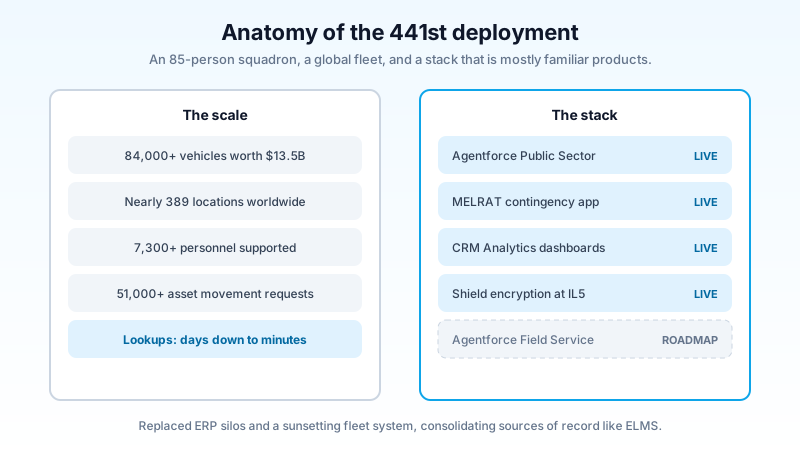
Keep the claims in proportion. What is verifiably live is data consolidation, analytics, and a fast lookup application on compliant infrastructure. The agentic layer, the part Salesforce most wants to sell, is partly pilot and partly forthcoming. That is still a real reference customer with named numbers, which is exactly what Agentforce has been short of in the enterprise market. It is just not yet the autonomous logistics brain the marketing gestures at.
What this means for your career
If you work in the Salesforce ecosystem, Missionforce changes the demand side of the market in specific ways.
Cleared talent gets a premium. IL5 environments require U.S. persons, and many roles require active clearances. The pool of people who hold both a clearance and real Salesforce depth is tiny, and $5.6 billion of contract ceiling is now aimed at it. If you are a U.S.-based architect or senior admin with any path to a clearance, the arbitrage is obvious. Partners staffing these programs are already paying for it.
Government Cloud fluency is a real skill. Commercial habits break in federal orgs. Features lag behind commercial release schedules, some products are interoperable rather than authorized, marketing tooling you take for granted may be out of boundary, and every integration gets scrutinized against the Impact Level of the data it touches. Architects who can read an authorization boundary document and design inside it are rare. That is learnable, and the compliance documentation on Salesforce's public compliance site is the place to start.
Admins and developers benefit too, not only architects. Programs like the 441st deployment need people to build the flows, configure the analytics, maintain the data model, and run the release process, all inside an environment where change management is a contractual obligation rather than a suggestion. The day-to-day work is recognizably the same platform work you do now. The differences are process discipline and the paperwork around who is allowed to touch what.
The pattern will repeat beyond defense. The Army IDIQ model, one master vehicle with fast task orders, is how large governments increasingly buy software. Salesforce proving a seven-week license-to-production turnaround gives every other agency, and every allied government watching, a template. Expect civilian agencies and state-level equivalents to follow the same shape.
There are honest caveats. IDIQ ceilings routinely go underspent, so the $5.6 billion figure is potential, not booked revenue. The Agentforce components of these deals are pilots, and government pilots die quietly all the time. And Salesforce is walking into a market where Palantir has years of operational credibility and entrenched relationships. Missionforce winning sustainment and personnel workloads is plausible. Missionforce displacing mission-critical operational systems is a much longer bet.
What to do next
If the defense corner of the ecosystem interests you, spend thirty minutes on two documents: the Government Cloud "available products and features" page on Salesforce Help, and the Government Cloud Plus Defense listing on compliance.salesforce.com. Learning to read an authorization boundary is the single skill that separates practitioners who can talk about federal work from practitioners who can be staffed on it.
About the Author
Dipojjal Chakrabarti is a B2C Solution Architect with 29 Salesforce certifications and over 13 years in the Salesforce ecosystem. He writes and edits salesforcedictionary.com, published by KineticBit Inc., to help admins, developers, architects, and cert/interview candidates sharpen their fundamentals. More about Dipojjal.
Share this article
Sources
- U.S. Army Awards Salesforce $5.6B Contract to Accelerate Military Modernization (Salesforce Newsroom)
- U.S. Air Force Modernizes Sustainment and Operations for Its $13.5 Billion Vehicle Fleet on Missionforce (Salesforce Newsroom)
- Department of the Air Force Selects Salesforce to Strengthen Mission Readiness (Salesforce Newsroom)
- Salesforce Products, Including Agentforce, Now FedRAMP High Authorized (Salesforce Newsroom)
- Salesforce Launches Missionforce, a National Security-Focused Business Unit (TechCrunch)
Related dictionary terms
Practise it
Five questions on Administrator
Exam-style questions with an explanation after each one. No account needed, and your answers build a weak-topic map once you have one.
Keep reading
Salesforce Shield: The Complete 2026 Guide
Salesforce Shield bundles Platform Encryption, Event Monitoring, and Field Audit Trail. Here is what each pillar does, what it breaks, what it costs, and when paying the 30 percent uplift is the right call.

What Is Agentforce 360? The Complete 2026 Guide for Salesforce Admins, Developers & Architects
Agentforce 360 is Salesforce's 2025 rebrand of its agentic-AI platform - built on the Atlas Reasoning Engine, Einstein Trust Layer, and Data 360. Here's the complete admin + dev + architect guide.
Comments
No comments yet. Start the conversation.
Sign in to join the discussion. Your account works across every page.