
What the Fin Acquisition Means for Your Salesforce Service Strategy
Salesforce spent $3.6 billion on Fin. Here is what changes for admins, architects, and service orgs, and what to decide before the deal closes.
A vendor pings you on a Tuesday. They want to know whether the AI deflection project you scoped last quarter is still happening, because they heard Salesforce just bought a company that does the exact thing you were about to build with Agentforce. You open the news, read "$3.6 billion," read "Fin," and now you have a meeting on your calendar that did not exist an hour ago. Your VP wants to know if the roadmap changed.
It probably did not. But you cannot say that with a straight face until you understand what Salesforce actually bought and where it lands in a portfolio that already has an AI service agent.
On June 15, 2026, Salesforce signed a definitive agreement to acquire Fin for about $3.6 billion. Fin is the company formerly known as Intercom, which rebranded in May 2026 around its AI agent. The deal is expected to close in Q4 of Salesforce's FY2027. Until then, nothing about your org changes. After that, the question is whether Fin becomes a tool you reach for or a footnote in a release note.
This post is the version your VP actually needs. Not "what was announced." What you do about it.
What Salesforce actually bought
Fin is not a new startup. Intercom was a 15-year-old company with a real install base: more than 30,000 customers, mostly in the SMB and commercial segment. Over the last two years it turned hard toward AI and shipped Fin, an agent that resolves customer support end to end rather than just suggesting replies to a human.
The number Salesforce cared about is the resolution rate. Fin's AI Agent resolves about 76% of support volume end to end, across chat, email, WhatsApp, SMS, phone, and Slack. Not deflects. Resolves. The customer asks, the agent answers or acts, the ticket closes, no human touches it. That is a higher autonomous-resolution figure than most Agentforce orgs report in production, and Salesforce paid for the gap.
A few specifics that matter for how you think about this:
- Fin runs on its own proprietary model, which the company calls Apex. Yes, the same word as the Salesforce programming language. Expect that naming collision to get cleaned up fast, because nothing confuses an admin like two Apexes.
- Fin has an internal orchestration layer called Operator that decides which actions an agent can take and chains them together. This is the part Salesforce will want to map onto its own Agentforce reasoning engine.
- The founders are staying. CEO Eoghan McCabe and co-founder Des Traynor are part of the deal, which usually signals Salesforce wants the product and the team intact rather than a quiet absorption.
The Operator layer is the piece worth understanding, because it is the closest thing Fin has to what Agentforce calls topics and actions. Operator is what lets the agent decide whether a question needs a knowledge lookup, an API call to issue a refund, or a handoff to a human. If you have ever built an Agentforce action and wired it to a topic, you already understand the shape of what Salesforce just acquired. The difference is that Fin's version was tuned over years against a narrow problem: resolve the ticket, fast, for a customer who has no Salesforce admin on staff. That constraint produced a product that is opinionated where Agentforce is flexible, and that tradeoff is exactly why the two products serve different buyers.
The real reason: the SMB gap
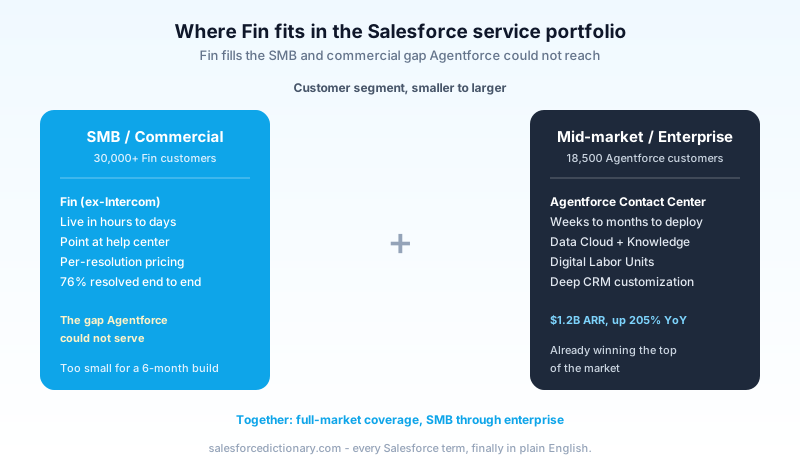
Here is the part the press release dances around. Agentforce is winning at the top of the market. As of Q1 FY27, Agentforce sat at $1.2 billion in ARR across 18,500 customers, up 205% year over year. Those are enterprise numbers, and they are good.
But Agentforce Contact Center is a heavy build. You need Data Cloud, grounded Knowledge, Omni-Channel routing, custom actions, and usually a partner. For a 40-person SaaS company that wants a chat agent live by Friday, that is the wrong tool. The deployment cost alone disqualifies it.
Fin lives exactly there. Drop in a snippet, point it at your help center, and you have an agent resolving tickets the same day. The 30,000 customers Salesforce just bought are mostly not Salesforce customers. They are the commercial segment Agentforce has been unable to reach because the product is too much for them.
So this is a market-coverage acquisition, not a technology rescue. Salesforce did not buy Fin because Agentforce is failing. It bought Fin because Agentforce only addresses the half of the market that can afford a six-month implementation.
For context on how serious this category got: NICE bought Cognigy for $955 million earlier this cycle. Salesforce paid nearly four times that for Fin. The autonomous-service-agent space is now a land grab, and Salesforce just made the biggest move in it.
How Fin and Agentforce Contact Center actually differ
If you run Service Cloud today, this is the comparison that determines whether Fin ever shows up in your stack. They are not competitors inside Salesforce. They are aimed at different customers and different problems.
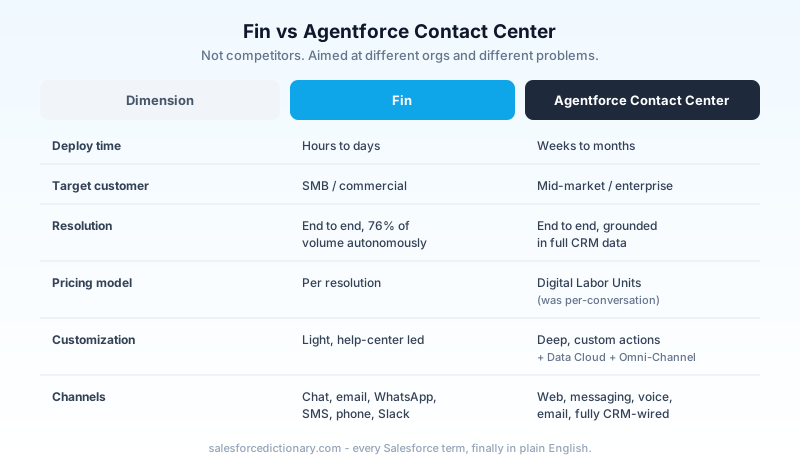
The deployment gap is the headline. Fin is hours-to-days. Agentforce Contact Center is weeks-to-months, because it is wired into your full CRM data model and your custom business logic. That depth is the point for an enterprise. It is the problem for an SMB.
Pricing is the other fault line, and it is the part that will reshape how you budget. Fin charges per resolution. You pay when the agent actually closes a ticket, not when it tries. Agentforce started on a per-conversation model and then moved to Digital Labor Units, a consumption credit you draw down. Two very different ways to forecast a bill.
The per-resolution model is not foreign to Salesforce anymore. On June 25, 2026, the day before this post, Salesforce launched the Agentforce Help Agent with pay-per-resolution pricing at $2 per resolution. That is the same shape as Fin's pricing, and it is not a coincidence. Salesforce has decided the market wants to pay for outcomes, and Fin is the biggest proof point it could buy.
Why does the pricing unit matter to you as an admin or architect? Because it changes what you optimize for. Under a per-conversation or consumption model, every interaction costs the same whether or not it solved anything, so your incentive is to deflect volume. Under per-resolution, you pay only for closed tickets, so a half-answer that bounces the customer back to a human costs you nothing on the AI side but everything in customer trust. The model rewards genuine resolution and punishes theater. If your knowledge base is thin, a per-resolution agent simply will not resolve much, and you will see that in the bill long before you see it in a dashboard. That is a healthier incentive than the old model, and it is the direction the whole Salesforce service portfolio is now pointed.
What changes, and when
The single most important thing to tell your VP: nothing changes before the deal closes. The agreement was signed June 15. Close is expected Q4 FY2027. Until regulators clear it and the deal completes, Fin and Salesforce are separate companies. You cannot buy an integrated product, because there is no integrated product. Anyone selling you one is selling vapor.
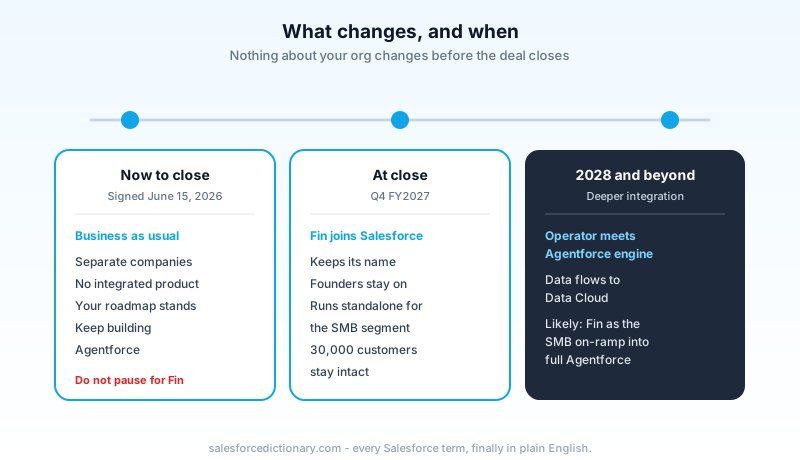
Here is the realistic shape of the next two years:
Now through close (Q4 FY27): business as usual. Your Agentforce roadmap stands. If you are mid-implementation on Agentforce Contact Center, keep going. Fin is not a reason to pause. The two products will not merge on a timeline that helps your current project.
At close: Fin becomes a Salesforce product. Expect it to keep its name and its standalone motion at first. Salesforce kept the founders, which means they will likely run it as a distinct offering for the SMB segment rather than ripping it apart on day one. The 30,000 Fin customers are the asset. Salesforce will not break their product to force a migration.
2028 and beyond: deeper integration. This is where Fin's Operator orchestration meets the Agentforce reasoning engine, where Fin's resolution data flows into Data Cloud, and where the model question gets answered. Salesforce will not run two competing autonomous agents forever. One of two things happens: Fin becomes the SMB on-ramp that graduates customers into full Agentforce, or Fin's resolution technology gets absorbed into Agentforce and the brand fades. My bet is the on-ramp, because the customer list is worth more intact.
One financial note worth passing up the chain: Salesforce stated the deal will not affect FY2027 guidance or its buyback plans. So if anyone asks whether this signals a spending problem, it does not. This is a tuck-in relative to Salesforce's scale, in the same recent run of acquisitions that included Contentful, the usage-billing company M3ter, and the marketing automation firm Qualified.
What to actually decide right now
You do not get to wait 18 months and then react. The acquisition does not change your roadmap, but it should sharpen a few decisions you were probably making anyway.
If you are an enterprise on Agentforce already: Do nothing differently on the core build. Keep grounding your Knowledge, keep tightening your Omni-Channel routing, keep expanding agent topics. Fin does not serve you directly. What you should watch is the pricing convergence. The Help Agent's $2-per-resolution model and Fin's per-resolution model together tell you where Salesforce is steering the whole portfolio. Start modeling your service AI cost in cost-per-resolved-ticket terms now, even if your current contract is on Digital Labor Units. When renewal comes, you want to negotiate in the unit Salesforce is moving toward.
If you run a smaller org and Agentforce always felt like too much: This acquisition is the best news you got this year. The thing you wanted, a deploy-in-a-day resolution agent that still lives under the Salesforce umbrella, is now on the roadmap. Do not buy Fin standalone today expecting a clean Salesforce integration tomorrow. But do start documenting your help content and your top ticket drivers, because whichever product you land on, garbage knowledge produces garbage resolution. The prep work is identical regardless of which agent wins.
If you are an architect designing a service stack from scratch: Build the decision into your design now. Org size, case complexity, existing Salesforce investment, and time-to-value pressure point to different answers, and they will point to different products once Fin is integrated.
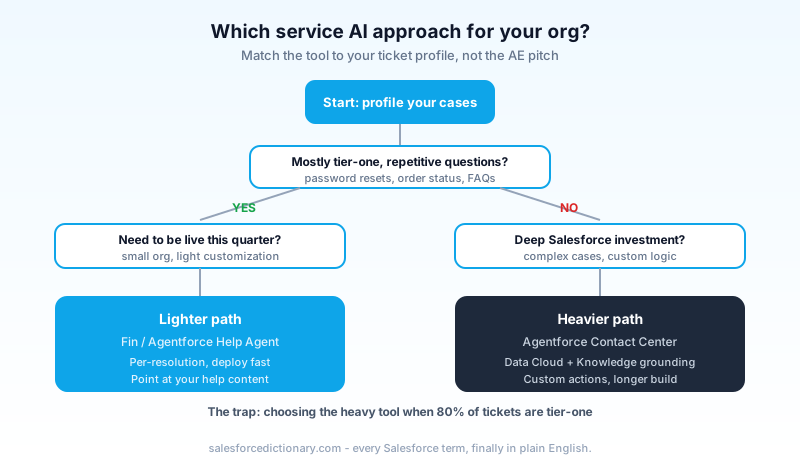
The framework is not complicated. Large org, complex cases, deep Salesforce investment, and tolerance for a longer build means Agentforce Contact Center. Smaller org, mostly tier-one questions, and a need to be live this quarter means the lighter path, which is where Fin and the Help Agent are heading. The trap is choosing the heavy tool because it is the one your AE pitched, when your ticket profile is 80% password resets and order-status checks.
The thing nobody is saying out loud
Two autonomous agents under one roof is a strategy problem, not just a product one. Salesforce now owns Agentforce, the Help Agent, and Fin, all of which resolve customer tickets without a human. That is not a portfolio, that is an overlap. Salesforce will have to tell a clear story about which one a customer picks and why, and right now that story does not exist.
For you, the practical risk is buying into a product line that gets quietly merged or sunset. That is exactly why the timeline matters. Anything you commit to before close should stand on its own value today, with zero assumption about future integration. If Fin standalone solves your problem this quarter at a price you accept, fine. Just do not pay a premium for an integration roadmap that is, at this moment, a slide deck.
The 76% resolution figure is the real prize here, and it is the number to hold Salesforce to. Whatever the products end up called, the test is the same: what percentage of your tickets close without a human, and what does each of those resolutions cost you. Everything else is branding.
Your next step
Pull your last quarter of case data and bucket it by resolution type. How many cases were genuine tier-one questions that an autonomous agent could close, versus tier-two and tier-three that need a human. That ratio is the single number that tells you whether the lighter Fin-style path or the full Agentforce Contact Center build is right for your org. Do it before your next renewal conversation, because that is the number your AE will not have and you will.
Then watch one thing between now and Q4 FY27: how Salesforce positions Fin against the Help Agent and Agentforce. The first time those three appear on the same pricing page with a clear "pick this if" guide is the signal that the strategy has settled and you can plan against it.
About the Author
Dipojjal Chakrabarti is a B2C Solution Architect with 29 Salesforce certifications and over 13 years in the Salesforce ecosystem. He runs salesforcedictionary.com to help admins, developers, architects, and cert/interview candidates sharpen their fundamentals. More about Dipojjal.
Share this article
Sources
- Salesforce Signs Definitive Agreement to Acquire Fin (Salesforce Newsroom)
- Salesforce acquires AI customer service platform Fin for $3.6B (TechCrunch)
- Salesforce to Buy AI Customer Service Firm Fin for $3.6 Billion (Bloomberg)
- Salesforce Launches Agentforce Help Agent with Pay-Per-Resolution (Salesforce Newsroom)
- Salesforce's Agentforce Help Agent Bets on Pay-Per-Resolution (Futurum Group)
- Agentforce Service - Salesforce
Related dictionary terms
Keep reading
Agentforce Service: The Complete 2026 Guide (Formerly Service Cloud)
Service Cloud is now Agentforce Service. This 2026 guide cuts through the rebrand: the Service Agent, IT Service, Agentic Milestones, knowledge grounding, and the real deflection numbers.
Agentforce Digital Labor Units Explained: What You're Actually Buying in 2026
Agentforce switched from per-conversation pricing to Digital Labor Units. Here is how DLU consumption works, what counts as a billable interaction, and how to estimate costs before you commit.
What Is Agentforce 360? The Complete 2026 Guide for Salesforce Admins, Developers & Architects
Agentforce 360 is Salesforce's 2025 rebrand of its agentic-AI platform - built on the Atlas Reasoning Engine, Einstein Trust Layer, and Data 360. Here's the complete admin + dev + architect guide.
Comments
No comments yet. Start the conversation.
Sign in to join the discussion. Your account works across every page.