
Agentforce Vibes Free Tier Ends
From June 1, Agentforce Vibes stops being free the way it was. Developer Edition orgs keep a one-time 110-request allowance that never refreshes, and non-DE orgs lose free agentic chat entirely. May 31 is the last day of the old rules.

You wired Agentforce Vibes into your sandbox in April, got used to free chat with Claude Sonnet inside the IDE, and built a habit around it. Tomorrow that habit breaks. Starting June 1, Agentforce Vibes moves to a new access model, and the free allowance you have been treating as a renewing monthly bucket turns into a one-time cap that never refills. Today, May 31, is the last day of the old rules. Here is exactly what changes, who it hits, and what to do before the clock runs out.
What Agentforce Vibes is, briefly
Agentforce Vibes is the AI coding agent Salesforce shipped alongside Headless 360 at TrailblazerDX 2026. It runs inside an IDE, reads your org, and writes and edits code with full awareness of your metadata, not just the file open in front of you. Through May, Salesforce bundled it into the free Developer Edition with a generous-looking allowance: 110 requests and 1.5 million tokens per month on Claude Sonnet 4.5, the Pro model. That monthly framing is the part that changes.
The billing transition is documented on the official Agentforce Vibes developer guide. Two distinct things happen on June 1, and they hit two different groups. Read the one that applies to you, because the consequences are not the same.
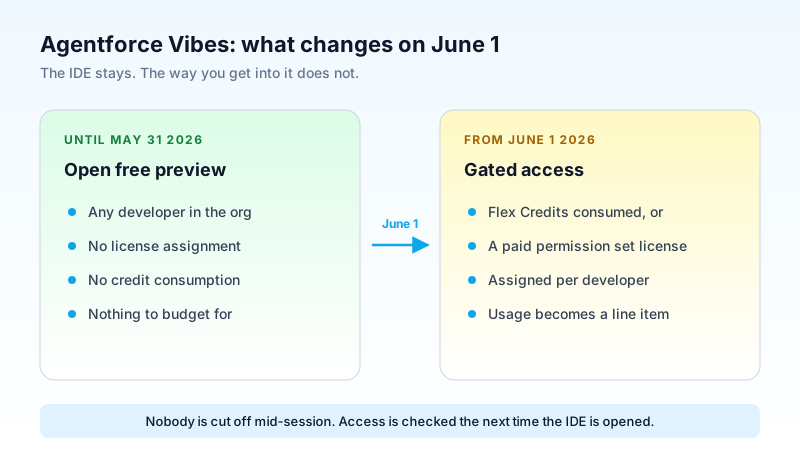
Change one: the Developer Edition cap stops refreshing
If you build in a Developer Edition org, you keep free access to Agentforce Vibes. That is the good news. The catch is in how the meter resets, or rather, that it stops resetting.
Through May 31, the 110 requests and 1.5 million tokens on Claude Sonnet 4.5 were a monthly bucket. Hit the limit, wait for the calendar to flip, get a fresh 110 requests. Starting June 1, per the developer guide, the DE org limit applies to the lifetime of the org and does not refresh. Read that twice. It is not 110 requests a month forever. It is 110 requests total, for the entire life of that org, and when they are gone they are gone.
For a Developer Edition org, 110 lifetime requests is a small number. A single afternoon of real work, asking the agent to scaffold a class, fix a test, refactor a trigger, can burn through a meaningful chunk of it. The framing matters because developers who set up Vibes in April have been spending against what felt like a renewable resource. Tomorrow the same usage pattern hits a wall that does not come back.
There is a second twist for DE orgs. When you exhaust the Pro model, there is no Core model fallback. Paid orgs get GPT-5 mini as a Core fallback rated at 1,500 requests or 15 million tokens per month. Developer Edition orgs do not. Once the lifetime Pro cap is spent, Vibes stops, with nothing underneath it to catch you.
Change two: non-DE orgs lose free agentic chat
The harder cutoff lands on orgs that are not Developer Edition. Through May 31, those orgs could use Agentforce Vibes agentic chat inside the free window. Starting June 1, that free window closes. To keep using agentic chat, a non-DE org needs one of two things: Flex Credits, or the Unmetered Platform Developer and Admin AI User permission set license (PSL).
This is the change most likely to surprise a team. If you piloted Vibes in a sandbox attached to a production or partner org rather than a clean Developer Edition org, your free access ends outright tomorrow. There is no lifetime allowance to fall back on, because the lifetime allowance is a Developer Edition benefit. You are straight into paid territory: provision Flex Credits or assign the PSL, or the agentic chat goes dark.
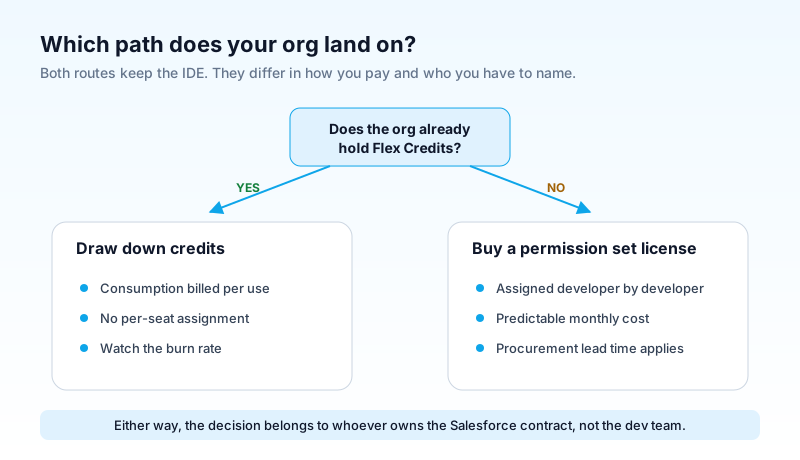
Salesforce has not published the dollar figure for Flex Credits in the context of Vibes. Salesforce Ben and Salesforce Bolt both note that the specific pricing is still listed as coming soon. That is its own problem: a paid requirement lands tomorrow, and the price tag is not yet visible. If your team depends on Vibes in a non-DE org, you are being asked to commit to a paid path without the number in front of you.
The models, and what GPT-5 changes
June 1 also brings a model change worth flagging. GPT-5 becomes available as a model option, joining Claude Sonnet 4.5. For paid orgs, the Core fallback is GPT-5 mini, with that 1,500 requests or 15 million tokens monthly allowance kicking in once the Pro model limit is reached.
So the tiering, after tomorrow, looks like this. Developer Edition: 110 Pro requests for the life of the org, no fallback. Paid (Flex Credits or the PSL): Pro access on Claude Sonnet 4.5 plus a GPT-5 mini Core fallback rated at 1,500 requests or 15 million tokens a month. The gap between those two tiers is wide, and it is deliberate. The free tier is now a sample, not a workspace.
Why Salesforce is doing this
The honest read is that the free period was a launch promotion, and the promotion is ending. Salesforce put Vibes and the 60-plus MCP tools from Headless 360 in front of developers cheaply to drive adoption out of TrailblazerDX. Adoption is now strong enough that the company is willing to convert the cheap access into paid access.
The timing tracks with the earnings story. On the Q1 FY27 call, Marc Benioff said Salesforce is holding engineering headcount flat while pushing AI tooling, and Agentforce ARR crossed $1.2 billion. The strategy depends on AI products carrying real revenue, not running as free perks indefinitely. A free coding agent with monthly-refreshing limits is a cost center. A coding agent that converts to Flex Credits after a taste is a revenue line. June 1 is where the conversion is engineered to happen.
There is also a token-cost reality underneath it. Salesforce committed $300 million to Anthropic tokens for 2026, the spend covered in the May 19 piece on the CRM rally. Every free Claude Sonnet request inside Vibes draws against that budget. Converting the lifetime DE cap to a hard ceiling, and pushing non-DE orgs to paid, is how Salesforce stops subsidizing inference for users who were never going to pay.
The part that deserves criticism
The mechanics are defensible. A vendor can charge for its product. What is harder to defend is the shape of the Developer Edition change. Recasting a monthly limit as a lifetime limit, on the same numbers, without changing the numbers, is a quiet way to make a free tier far smaller than it reads. A developer who saw "110 requests per month" in April and plans around it is in for a surprise when the same 110 turns out to be the whole story for the life of the org.
The non-DE cutoff has the opposite problem: it is abrupt and priced in the dark. Telling teams that free agentic chat ends tomorrow, while the Flex Credits price is still coming soon, leaves no clean way to budget the transition. You cannot model a cost that has not been published. The right move would have been to name the price before flipping the switch, not after.
None of this makes Vibes a bad tool. The criticism is about how the transition is communicated, not about the product. But if you run developer tooling for a team, the communication gap is exactly the thing that turns a planned migration into a fire drill on June 1.
What this means for the people actually using it
For a solo developer learning the platform, the Developer Edition tier is still usable, but treat those 110 requests as a finite, one-time budget. Spend them on something worth keeping, not on exploratory prompts you would throw away. When they run out, that org is done with Vibes Pro, and there is no monthly reset to wait for. Spinning up a fresh Developer Edition org resets the lifetime counter, because the limit is per org, but that is a workaround, not a supported plan, and it means losing the metadata context the agent built up.
For a team running Vibes in a non-DE sandbox, the picture is sharper. Free access ends tomorrow. If Vibes is in your daily loop, you need a paid path provisioned before the first developer hits the wall on Monday. That means a conversation with whoever controls your Salesforce spend, today, not next week.
What to do before May 31 ends
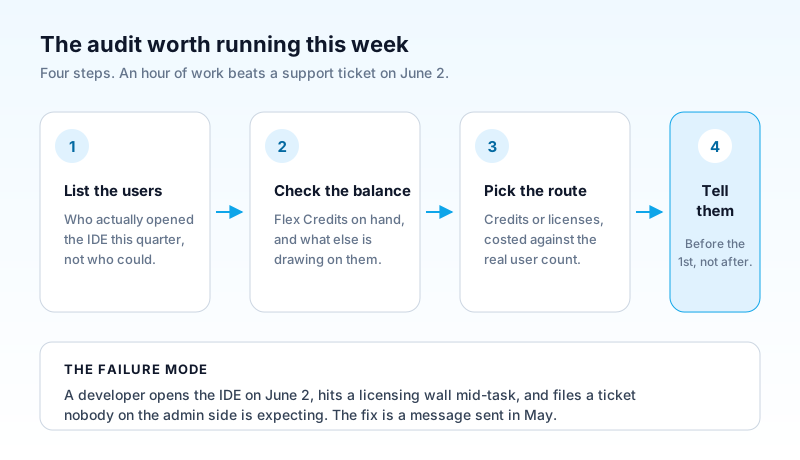
Run a three-item check before tomorrow. First, confirm which kind of org each developer is using Vibes in. Developer Edition orgs keep the lifetime free tier; everything else loses free agentic chat on June 1. You probably have a mix, and the mix determines who is affected.
Second, for any non-DE org your team depends on, decide now whether you are buying Flex Credits or assigning the Unmetered Platform Developer and Admin AI User PSL, and get the request into your admin queue today. The price for Flex Credits is not published yet, so flag that you are committing to a path before the number lands, and ask your account team for the figure directly rather than waiting for the public page.
Third, tell your developers the monthly-reset assumption is dead. The single most useful thing you can do before midnight is make sure nobody on your team starts June expecting a fresh bucket of 110 requests that is never coming. Set the expectation now, and the transition is an annoyance instead of a surprise.
About the Author
Dipojjal Chakrabarti is a B2C Solution Architect with 29 Salesforce certifications and over 13 years in the Salesforce ecosystem. He writes and edits salesforcedictionary.com, published by KineticBit Inc., to help admins, developers, architects, and cert/interview candidates sharpen their fundamentals. More about Dipojjal.
Share this article
Sources
- Upcoming Billing Transition (Agentforce Vibes Developer Guide, Salesforce Developers)
- Salesforce Agentforce Vibes No Longer Free from June 2026 (Salesforce Ben)
- Agentforce Vibes Is Going Paid: Here's What Changes on June 1 (Salesforce Bolt)
- New in Salesforce Developer Edition: Agentforce Vibes IDE, Claude 4.5, MCP (Salesforce Developers Blog)
- What Salesforce Headless 360 Means For Developers (Salesforce Developers Blog)
Related dictionary terms
Practise it
Five questions on Agentforce Specialist
Exam-style questions with an explanation after each one. No account needed, and your answers build a weak-topic map once you have one.
More news

Salesforce CLI Breaks CI/CD on May 27
Salesforce CLI stops returning access tokens, passwords, and SFDX Auth URLs in standard output on May 27, 2026. Pipelines reading sf org display will break. Here is the affected command list and migration path.

Salesforce Q1 FY27: Agentforce $1.2B
Salesforce beat Q1 FY27 estimates on every major metric: $11.13B revenue, $3.88 non-GAAP EPS, $33.6B cRPO at 14% growth. Agentforce ARR crossed $1.2B at 205% growth. Then Benioff revealed engineers haven't been hired in two years.

Headless 360 Adoption Numbers Land
Salesforce backed Headless 360 with real numbers at a May 29 webinar: 4.5M MCP calls, ~1 trillion API calls, and 1M Slack MCP users in six weeks. Here is what the API-is-the-UI shift means for developers, architects, and your budget.
Comments
No comments yet. Start the conversation.
Sign in to share your take on this article. Your account works across every page.