
The Workday Bid Reprices Salesforce
Reuters reported Thursday that Silver Lake is in talks to take Workday private, and the stock closed up almost 18 percent at a $51.1 billion market value. Salesforce spent Friday giving back most of its own gain. The two moves are the same trade, and the multiple underneath it is one your renewal conversation now inherits.
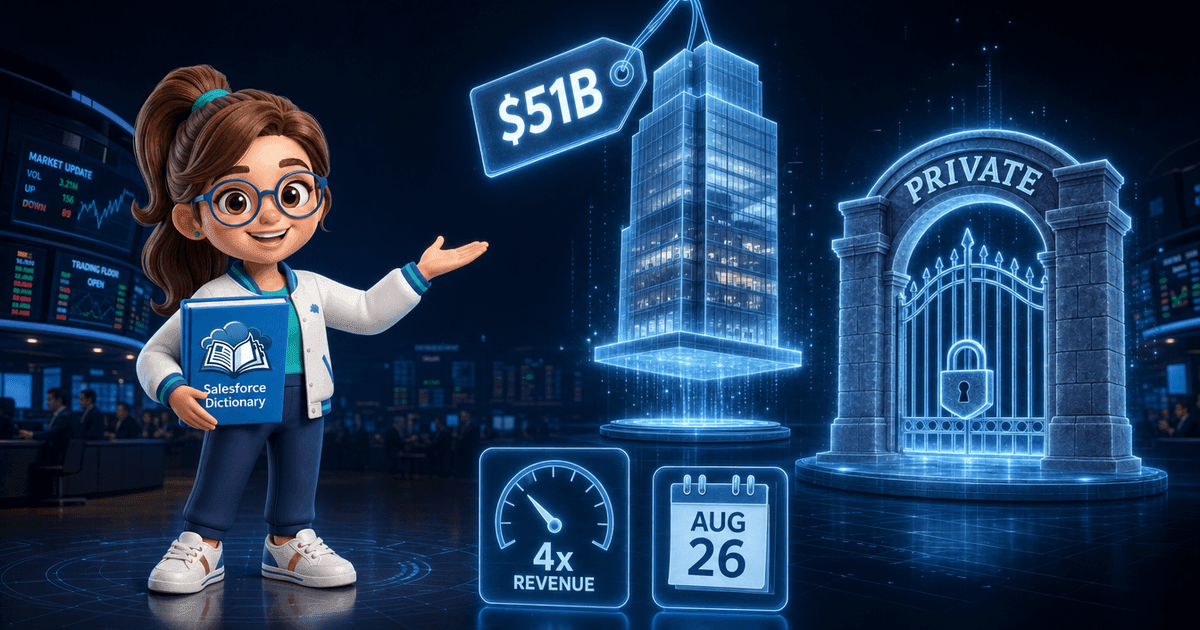
Reuters reported on Thursday that Silver Lake is in talks to take Workday private. Trading in Workday was halted for volatility, and the stock closed up almost 18 percent at $206.45, its best single day in ten years.
Salesforce spent Friday going the other way. It closed at $196.21, down 2.6 percent, giving back roughly 64 percent of the gain J.P. Morgan's Overweight initiation had handed it a day earlier.
Two different companies, two opposite tape moves, one underlying trade. The market is deciding what a seat-based enterprise application is worth, and it is not settling on a number either company's management would have accepted two years ago.
What Was Actually Reported
Silver Lake and Workday have held discussions about a take-private in recent months, according to people Reuters described as familiar with the matter. The talks are ongoing and no deal is guaranteed. That caveat is doing real work here, and nothing below assumes the deal closes.
Workday carried a market value near $43 billion before the report. Thursday's close put it at roughly $51.1 billion. Analysts running standard takeover math landed between $54 billion and $60 billion for the equity cheque depending on the premium assumed, which would put it alongside or above Silver Lake's roughly $55 billion Electronic Arts take-private as one of the largest software buyouts on record.
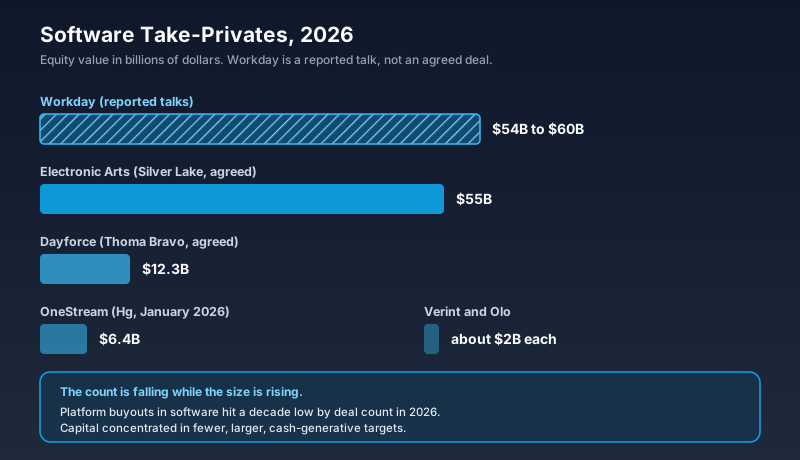
It is not an isolated bid. Thoma Bravo agreed to buy payroll vendor Dayforce for about $12.3 billion. Hg took OneStream private in January for roughly $6.4 billion at a 31 percent premium. Verint and Olo both went at about $2 billion each. Platform buyouts in software have fallen to a decade low by count, and the deals still getting done are concentrated in a specific kind of asset.
Workday's own numbers explain the interest. Fiscal 2025 revenue was $9.6 billion, up 13 percent from 16 percent the year before. Operating cash flow was $2.9 billion, up 19 percent. The stock had fallen about 15 percent year to date and more than 40 percent from its 2024 peak before Thursday. Cash generation holding up while the multiple compresses is the exact profile a buyout fund is built to buy.
The Multiple Is the Story
Here is the part worth sitting with.
Workday at $43 billion on $9.6 billion of revenue was trading around 4.5 times sales. Salesforce closed Friday with a market capitalisation near $165 billion on trailing twelve month revenue of $42.8 billion. That is roughly 3.9 times sales.
Salesforce trades at a lower multiple of revenue than the company private equity just bid for.
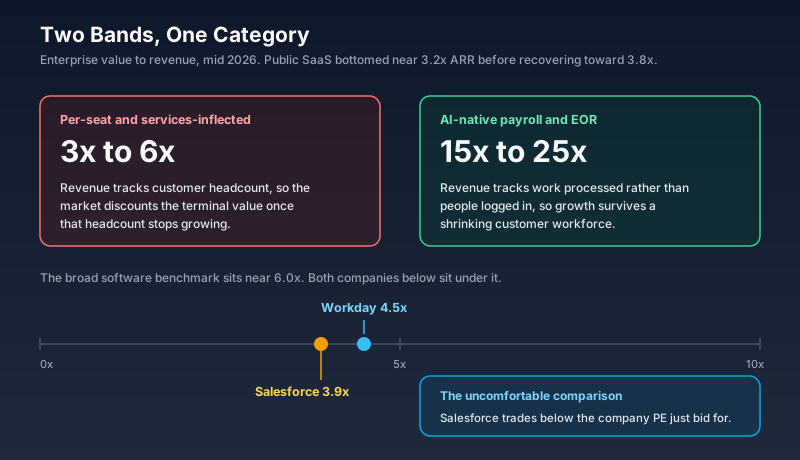
The bands around those numbers matter more than either figure on its own. Public software multiples bottomed near 3.2 times annual recurring revenue by mid 2026 before recovering toward 3.8 times. The broad market benchmark sits near 6 times enterprise value to revenue. Underneath that average sits a split: AI-native payroll and employer-of-record platforms clear 15 to 25 times, while per-seat and services-inflected models sit at 3 to 6 times.
Salesforce and Workday are both in the lower band. They are there for the same reason, which has nothing to do with either company's execution. The market has stopped paying for a business model in which revenue grows because customer headcount grows.
Thoma Bravo's public position is that this reading is wrong, and that the real dividing line is between replaceable point solutions and mission-critical systems that carry compliance weight. Payroll and security survive. Feature-thin tools do not. That thesis is coherent, and it is also the thesis of a firm whose economics improve when public multiples stay low. Both things can be true.
Why Friday Undid Most of Thursday
Salesforce did not fall 2.6 percent because of Workday. It fell because the setup into August 26 is fragile enough that a single day of profit-taking erases a rating upgrade.
The stock had already run roughly 31 percent off its June bottom. J.P. Morgan initiated at Overweight with a $250 target on Thursday. UBS held Neutral two days before that and told clients the margin for error had gone. Q2 fiscal 2027 guidance is $11.27 billion to $11.35 billion, and the 4.7-point gap between guidance and the company's own Rule of 50 target is the argument both notes are having.
Put the Workday report next to that and the message from the week is blunt. When a fund is willing to pay a premium for a 13 percent grower with $2.9 billion of operating cash flow, and the public market simultaneously refuses to hold a 4 percent pop in an 11 percent grower for one session, the disagreement is not about either company. It is about whether growth in this category is worth a growth multiple at all.
Salesforce's answer to that question is consumption pricing. Agentic Work Units billed against Flex Credits are an attempt to break the link between revenue and seat count, which is precisely the link the market is now discounting. Whether that works is the thing August 26 is really about.
What This Would Change In Your Org
Skip the tape for a moment. A Workday take-private has a concrete surface area inside Salesforce estates, and most teams have never mapped it.
Workday serves more than 11,500 customers. In July 2024 the two companies announced a strategic partnership and a joint AI employee service agent that combines the Agentforce platform and Einstein with the Workday platform and Workday AI. Workday also runs natively inside Slack, where employees pull worker records, pay data, job requisitions and general ledger entries without leaving the channel.
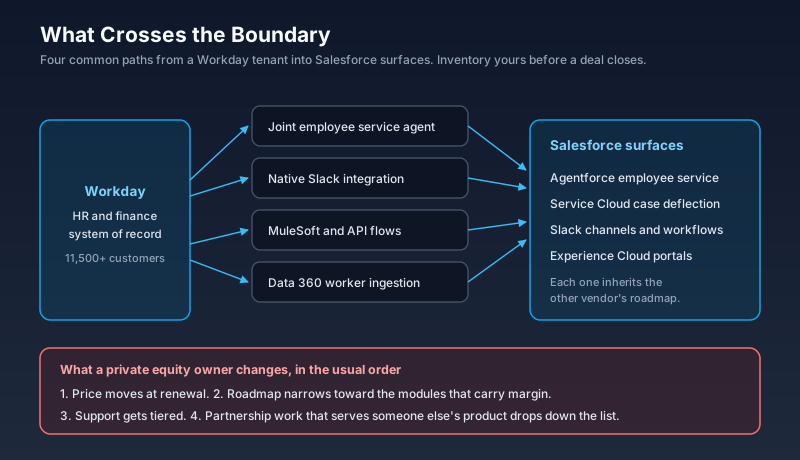
If any of that is load-bearing in your org, a change of ownership at Workday is your problem too. Not on day one, and not catastrophically. The buyout playbook is well documented and slow: price moves at renewal, roadmap narrows toward the modules that carry margin, support gets tiered, and integration investment that serves a partner rather than the balance sheet drops down the list.
Joint product work between two public companies is the first line item that gets a hard look when one of them starts servicing acquisition debt. The employee service agent is a partnership deliverable, not a contractual obligation to you. Read your own dependency accordingly.
The near-term risk is not that anything breaks. It is that a roadmap you have been planning against quietly stops moving, and nobody sends a notice.
The Pattern Worth Naming
Three things happened in the same week. A buyout fund bid for a seat-based application at a premium. A rating upgrade on the largest seat-based application in the category lasted one session. And Marc Benioff's fund put money into a startup whose product automates the implementation work that seat-based applications generate.
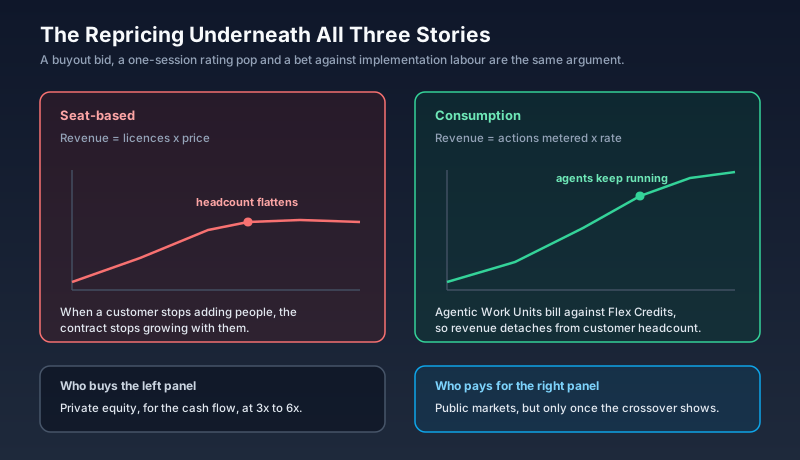
None of those three is a story about AI replacing software. They are all stories about the same repricing. If a customer's headcount stops growing, a per-seat contract stops growing with it, and the terminal value of that contract shrinks. Private equity is comfortable owning that cash flow at four times revenue. Public markets are not comfortable paying a growth multiple for it.
Salesforce has read the situation correctly and is moving toward metered work. The gap is timing. Consumption revenue has to scale faster than seat revenue decelerates, and that crossover is a second-half fiscal 2027 question, not a settled fact.
What To Do Next
Spend twenty minutes this week building a one-page Workday dependency list for your org, before the deal either happens or does not.
Write down every integration that crosses the boundary: the employee service agent if you deployed it, the Slack connection, any MuleSoft flows, any Data 360 ingestion of worker or organisational data, and any Experience Cloud portal that reads HR records. Next to each one, put the contract renewal date and the name of the person who owns it.
Then flag the ones with no fallback. A joint roadmap item with a single-vendor dependency and a renewal inside twelve months is the row you want in front of your architecture review, not in someone's head.
If the deal never closes, you have spent twenty minutes and gained an integration inventory you should have had anyway. If it does close, you already know which three rows to renegotiate first, and you know it before the account team calls you.
About the Author
Dipojjal Chakrabarti is a B2C Solution Architect with 29 Salesforce certifications and over 13 years in the Salesforce ecosystem. He writes and edits salesforcedictionary.com, published by KineticBit Inc., to help admins, developers, architects, and cert/interview candidates sharpen their fundamentals. More about Dipojjal.
Share this article
Sources
- Exclusive: Silver Lake in talks to buy Workday, sources say (Reuters via Yahoo Finance, August 13 2026)
- Workday shares post best day in 10 years on Silver Lake takeover report (CNBC, August 13 2026)
- Silver Lake eyes Workday take-private (Axios, August 14 2026)
- Salesforce Shares Retrace 64% of JPMorgan Surge Ahead of a 4.7-Point Growth Test (TS2, August 14 2026)
- Workday Shares Hold 18% Gain as Silver Lake Talks Point to $54 Billion Deal Math (TS2, August 14 2026)
- PE pivots as platform buyouts in software fall to decade low (Yahoo Finance)
- Thoma Bravo eyes software takeovers as AI fears hit valuations (Private Equity Insights)
- Salesforce and Workday Form Strategic Partnership, Unveil New AI Employee Service Agent (Salesforce, July 24 2024)
- Salesforce (CRM) Statistics and Valuation (StockAnalysis)
Related dictionary terms
Practise it
Five questions on Agentforce Specialist
Exam-style questions with an explanation after each one. No account needed, and your answers build a weak-topic map once you have one.
More news
Salesforce's Rule of 50 Gap
J.P. Morgan started coverage of Salesforce at Overweight with a $250 target on Thursday, a day after UBS warned about the setup into August 26 earnings. Both notes turn on the same 4.7 points.

CRM's 13-Day Slide to a 3-Year Low
Salesforce fell 13 sessions in a row to a 3-year low of $149.78, its longest losing streak ever. Here is what caused it and where CRM trades now.
Comments
No comments yet. Start the conversation.
Sign in to share your take on this article. Your account works across every page.