
Salesforce State of Sales 2026
Salesforce's new State of Sales report says reps spend just 40% of their time selling, and 90% of teams plan to run AI agents by 2027. Here is what the data actually shows, and what to fix in your org first.

A sales rep on your team spends roughly three hours of an eight-hour day actually selling. The other five go to data entry, internal meetings, hunting for the right content, and updating records nobody reads. That is not a guess. That is the headline number from the Salesforce State of Sales report for 2026, released this week, which puts active selling time at 40 percent.
Salesforce surveyed more than 4,000 sales professionals for this edition. The report is a marketing instrument, so read it with the appropriate suspicion: every chart bends toward the conclusion that you should buy Agentforce. But the underlying data is useful, and the gap between what the report recommends and what most orgs can actually execute is the part worth your attention.
Here is what the numbers say, where the report oversells, and the one thing you should fix before you let an agent anywhere near a deal.
The 40 Percent Problem
Start with the number that frames everything else. Reps spend 40 percent of their time selling. The remaining 60 percent is administrative drag: logging activity, building forecasts by hand, searching for collateral, sitting in pipeline reviews, and copying data between systems that do not talk to each other.
This is not new. Salesforce has been publishing some version of this statistic for years, and the number barely moves. That is the uncomfortable subtext. A decade of CRM investment, automation, and "productivity" tooling, and reps still spend most of their day not selling. The tools were supposed to fix this. Mostly they added more fields to fill in.
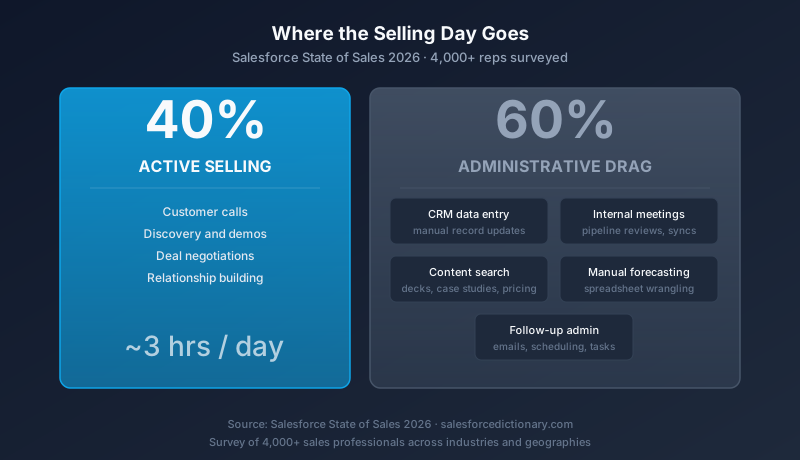
The report's framing is that the drag is structural, not a people problem. Reps are not lazy and they are not unskilled. They are buried under process. Adam Alfano, EVP of Sales at Salesforce, put it plainly in the announcement: "We want to kill the busywork so our teams can focus on what actually moves deals forward: building relationships and driving success."
That is a fair diagnosis. The question is whether the prescribed cure works.
What the AI Adoption Numbers Actually Mean
The report leans hard on AI, and the adoption figures are genuinely high. Some of the headline stats:
- 87 percent of sales organizations now use AI somewhere in the sales cycle, for prospecting, forecasting, lead scoring, or drafting emails.
- 89 percent of reps agree AI is improving how they understand customers.
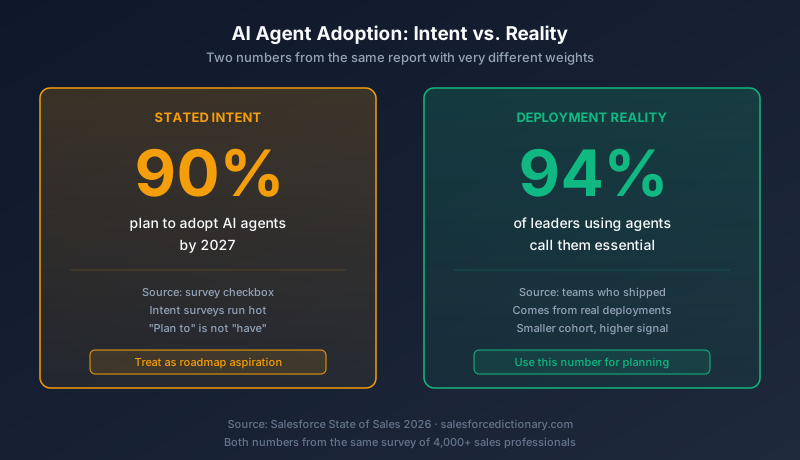
- 90 percent of teams plan to adopt AI agents by 2027.
- 94 percent of sales leaders who already use agents say those agents are essential to growth.
- Teams using AI report a 33 percent reduction in time spent on research and content creation.
Take the 87 percent first. "Uses AI somewhere" is a low bar. Drafting an email with a generative assistant counts. Einstein lead scoring counts. That figure tells you AI features are switched on, not that they are changing outcomes. It is adoption breadth, not depth.
The 90 percent "plan to adopt agents by 2027" number is the one Salesforce most wants you to fixate on, and it is the softest. Intent surveys always run hot. "Plan to" is not "have," and the gap between a leader checking a box on a survey and an agent autonomously working live opportunities is enormous. Compare it against the actual deployment figure: 94 percent of leaders who already use agents say they are essential. That second number is more credible because it comes from people who have shipped something. The first is a roadmap aspiration.
The 33 percent time savings on research and content is the most actionable claim, and it is plausible. Drafting and research are exactly the tasks generative AI handles well. If you want a metric to benchmark your own rollout against, this is the one. If your team is using AI to draft outreach and summarize accounts and you are not seeing a meaningful dent in research time, your deployment is the problem, not the technology.
The Blocker Buried in the Data
Here is the finding the press release does not put in the headline, and it is the most important one in the whole report. 51 percent of sales leaders using AI say disconnected systems are hindering their AI initiatives.
Read that again. More than half of the leaders trying to make AI work in sales say their data plumbing is the thing breaking it.
This is the real story, and it cuts directly against the optimism of the rest of the report. You cannot bolt an autonomous agent onto a fragmented data estate and expect good behavior. An agent that reads from a CRM where opportunity data is stale, contact records are duplicated, and product data lives in a separate system the agent cannot see will confidently produce wrong answers. Garbage in, confident garbage out, at machine speed.
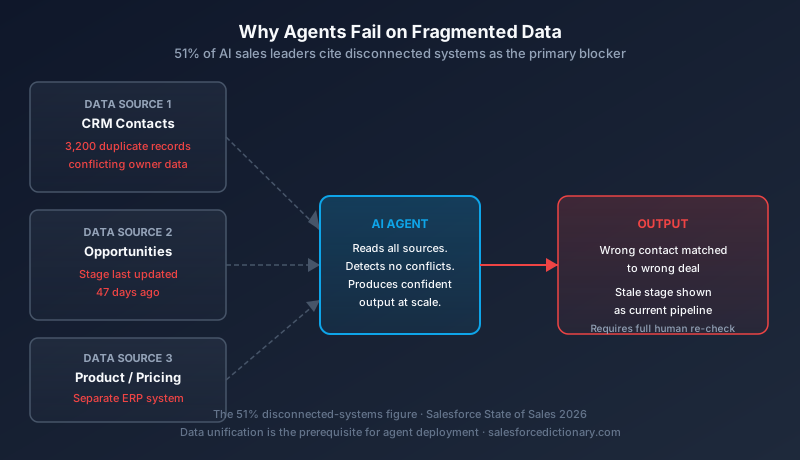
This is why Salesforce keeps pushing Data Cloud and, more recently, the Databricks data sharing work and the broader Data 360 story. The agent layer is only as good as the unified data underneath it. Salesforce knows this, which is why every agent pitch now comes attached to a data unification pitch. The 51 percent figure is the company quietly admitting that the data problem is the gating factor for the entire agentic vision. The agents are ready. Most customers' data is not.
That is not a knock on the technology. It is a sequencing reality. If you are a leader reading the report and getting excited about deploying agents across your sales floor, the data layer is your prerequisite, not your phase two.
Where the Report Is Selling You Something
Let me be direct about the parts to discount.
The phrase "AI agents are reshaping our entire sales engine" is the kind of language that belongs in a keynote, not a finding. The report consistently blurs the line between what AI assistants do today (draft, summarize, score) and what autonomous agents promise to do tomorrow (prospect 24/7, work deals end to end, update the CRM without a human). Those are different maturity levels. The high adoption numbers mostly describe the first category. The exciting language mostly describes the second. The report lets you conflate them.
There is also a generational angle the report plays up: newer reps, particularly Gen Z, spend a disproportionate share of their time on administrative work, and AI is framed as the fix. That is probably true, but it is also a convenient story. Junior reps spend more time on admin in every era because admin is what you give junior reps. The AI framing makes it sound like a technology problem when a chunk of it is just org structure.
None of this means the report is wrong. It means it is a vendor report doing what vendor reports do. The data is real. The interpretation is for sale.
What This Means for Your Org
Strip out the marketing and the report leaves you with three honest signals.
First, the selling-time problem is structural and persistent. If your reps are below 50 percent active selling time, you are normal, and that is the indictment. The drag is process and data entry, and that is addressable without buying anything new. Audit what your reps are actually required to log and ask which of those fields drive a decision. Most do not.
Second, AI assistance for drafting, research, and summarization is a safe, high-return starting point. The 33 percent research time savings is achievable with tools many orgs already own. This is the low-risk on-ramp. Start here before anything autonomous.
Third, and most important, the data layer is the gate. The 51 percent disconnected-systems figure is the report telling you that agents fail on bad data. Before you scope an Agentforce rollout for sales, run a hard look at your data quality: duplicate accounts and contacts, stale opportunity stages, ownership of the data model, and what your agent can and cannot actually read at runtime.
What to Do Now
Pull your own selling-time number before you trust Salesforce's. Open your activity and event data and calculate what fraction of your reps' logged time maps to direct selling activity versus admin. Then run a data quality pass on the objects an agent would touch: Account, Contact, Opportunity, and your key custom objects. Fix duplicates and stale records first. The report's most useful lesson is the one it tries hardest to soften: the agents are not the hard part. Your data is. Sequence the work accordingly, and read the full report through that lens rather than the headline one.
About the Author
Dipojjal Chakrabarti is a B2C Solution Architect with 29 Salesforce certifications and over 13 years in the Salesforce ecosystem. He writes and edits salesforcedictionary.com, published by KineticBit Inc., to help admins, developers, architects, and cert/interview candidates sharpen their fundamentals. More about Dipojjal.
Share this article
Sources
Related dictionary terms
More news

Salesforce x Databricks Partnership
Salesforce and Databricks expanded their Zero Copy partnership at Data + AI Summit 2026. New governance controls, federated search, and MuleSoft Agent Scanner for Databricks. Some of it GA now. Most lands in H2 2026.

Agentforce for Financial Services
Salesforce launched Agentic Advisor in Agentforce for Financial Services on June 18. Meeting Concierge is generally available now; Run My Day and an enhanced Client Details page arrive in summer 2026. Here is what each piece does.
Comments
No comments yet. Start the conversation.
Sign in to share your take on this article. Your account works across every page.