
Salesforce's $1B Switzerland Bet
On July 7 Salesforce committed $1 billion over five years to Switzerland's agentic AI push. It is the third European country to get a ten-figure check in six weeks. Here is what the money buys.
Salesforce pledged $1 billion to Switzerland on July 7. It is the third country to get a ten-figure Salesforce AI check in about five weeks, and at this point the pattern is the story.
Marc Benioff announced the commitment during a visit to Switzerland, timed to the AI for Good Global Summit in Geneva. The money runs over five years and is aimed at what Salesforce calls the country's "agentic AI transformation." Benioff framed the choice of Switzerland in the language he tends to reserve for Davos: "Switzerland is where the world comes together to solve its greatest challenges, home to global institutions, pioneering companies, and a deep tradition of innovation and trust." Here is what the figure actually covers, which Swiss companies already run the product, and why three European governments got a Salesforce billion in six weeks.
What the billion covers
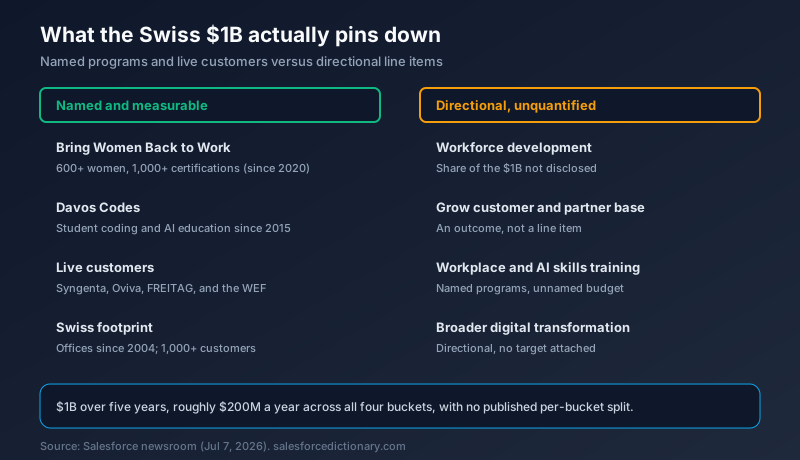
Salesforce splits the $1 billion across four buckets: local workforce development, growing its Swiss customer and partner base, workplace and AI skills training, and broader Swiss digital transformation. Spread over five years, that is roughly $200 million a year against all four goals combined. No per-bucket breakdown is published, so the split between them is Salesforce's to decide as it goes.
Read those four line items again. Only one, workforce and skills, arrives with named programs and hard numbers attached. The other three are directional. "Growing the customer base" and "broader digital transformation" are outcomes a vendor would chase anyway, now folded into a headline figure. This is standard for sovereign investment announcements, and the France pledge on June 1 was built the same way. The useful exercise is separating the parts with names and targets from the parts that are ambition with a dollar sign in front.
The customers already running it
The strongest part of the announcement is not the money. It is the customer list, because those are deployments that exist today rather than promises about tomorrow.
Syngenta Group, the Basel agribusiness giant, is the anchor reference and a 14-year Salesforce customer. CEO Jeff Rowe put the value in operational terms: "Agentforce is helping our sales teams work smarter, our data cycles improve, and our advisers spend less time gathering information and more time helping farmers." That last clause is the entire Agentforce pitch in one sentence. An agent pulls the field and account data so a human adviser spends the hour with the farmer, not the spreadsheet. When a reference customer describes the product by the task it removed rather than the technology it added, that is the version of AI adoption Salesforce most wants investors to see.
Three other Swiss names are cited. Oviva, a digital provider treating diet-related conditions across Europe. FREITAG, the Zurich maker of bags cut from used truck tarpaulins, a brand with a cult following and a direct-to-consumer operation that maps neatly onto Salesforce's commerce and service stack. And the World Economic Forum itself, the body behind Davos. That last one is not a throwaway. Benioff has cultivated the WEF for years, and having the Forum run Agentforce while he co-chairs a Geneva AI commission is the kind of alignment Salesforce engineers on purpose, not by accident.
Why Switzerland, specifically
France got pitched as Salesforce's fourth-largest market. Switzerland is a different argument. Its economy concentrates exactly the industries where agentic AI has the most regulated, highest-value work to automate: private banking and insurance in Zurich, pharma in Basel, commodities trading in Geneva, and a dense layer of global institutions headquartered on neutral ground. These are data-heavy, compliance-heavy businesses where an agent that can read a customer file, respect a retention rule, and log every step is worth real money.
That is also where the word "trust" in Benioff's quote is doing quiet work. Swiss enterprises and the institutions clustered around Geneva are among the most conservative buyers of cloud AI anywhere, for reasons of data-protection law and reputation. Salesforce has spent three years selling the Einstein Trust Layer on that exact anxiety: prompt masking, zero data retention, and an audit trail on every AI interaction. Switzerland is close to a purpose-built market for that pitch. Reading the country as a trophy is a mistake. It is a market where Salesforce's trust architecture is the product, not the packaging.
The programs with actual numbers
The philanthropic pieces are older than the announcement, which counts in their favor. They have track records instead of projections.
"Bring Women Back to Work," launched in 2020, helps women return to the workforce after extended career breaks. Salesforce cites more than 600 participants and over 1,000 Salesforce certifications earned, and the program has since spread across several European countries. "Davos Codes," running since 2015, brings coding, data, and AI education to Swiss students, culminating in a workshop tied to the WEF's annual meeting. Neither is new. Neither is large in dollar terms. Both are precisely the kind of proven program that gets counted toward a fresh billion-dollar total because it already works, which is the honest way to read their inclusion.
The Swiss footprint, in context
Salesforce opened its first Swiss office in Zurich in 2004 and later added Lausanne. The company reports more than 1,000 Swiss customers, over 100 partners, support for 480-plus nonprofits and educational organizations, over $7.5 million in grants, and more than 79,000 employee volunteer hours in the country. That is a two-decade presence, not a market entry. The $1 billion is a deepening of a position Salesforce already holds, the same framing it used in Paris. The press release title even says so: "deepens commitment," not "enters" or "launches."
The real story: three sovereign bets in six weeks
Here is the part no one has connected yet. Switzerland is not a standalone event. It is the third data point in a pattern that started five weeks earlier.
France got $2 billion on June 1 at the Choose France summit, committed through 2030 and anchored by an EU AI Innovation Hub in Paris, covered here in full. Italy got $1 billion on June 16, a five-year commitment tied to a Milan office. Switzerland now gets $1 billion over five years. That is roughly $4 billion pledged to three European countries inside six weeks, each announcement following the same script: deepen an existing presence, name a marquee local customer, attach a skills program, and let the host country claim a headline.
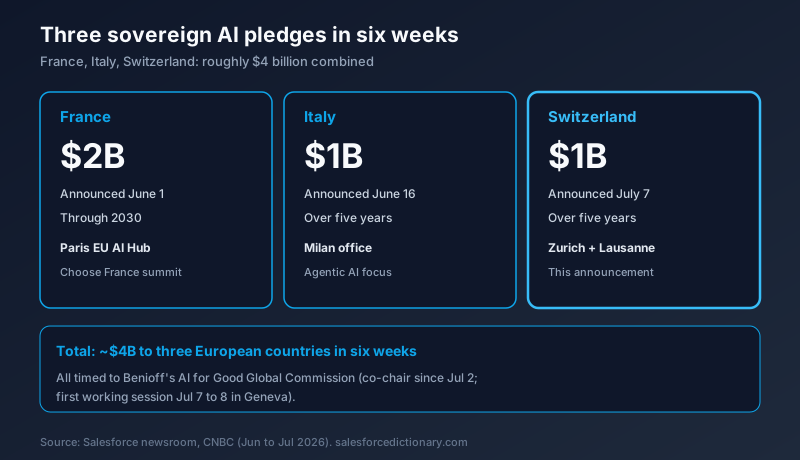
The timing is not random either. All three land in the same window as Benioff's diplomatic push around the AI for Good Global Commission, the UN-linked body he agreed to co-chair on July 2, whose first working session runs July 7 and 8 in Geneva. This site covered the governance side of that commission separately; the short version is that it convenes serious power without the authority to bind anyone to anything. The Switzerland money and the Geneva commission seat were announced the same week, in the same country, by the same CEO. Read together, they are one campaign. Salesforce is positioning itself as the enterprise AI partner of European governments at the exact moment those governments are deciding whose AI to trust and whose to regulate.
The skeptic's read
Four billion dollars in six weeks is a lot of goodwill spend for a company whose stock has fallen sharply on the year and whose AI revenue story Wall Street keeps questioning.
CNBC laid the doubt out on June 29 in a piece titled "Salesforce is on an AI buying spree, but Wall Street still has its doubts." The core worry is simple. Salesforce has deployed enormous capital in the AI era through acquisitions, buybacks, and now sovereign pledges, and analysts are not yet seeing it convert into the Agentforce revenue growth that would justify the outlay. A billion-dollar country commitment is a five-year operating and goodwill line, not a number that lands in next quarter's results. It buys pipeline and political access. It does not, by itself, close the gap between AI ambition and AI revenue that the market has been marking Salesforce down for since spring.
So the skeptical framing writes itself. Three national announcements in six weeks generate headlines, government access, and a co-chair seat at a UN commission. What they do not visibly generate, at least not yet, is the Agentic Work Unit growth Salesforce keeps telling investors to watch. The customer references are the counterweight, and they are the reason the Switzerland release is not empty. Syngenta running Agentforce for 14 years of partnership is a real, monetized deployment. But one flagship customer per country is a thin base to hang a billion-dollar number on, and the market knows how to read the difference between a signed reference and a signed check.
None of this makes the Swiss commitment fake. The customers are live, the programs have run for years, the office presence is two decades deep. It makes the commitment strategic rather than charitable, and strategic in a way aimed as much at European policymakers as at Swiss buyers. Whether that strategy shows up in revenue is the open question, and it is the same one France and Italy left hanging. A fourth country announcement would sharpen the skeptics' point rather than answer it.
What to do next
If you run Salesforce in Switzerland or anywhere in the EU, treat this like the France pledge: the practical value is access, not the headline. Ask your account team what the workforce and AI skills programs actually offer your org, and whether Swiss customers get priority co-build or support resources out of this commitment. Those are the concrete benefits you can use; the rest is positioning you can safely ignore. If your teams need agent literacy, ask specifically about the training tied to this pledge rather than waiting for a general rollout.
If you track the stock, do not score $4 billion in European pledges as a catalyst. Score it as narrative until an earnings call cites European Agentforce revenue by name. Watch the next two quarters for that exact line. Until it shows up, the CNBC skeptics hold the stronger position, and the smartest thing you can do with a billion-dollar country headline is wait for the customer numbers that either back it or don't.
About the Author
Dipojjal Chakrabarti is a B2C Solution Architect with 29 Salesforce certifications and over 13 years in the Salesforce ecosystem. He writes and edits salesforcedictionary.com, published by KineticBit Inc., to help admins, developers, architects, and cert/interview candidates sharpen their fundamentals. More about Dipojjal.
Share this article
Sources
- Salesforce Deepens Commitment to Switzerland with $1 Billion Investment to Accelerate Agentic AI Transformation (Salesforce Newsroom)
- Salesforce Deepens Commitment to Switzerland with $1 Billion Investment (MarketScreener)
- Salesforce Commits $1 Billion To Switzerland To Accelerate Agentic AI Push (Benzinga)
- Salesforce is on an AI buying spree, but Wall Street still has its doubts (CNBC)
Related dictionary terms
Practise it
Five questions on Agentforce Specialist
Exam-style questions with an explanation after each one. No account needed, and your answers build a weak-topic map once you have one.
More news

Free Agentforce Lands in Singapore
Salesforce switched on free Agentforce and Slack CRM for Singapore SMBs on July 1, 2026. Hours later, Guggenheim upgraded the stock to Buy. Here is what shipped, what it costs once you exceed free, and what to check first.
Benioff's AI Commission Has No Teeth
As the UN Global Dialogue on AI Governance opens with 193 nations, scientists warn AI could cause catastrophic harm, and critics note Benioff's commission cannot force a single member to comply.
Salesforce's $2B France Bet
Salesforce pledged $2 billion to France through 2030 at the Choose France summit on June 1, anchored by a Paris AI Innovation Hub, the first of its kind in the EU. It sat inside a record €93 billion of AI-heavy summit pledges.
Comments
No comments yet. Start the conversation.
Sign in to share your take on this article. Your account works across every page.