
Salesforce's August 3 Sync Deadline
Microsoft is switching off Exchange Web Services and three Salesforce features ride on it. The recommended Graph upgrade date is Monday, and two Salesforce research drops from the last 48 hours explain why stale activity data has become an Agentforce problem.
Open Setup, find your [Einstein Activity Capture](/terms/einstein-activity-capture) configuration, and look at which connection method the Microsoft 365 account uses. If it reads Exchange Web Services, you have two days.
August 3 is the date Salesforce and its partners have been circulating for upgrading existing Microsoft 365 connections to Microsoft Graph. It is not the moment anything breaks. It is the buffer date, picked so that user reconnection and testing finish before the real cutoff lands. The real cutoff belongs to Microsoft, not Salesforce, which is exactly why it has been so easy to leave off the release calendar.
Three Salesforce features sit on top of Exchange Web Services: Einstein Activity Capture, Salesforce Inbox, and Lightning Sync. All three stop capturing when EWS goes.
The Deadline Is Microsoft's, the Damage Is Yours
Microsoft has been retiring EWS in Exchange Online in phases, and the phases have teeth.
From October 1, 2026, EWS calls are blocked in Exchange Online unless the tenant explicitly configures an AppID allowlist and sets EWSEnabled to True. That is a temporary reprieve rather than an opt-out, and it has its own paperwork deadline: if your organisation needs EWS past October, the allowlist has to be in place before the end of August. On April 1, 2027, EWS access is removed permanently. No allowlist, no re-enablement, no exceptions.
Salesforce's guidance sits inside that window. Upgrade the Microsoft 365 connections to Graph by August 3, so that the reconnection work and the inevitable long tail of users who ignore the prompt are handled with two clear months to spare.
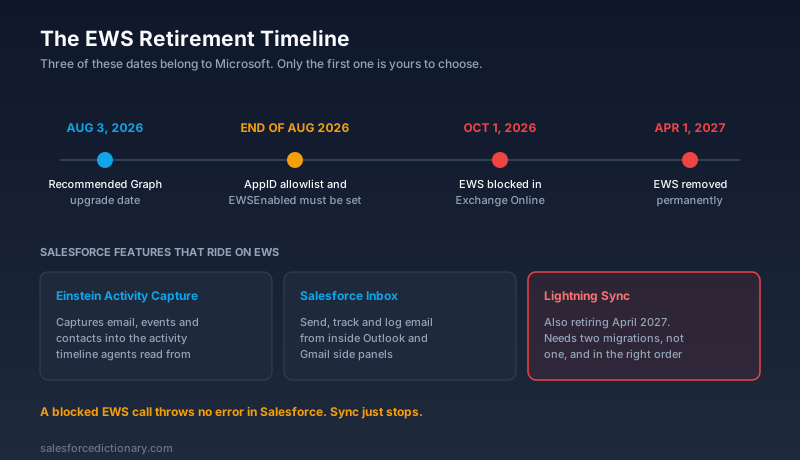
What makes this one nastier than the usual deprecation is the failure mode. A blocked EWS call does not throw a red banner on the account page. Email and event capture simply stops. Activities stop landing on records. Reps log by hand for a week, then stop logging at all, and the CRM's account of who touched which opportunity quietly goes hollow while every dashboard keeps rendering. By the time someone notices the activity timeline has thinned out, the gap is a quarter deep.
Compare that with the connected app deadline in May, which broke loudly and got fixed inside a day. Loud failures get fixed. Silent ones get discovered in a QBR.
Two Migrations Wearing One Deadline
Orgs still running Lightning Sync have the harder version of this problem, because they are looking at two migrations stacked on top of each other.
Lightning Sync retires in April 2027 and the replacement is Einstein Activity Capture. So the sequence for a Lightning Sync org is: run the Lightning Sync migration tool to move onto EAC, grant users the Einstein Activity Capture permissions, turn Lightning Sync off, and only then upgrade that EAC connection from EWS to Microsoft Graph.
The ordering matters more than it looks. Migrate to EAC without the Graph step and you have moved onto the supported product while still sitting on the protocol that gets blocked in October. You did the work and bought nothing.
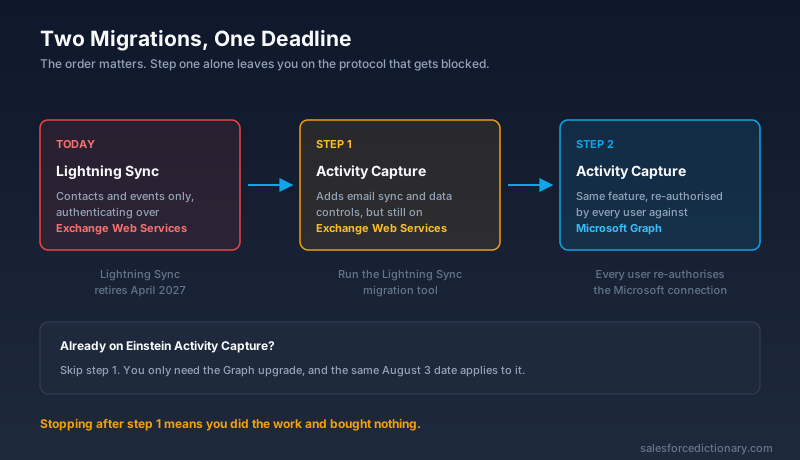
There is a genuine upside on the other side of it, and it is worth stating plainly because the migration is otherwise a pure tax. Einstein Activity Capture adds email sync on top of the contact and event sync Lightning Sync did, gives admins more control over what gets stored and where, and is the surface that AI and agent features actually read from. Lightning Sync was a pipe. EAC is a pipe with a data model attached.
The cost is user-visible. Each user re-authorises the Microsoft connection. Plan for the support tickets, and plan for the people who are on holiday in August and come back to a broken Outlook panel in September.
August Was Already Full
The calendar does not help.
Winter '27 preview sandboxes get upgraded around August 29, with the production release weekends running August 29, October 3, and October 10. That puts a sandbox refresh decision in the last week of August, right after the Graph deadline, and it puts the October 1 EWS block squarely between the two October release weekends.
Read the sequencing once and it is obvious what goes wrong. A team that refreshes a preview sandbox in late August, tests Winter '27 through September, and deploys on the October 10 weekend will hit the EWS block nine days before the deploy, in production, while everyone's attention is on the release. Our Winter '27 sandbox preview guide has the refresh mechanics. The point here is simply that the two workstreams collide, and only one of them has a hard external date.
Why This Is an Agentforce Problem
Activity data is grounding data. That is the part that turns a mail-sync chore into something a solution architect should care about.
Einstein Activity Capture is what feeds email and meeting history into the activity timeline. The activity timeline is what a sales agent reads when it summarises an account, drafts a follow-up, or decides an opportunity has gone quiet. Cut the sync and the agent does not fail. It keeps answering, fluently, from a record that stopped updating in October. An agent grounded on stale data is more dangerous than an agent that is switched off, because the output looks identical to the output you trusted last quarter.
Salesforce published research on July 30 that makes the same argument from a different direction. The field service study surveyed 2,317 professionals across nine countries between April 22 and May 12, and the headline numbers are a study in mismatch. Ninety-five percent of field service organisations have deployed AI. Eighty-five percent plan to increase that investment over the next one to two years. Sixty-six percent report increased mobile worker turnover over the past two years, and the top driver of that turnover is insufficient training on the new technology.
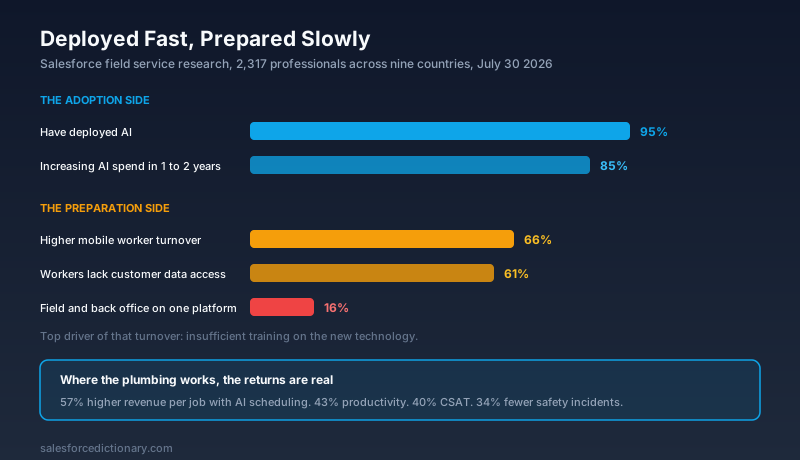
Two more numbers from that study land directly on the sync question. Sixty-one percent say mobile workers do not have sufficient access to customer data, and only 16 percent have field and back-office technology unified on a single platform. The AI is deployed. The data it runs on is scattered, and in a few thousand orgs one of the pipes carrying it is about to be switched off by a vendor nobody in the Salesforce team reports to.
Where the plumbing does work, the returns show up. Fifty-seven percent of organisations using AI-powered scheduling and dispatch report higher revenue per job. Forty-three percent report improved mobile worker productivity, 40 percent better customer satisfaction, and 34 percent fewer safety incidents. The technology is doing its job. The preparation around it is the constraint.
The Commerce Numbers Say It Twice
Salesforce published a second set of research on July 28, and it repeats the pattern in a different market.
Agentic search grew 200 percent year over year, measured across 1.5 billion global shoppers in 37 countries between the first quarter of 2024 and the first quarter of 2026. Traffic referred from AI chats grew between 150 and 428 percent year over year in every quarter measured, against overall traffic growth in the single to low double digits. Caila Schwartz, who leads shopper insights for agentic commerce at Salesforce, put it directly: "Customers aren't starting with 10 blue links anymore. They're asking an AI what to buy, and by the time they reach your site, they've already formed an opinion."
Then the readiness numbers from the same release. Twenty-eight percent of commerce organisations currently use agentic AI and 44 percent plan to adopt within six months. Only 32 percent have fully defined AI success metrics. Seventy-eight percent report growing vendor counts. Twenty-seven percent have unified customer data across departments.
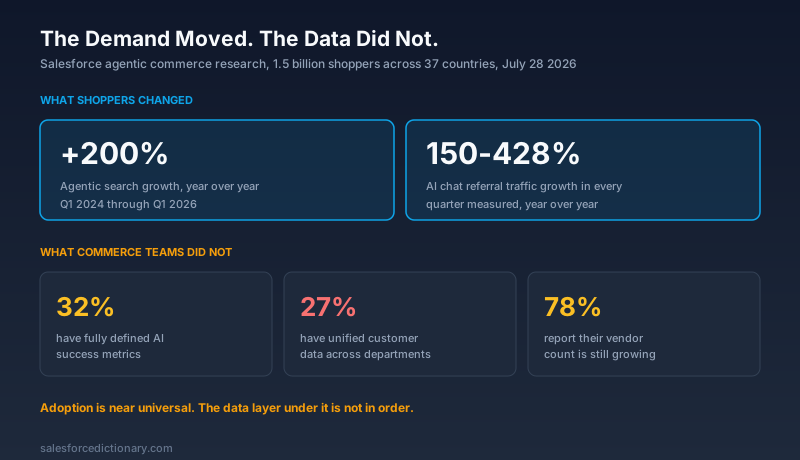
Three Salesforce publications inside a week, covering jobs, field service, and commerce, all arriving at the same finding. Adoption is close to universal. The data layer underneath it is not in order. The August 3 deadline is that finding in miniature, with a date attached.
The rest of the week was quieter. Salesforce showed Agentforce Public Sector for licensing, permitting and inspections at the White House Council on Environmental Quality's Permitting Innovators Expo on July 31, a week after the Department of Veterans Affairs awarded the company a three-year agentic enterprise licence agreement with a $1.6 billion ceiling covering Missionforce, Agentforce, Slack, MuleSoft, Tableau, and Data 360. CRM closed July 31 at $184.02.
What To Do Before Monday
Start with an inventory, because most orgs do not actually know which connection method they are on.
In Setup, open Einstein Activity Capture and check the connection method on every Microsoft 365 configuration, not just the default one. Do the same for Salesforce Inbox and, if it is still switched on, Lightning Sync. Write down which configurations say Exchange Web Services and how many users sit under each.
If you are on EAC with EWS, upgrade that connection to Microsoft Graph now and communicate the re-authorisation to users before you flip it, not after. If you are still on Lightning Sync, run the migration tool to EAC first, then do the Graph upgrade, and treat those as two changes with a test window between them rather than one Saturday.
If you genuinely cannot finish before October, get your Exchange administrator to configure the AppID allowlist and set EWSEnabled to True before the end of August. That buys you until April 1, 2027 and not one day past it, so book the real migration while you are asking.
Then set a monitor. Add a scheduled check on activity record volume per week, alert on a drop, and put it in front of a human. The whole reason this deadline is dangerous is that missing it looks like nothing at all.
About the Author
Dipojjal Chakrabarti is a B2C Solution Architect with 29 Salesforce certifications and over 13 years in the Salesforce ecosystem. He writes and edits salesforcedictionary.com, published by KineticBit Inc., to help admins, developers, architects, and cert/interview candidates sharpen their fundamentals. More about Dipojjal.
Share this article
Sources
- Microsoft Is Killing EWS: What Every Salesforce Admin Needs to Do Before October 2026 (Concept)
- Retirement of Exchange Web Services in Exchange Online (Microsoft Exchange Team Blog)
- Move from Lightning Sync to Einstein Activity Capture (Salesforce Help)
- Salesforce Winter '27 Release Date and Preview Information (Salesforce Ben)
- New Research: Field Service Leaders Face a Growing Talent Crisis and ROI Challenge (Salesforce, July 30 2026)
- Shopping's New First Step: Agentic Search Grows 200% (Salesforce, July 28 2026)
- VA Awards Salesforce $1.6B Contract to Transform Veteran Care and Services (Salesforce Newsroom)
Related dictionary terms
 Our appAdWake up sharp. Not just awake.The alarm that rings through Silent and DND — free on iOS & Android.Get WakeSharp →
More news
Salesforce's AI Jobs Never Arrived
A 2025 study found 72 prompt engineer vacancies across 20,000 LinkedIn listings. Salesforce's operating margin hit 22 percent against a 14.2 percent five-year average. Those two facts are the same story.
Salesforce Security Enforcement Week
Step-up auth for reports broke things, Salesforce patched mid-enforcement, and the next wave hits sandboxes tomorrow. Here is the current state and what to do before July 1.
The May 11 Connected App Deadline
Salesforce's mandatory PKCE and Refresh Token Rotation deadline for every AppExchange Connected App and External Client App lands May 11. Here is what changes Monday.


Comments
No comments yet. Start the conversation.
Sign in to share your take on this article. Your account works across every page.