
Salesforce Momentum: Conversation Intelligence Written Straight Into Your CRM
Salesforce bought Momentum to capture what customers actually say on calls, then write it back into Salesforce as structured data. Here is how it feeds Agentforce Sales, how it differs from Einstein Conversation Insights, and where it still bites.
The call ended twenty minutes ago. Your rep opens the opportunity and types six words into the notes field: "Good call, sending follow-up next week." What the prospect actually said on that call, that their budget got cut in half, that the internal champion is leaving in August, that a competitor already emailed them a signed order form, lives nowhere your forecast can see it. It evaporated the moment the Zoom window closed.
That gap is the entire reason Salesforce bought Momentum. Not to give you prettier call summaries. To stop the highest-value data your company generates from disappearing into a rep's short-term memory.
What Momentum actually is
Momentum is a conversational insights and revenue orchestration platform. It captures unstructured data from voice and video interactions, then converts it into structured records that live inside Salesforce. Salesforce announced the acquisition on February 18, 2026 and expected it to close in its first fiscal quarter of 2027 (Salesforce Ben). It was one of a long run of 2026 Agentforce-adjacent acquisitions, and the pattern behind that run matters. CX Today counted it among roughly ten deals in six months and read the strategy plainly: rather than rebuild the data layer Agentforce needed from scratch, Salesforce "largely bought its way out" of it (CX Today).
The piece Momentum fills is a specific one. Salesforce CPO Steve Fisher framed it in the announcement: "To deliver on the promise of agents, we need visibility and context from every meaningful interaction" (Salesforce Newsroom). An agent that recommends the next step on a deal is only as good as its picture of the deal. If that picture is six words in a notes field, the recommendation is guesswork wearing a confidence score.
Momentum ships as part of the Summer '26 release, which reached general availability on June 15, 2026 after production waves starting June 13. Salesforce describes it capturing "calls, emails, and meetings" and writing that data back to Salesforce in real time, "with no change to how reps work today" (Salesforce Newsroom). That last clause is the sales pitch to your reps: nobody has to fill in another form.
The fidelity gap, in one picture
Before you decide whether Momentum is worth turning on, look at what it is actually replacing. Your CRM already has a record of every deal. The problem is that the record is written by the person with the least time and the most incentive to be optimistic.
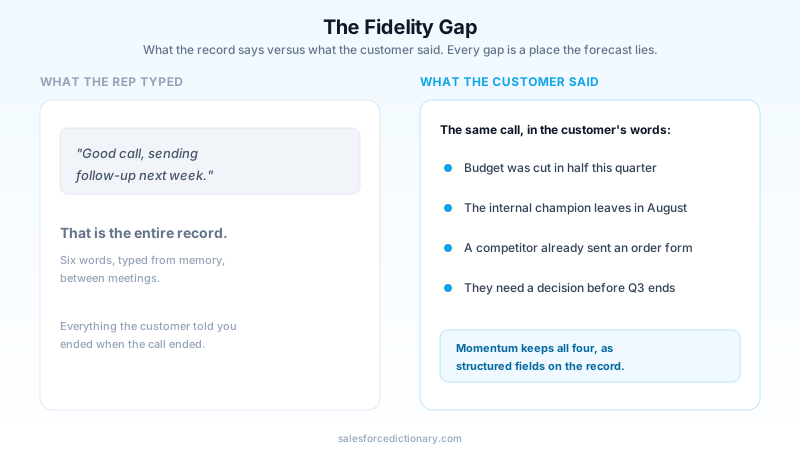
The left side is the record most orgs run on today. The right side is what the customer said. Every gap between them is a place your pipeline reports lie to you, and none of it is malice. Reps type notes between meetings, from memory, in the words they wish the customer had used. Momentum's argument is that the raw conversation is the source of truth, and the rep's summary is a lossy copy of it.
How the capture and writeback works
Momentum runs on what Salesforce calls a universal ingestion engine. It pulls conversation data from third-party voice and video channels, Zoom and Google Meet named explicitly, plus email and calls, and applies the resulting insights to agentic workflows inside Agentforce 360 and Slack (Salesforce Ben). The founder, Santiago Suarez Ordoñez, described the company's purpose as bridging "the gap between unstructured conversation and structured action." Structured action is the operative phrase. The output is not a transcript you have to read; it is fields, tasks, and signals attached to the right records.
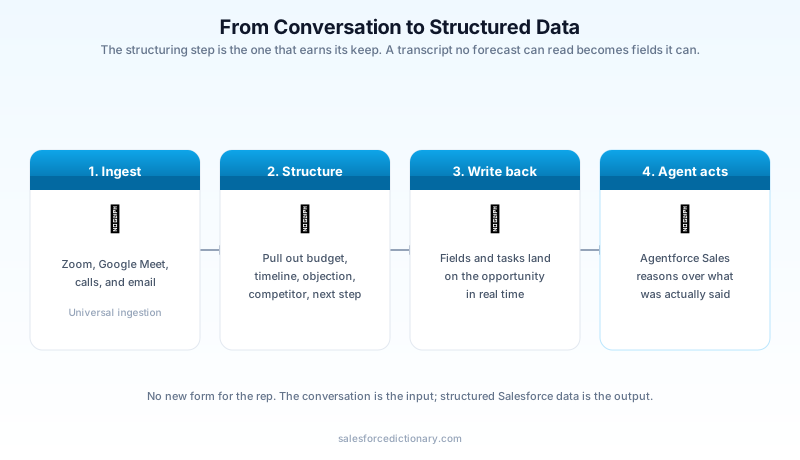
Read that pipeline left to right. Ingestion sits at the front: the recording and transcript arrive from wherever the conversation happened. Structuring is the step that earns the money. A raw transcript is unstructured text, useless to a forecast. Momentum extracts the parts that map to your data model: the stated budget, the decision timeline, the objection, the named competitor, the next commitment. Writeback lands those on the opportunity and contact in real time, so the record updates while the deal is still warm rather than at end of quarter when someone runs a hygiene report.
The last box is why this sits under Agentforce and not off in a standalone analytics tool. Once the conversation is structured Salesforce data, Agentforce Sales can act on it. Momentum is described as the foundation Agentforce Sales needs so that "deals move faster, forecasts reflect reality, and revenue stops slipping through the cracks" (Salesforce Newsroom). The agent stops reasoning over a rep's optimistic summary and starts reasoning over what the customer said.
A concrete version helps. A prospect says on a Zoom call: "We like it, but we cannot move until the new fiscal year in April, and honestly Acme quoted us fifteen percent lower." A rep types "positive call, budget concern." Momentum, working from the same sentence, can set the close date to the new fiscal quarter, flag a pricing objection, tag Acme as a competing vendor on the opportunity, and create a follow-up task for late March. None of that required the rep to fill in a field. The next time Agentforce Sales looks at the deal, it sees a timeline and a competitor, not a vague sentiment word.
Momentum and Einstein Conversation Insights: do you need both?
This is the first question every existing Sales Cloud customer asks, because Salesforce already had conversation intelligence. Einstein Conversation Insights (ECI) has recorded, transcribed, and analyzed sales calls for years. So what is Momentum doing that ECI was not?
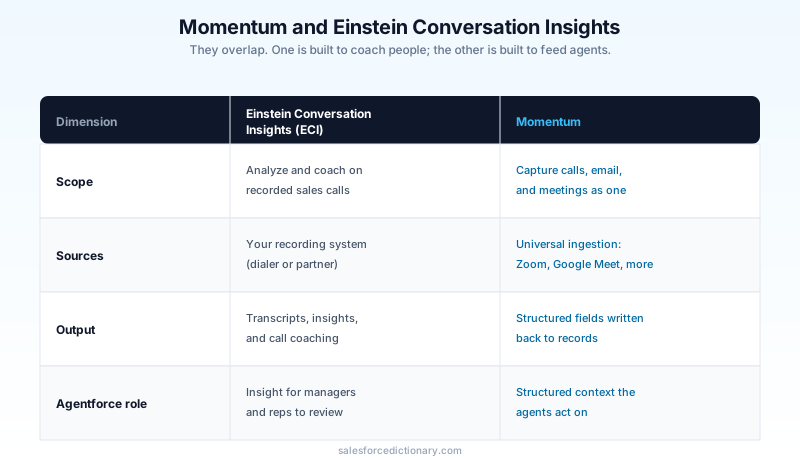
The honest read: they overlap, and Salesforce has not yet drawn a hard line between them in public docs. ECI is built to analyze recordings and surface coaching insight. It does not initiate call recordings itself. It connects to your recording system, whether that is Lightning Dialer or a supported partner, and processes the audio and video you already capture (Salesforce Help). Its center of gravity has always been the call: transcripts, keyword tracking, call coaching, win/loss recaps.
Momentum's framing is wider and pointed at a different target. It treats calls, emails, and meetings as one stream and optimizes for one output, structured records written back for agents to act on. ECI helps a manager coach a rep. Momentum feeds a machine. If you already run ECI, expect Momentum to sit alongside it and above it rather than rip it out, at least through 2026. Treat the two as complementary until Salesforce publishes a clear consolidation story, and do not rush to disable ECI coaching your managers actually use.
Where this lands against Gong and Clari
If Momentum sounds familiar, that is because Gong, Clari, and Chorus have owned this category for years, and plenty of Salesforce shops already pay one of them. The interesting part of Momentum is not that it does something those tools cannot. It is where the data ends up.
Gong is a strong standalone platform that integrates with Salesforce but stores the conversation data in its own system. You get excellent analysis, and you get another place your customer data lives. Momentum's whole design goal is the opposite: the conversation becomes native Salesforce data on the standard objects, inside the same trust and sharing model as the rest of your CRM. For an org already committed to Agentforce, that native path is the argument. The agent reasons over one data model, not over an API round-trip to a third party.
That does not make Momentum better than Gong at analysis today. Gong has years of head start on the coaching and deal-intelligence surface. It makes Momentum better positioned for the specific job Salesforce cares about right now: feeding agents. If your team lives in Gong dashboards and loves them, Momentum is not an obvious replacement yet. If your team barely touches Gong and you are building on Agentforce Sales, paying for a standalone tool to hold data you want inside Salesforce anyway starts to look like a tax.
What it costs, and what is still fuzzy
Here is the part the launch posts skip. As of the Summer '26 rollout, Salesforce has not published clean standalone pricing for Momentum the way it has for a per-user add-on. It arrived through an acquisition that closed inside the fiscal quarter, and its capabilities are being folded into the Agentforce Sales and Agentforce 360 story rather than sold as a tidy SKU with a public price card. Assume the cost shows up bundled into your Agentforce Sales entitlement and consumption, and get the specifics from your account executive in writing before you plan a budget around it.
A few other things are still fuzzy and you should treat them as open questions, not settled facts: the exact division of labor between Momentum and Einstein Conversation Insights over time, which conversation channels are supported at GA versus on the roadmap, and how Momentum's capture interacts with call recording you already run through a partner dialer. None of that should stop a pilot. All of it should stop you from signing an org-wide rollout on the strength of a keynote slide.
What you have to get right before you turn it on
Recording conversations is a legal act, not a feature toggle. This is where I get blunt: turning on conversation capture without a consent plan is how you end up in front of your legal team, and "the AI did it" is not a defense.
Salesforce is explicit that with ECI, managing consent and complying with local privacy law is your responsibility, not the platform's (Salesforce Help). The same logic carries to Momentum, and it gets harder, not easier, because Momentum ingests across more channels. Two-party consent states, GDPR, and recording disclosure rules all apply the moment you capture a call, regardless of how cleanly the transcript later maps to an opportunity field.
Three things to settle before the first recording lands:
- Consent and disclosure. Decide how prospects are notified that calls are recorded and analyzed, and make sure that notice covers AI processing, not just recording. Get this in writing from legal per region.
- Access control. Conversation data is some of the most sensitive data in your org. Recordings and transcripts hold pricing, personal detail, and offhand remarks nobody meant for the CRM. ECI already gates recording access behind role-based permissions you request from an admin. Plan the equivalent sharing model for Momentum data before it exists, not after.
- The Trust Layer. Anything Momentum sends to an LLM should ride the Einstein Trust Layer, which masks selected PII and PCI data before it reaches the model and enforces a zero-retention policy so your conversation data is not retained by the model provider. If you have not read how the Trust Layer masking rules actually work, do that first, because a conversation transcript is exactly the kind of free text where PII hides in plain sight.
Where it bites
Two honest cautions. First, the capture-everything model only pays off if your data model can catch what it captures. If your opportunity stage definitions are mush and your competitor field is a free-text mess, Momentum will faithfully write structured data into a structure that cannot support it. Garbage schema in, confident garbage out. Fix your data model before you point a firehose at it.
Second, "no change to how reps work today" is a promise about input, not about trust. The first time an agent surfaces a deal risk your rep did not flag, pulled from a call the rep thought was private-ish, you will have a culture conversation on your hands. Reps who feel surveilled route their real conversations off the recorded channels, and then you are back to six words in a notes field, except now you paid for the privilege. Roll this out as a tool that makes reps look good to their manager, not as a monitor that catches them out. The technology is the easy part.
What to do now
Before you request a Momentum trial or turn anything on, run one exercise this week. Pull ten closed-lost opportunities from last quarter and read the notes field on each. Count how many tell you the real reason the deal died in a way a forecast could have acted on. If that number is low, and it almost always is, you have just measured your fidelity gap in your own data, and you have the business case. Take that number to whoever owns your consent and access policy, settle the three governance items above, then scope a pilot on a single team before you touch the whole org.
About the Author
Dipojjal Chakrabarti is a B2C Solution Architect with 29 Salesforce certifications and over 13 years in the Salesforce ecosystem. He writes and edits salesforcedictionary.com, published by KineticBit Inc., to help admins, developers, architects, and cert/interview candidates sharpen their fundamentals. More about Dipojjal.
Share this article
Sources
- Salesforce Acquires Momentum to Power Agentforce With Zoom and Google Meet (Salesforce Ben)
- Salesforce Signs Definitive Agreement to Acquire Momentum (Salesforce Newsroom)
- Summer '26 Release: 10 Innovations Bringing the Agentic Enterprise to Life (Salesforce Newsroom)
- Considerations for Setting Up Einstein Conversation Insights (Salesforce Help)
- Is Salesforce Buying Its Way to a Better Agentforce? (CX Today)
Related dictionary terms
Practise it
Five questions on Agentforce Specialist
Exam-style questions with an explanation after each one. No account needed, and your answers build a weak-topic map once you have one.
Keep reading

The New Agentforce Builder and Agent Script: What Changes July 13, 2026, and How to Upgrade
Starting the week of July 13, 2026, the New Agent button disappears from the legacy Setup builder. Here is what the new Agentforce Builder and Agent Script change, what still works, and how to upgrade an existing agent without breaking it.

Agentforce Sales: The Complete 2026 Guide (Formerly Sales Cloud)
Sales Cloud got a new name and five new agents. This 2026 guide cuts through the marketing: what changed, the SDR and Sales Coach agents, the pricing tiers, and the 30-day rollout that actually works.
Salesforce Data 360: The Complete 2026 Implementation Guide
Data 360 is Salesforce's unified data platform for the agent era. This 2026 implementation guide walks data streams, identity resolution, segmentation, activations, and zero-copy federation.

Salesforce Einstein Trust Layer: The Complete 2026 Guide to Secure AI
Your security team asks where the customer data goes when Agentforce processes it. Here is the full answer: how the Einstein Trust Layer's prompt journey, data masking, zero-data retention, and toxicity detection actually work.
Comments
No comments yet. Start the conversation.
Sign in to join the discussion. Your account works across every page.