
Pardot
Pardot is the former name of Salesforce's B2B marketing automation product, renamed Marketing Cloud Account Engagement in 2022.
Definition
Pardot is the former name of Salesforce's B2B marketing automation product, renamed Marketing Cloud Account Engagement in 2022. The name was retired. The product was not.
Pardot reached Salesforce through the ExactTarget acquisition in 2013. Prospect scoring, grading, engagement programs, and the Salesforce connector all predate the rename and survived it unchanged.
The old name survives wherever Salesforce never rewrote a string, which is most places a machine reads rather than a person.
In plain English
“A company called Pardot built software that helps businesses follow up with people who show interest in what they sell. Salesforce bought it, then gave it a longer name. Same software, new label. When someone says Pardot today, they mean that product.”
Worked example
A marketing ops lead at a 400-person logistics firm opens a runbook written in 2020. Step three checks the Pardot Score field on the Lead before routing. The label no longer says Pardot, but it is the same field, fed by the Account Engagement connector. Step seven pastes a tracking snippet pointing at pi.pardot.com. Both steps still work. Only the cosmetics are stale: Setup labels now read Account Engagement.
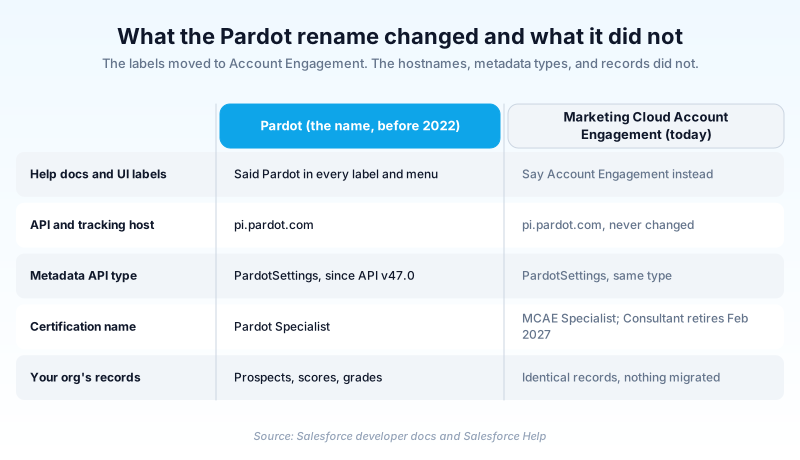
What the rename changed and what it left alone
The 2022 rename was branding, not re-platforming
Salesforce folded the product under the Marketing Cloud umbrella and gave it a longer name. Nothing was migrated and no org was reconfigured. The Monday after behaved exactly like the Friday before. Salesforce has genuinely retired marketing products, and those retirements removed capability on a published deadline. This one took a word.
Where Pardot is still hard-coded
The API answers on pi.pardot.com across versions 3, 4, and 5, with pi.demo.pardot.com for demo accounts. The Metadata API type is PardotSettings, available since API version 47.0, and Salesforce keeps adding switches to it: enableAeDataConnector and cdpEnablementStatus both cover Data 360 wiring, and enableEngagementHistoryDashboards controls dashboard sharing. Read the field list before you copy an old package forward, though. Three older fields now carry Deprecated notices: enablePardotEnabled, enablePardotObjectSync, and enableB2bmaAppEnabled. The type is live. Some of its parts are not.
The credentials moved, and one is closing
The Specialist exam is now Salesforce Certified Marketing Cloud Account Engagement Specialist. Do not plan around the matching Consultant credential. Registration closed on 24 July 2026, the last sitting is 31 August 2026, and it retires on 1 February 2027, with the skills folded into an Agentforce Marketing certification. Trailhead retitled its content too: the foundational badge reads Marketing Cloud Account Engagement Basics while its URL still says modules/pardot-basics-lightning. Titles get rewritten because people read them. Identifiers do not, because integrations depend on them.
What to call it in 2026
Write Account Engagement in anything a customer reads. Say Pardot when you are searching, because a decade of forum answers indexes under it. On the product itself, two facts sit together. The Summer '26 release notes still add real capability: engagement history on Opportunity records, consent mapping into Marketing Cloud Next. But that cycle reads as maintenance, Salesforce now ships a Marketing Cloud Next foundations module aimed at Account Engagement customers, and the Consultant exam is closing. Supported and steady, then. Not the thing Salesforce is betting on next.
Trust & references
This term has been renamed to Marketing Cloud Account Engagement.
View current pageCross-checked against the following references.
- Get Started with the Account Engagement API (opens in new tab)Salesforce
- PardotSettings, Metadata API Developer Guide (opens in new tab)Salesforce
- Version 5 Docs, Account Engagement API (opens in new tab)Salesforce
- Version 3 and 4 Overview, Account Engagement API (opens in new tab)Salesforce
- Marketing Cloud Account Engagement Release Notes (opens in new tab)Salesforce
- 2027 Salesforce Certification Retirements FAQ (opens in new tab)Salesforce
Straight from the source - Salesforce's reference material on Pardot.
Hands-on resources to go deeper on Pardot.
About the Author
Dipojjal Chakrabarti is a B2C Solution Architect with 29 Salesforce certifications and over 13 years in the Salesforce ecosystem. He writes and edits salesforcedictionary.com, published by KineticBit Inc., to help admins, developers, architects, and cert/interview candidates sharpen their fundamentals. More about Dipojjal.
Test your knowledge
+5 pts / dayQ1. Which host do the Account Engagement API and tracking endpoints still resolve to?
Q2. What happened inside customer orgs when Salesforce renamed Pardot in 2022?
Q3. Which Metadata API type controls Account Engagement settings in a Salesforce org?
Discussion
Loading discussion…