
Knowledge Agent
A Knowledge Agent is an informal name for the person on the support side who works with Salesforce Knowledge articles.
Definition
A Knowledge Agent is an informal name for the person on the support side who works with Salesforce Knowledge articles. They read articles while handling cases and, with the right access, draft, edit, publish, and archive them. The phrase is a team habit rather than a Salesforce one, and it is now the older label. Salesforce Help never used it. Current documentation says Knowledge author instead of Knowledge Agent, and Knowledge User for the feature license the role requires.
The wording matters more than it used to, because Agentforce reassigned the word agent. Today that noun usually points at software, not at the person who wrote the article.
The work itself is entirely current. Authoring still runs on the standard Knowledge object and still needs the Knowledge User license. What those articles feed has expanded: self-service sites, agent assist in the console, and AI grounding.
In plain English
“Someone at a company has to write the help articles that answer customer questions. Support teams have called that person a Knowledge Agent for years. Salesforce itself says Knowledge author, because the word agent has come to mean a piece of software instead.”
Worked example
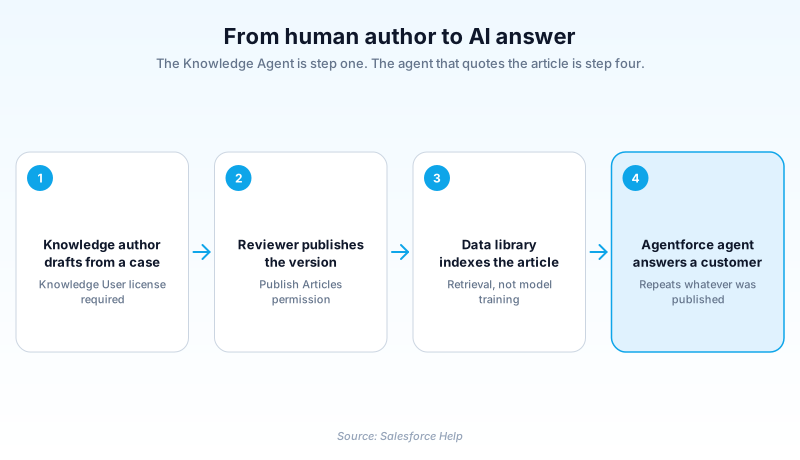
At a regional broadband provider, a tier-1 rep whose permission set is still called Knowledge Agent closes a case about modems dropping out. She drafts an article from the case and picks the How To record type. She titles it "Modem Reconnects Every 15 Minutes" and tags the Data Categories Product = Broadband and Region = EMEA. Her permission set grants Manage Articles but not Publish Articles. So the version sits in Draft until a Knowledge Manager reviews it and publishes it to the public channel. From there the article is indexed by the org's Agentforce Data Library and quoted back to customers in chat.
What the label meant, and what to call it now
The architecture the label outlived
No Salesforce document coined this. It grew inside support teams, where everyone on the case queue was an agent and some of them wrote too. Any tidy origin story you read is invention, however official it sounds. In the Classic era every article format was its own custom object, called an article type. Lightning Knowledge collapsed that: articles now live on one standard object, and the old article types became record types. Salesforce has since pushed orgs off Classic through a release update and the Lightning Knowledge Migration Tool.
The license and the permissions behind it
Reading published articles is free. Internal users, community members, partners, and unauthenticated guests all read without a special license. Writing is the part that costs. An author needs the Knowledge User feature license, still granted by the Knowledge User checkbox on the user record under Setup, Users. On top of that sit the article permissions, granted through a permission set: Manage Articles, Publish Articles, Manage Salesforce Knowledge, and Manage Data Categories.
Turning it on, the long way and the short way
The manual route has not moved. From Setup, enter Knowledge in the Quick Find box and click Knowledge Settings, then enable Lightning Knowledge. Service Setup is a separate onboarding launcher, not a stop on this path. Salesforce Go is the newer shortcut: search for Knowledge, click Manage, and one pass turns the feature on, assigns author licenses, and seeds starter data categories.
The word agent means something else now
Agentforce took the noun. In a current org an agent is an autonomous AI handling a customer conversation, and one of its standard actions is Answer Questions with Knowledge. That action reads from an Agentforce Data Library, which indexes published articles and retrieves them mid-conversation. So a permission set called Knowledge Agent is genuinely ambiguous. It might grant a person the right to write articles, or it might be a half-finished attempt at wiring up a bot. Rename it Knowledge Author.
The human role got more consequential, not less
It would be easy to read the rename as a demotion. It is the opposite. When a rep hit a weak article, they rewrote the answer in their own words. An AI agent does not. It retrieves what is published and phrases it fluently. A stale workaround becomes a confident wrong answer on a public channel, with nobody in the loop to catch it. Article quality used to be measured in helpful votes. It now decides what your AI tells customers.
How organizations use Knowledge Agent
Scopes the Knowledge source on its Agentforce Data Library so the public-site agent retrieves customer-facing articles only, and internal troubleshooting notes stay out of the index.
Splits the role: claims reps get Manage Articles to draft from resolved cases, and two Knowledge Managers hold Publish Articles so nothing ships unreviewed.
Trust & references
Cross-checked against the following references.
Straight from the source - Salesforce's reference material on Knowledge Agent.
Hands-on resources to go deeper on Knowledge Agent.
About the Author
Dipojjal Chakrabarti is a B2C Solution Architect with 29 Salesforce certifications and over 13 years in the Salesforce ecosystem. He writes and edits salesforcedictionary.com, published by KineticBit Inc., to help admins, developers, architects, and cert/interview candidates sharpen their fundamentals. More about Dipojjal.
Test your knowledge
+5 pts / dayQ1. In a current Salesforce org, what does a user need before they can create and edit Knowledge articles?
Q2. What happens to Classic article types when an org moves to Lightning Knowledge?
Q3. An author publishes an article containing a workaround that stopped working months ago. What happens in an Agentforce org?
Discussion
Loading discussion…