
Salesforce News Roundup: May 8-9, 2026
Summer '26 lands in sandboxes, the State of Sales 2026 report drops, and Headless 360 plus Agentforce Vibes 2.0 ship to every Developer Edition org.
It has been a noisy 48 hours in Salesforce land. The Summer '26 release rolled into sandboxes on the night of May 8 and finished its second wave on the morning of May 9, putting a long list of GA features in front of admins and developers six weeks before they hit production. At the same time, the marketing org dropped the 2026 edition of the State of Sales report, with new numbers on how sales teams are actually using AI agents. And on the developer side, the Headless 360 and Agentforce Vibes 2.0 announcements from TDX 2026 stopped being slideware: every Developer Edition org now ships with a hosted MCP server, a browser-based Vibes IDE, and Claude Sonnet 4.5 wired up as the default coding model.
Here is what changed, in the order it will affect your week.
Summer '26 hits the sandbox preview window
If you provisioned a preview sandbox in the last two weeks, you woke up on May 9 to a refreshed org running the Summer '26 build. Most preview sandboxes received the upgrade between late evening on May 8 and the morning of May 9, depending on instance. Production rollout follows in three waves on July 10, July 17, and July 18. That gives every team about two months to test customizations against the new behavior before customers start seeing it.
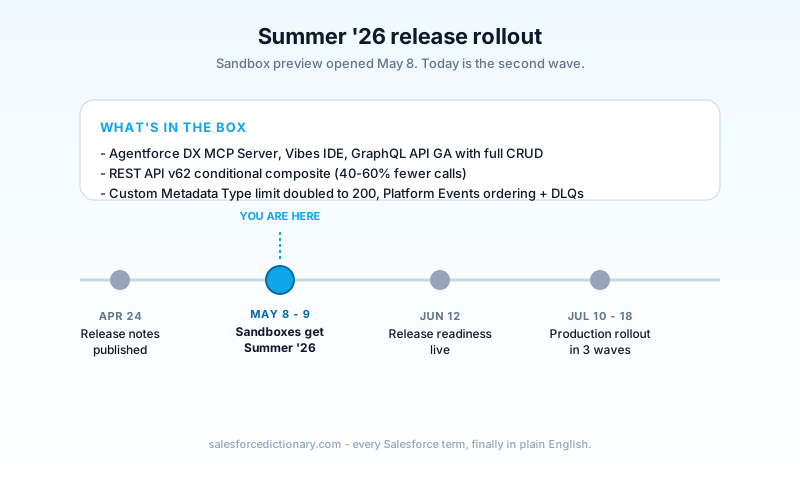
Summer '26 is a heavy release, and most of the weight is on the developer side. The four headlines:
- Agentforce DX MCP Server, Vibes IDE, and a flow-error troubleshooter. The Agentforce DX MCP Server lets coding agents author, test, and deploy Apex, LWC, and Flow against a live org using natural-language prompts. The new flow-error troubleshooter uses generative AI to read both design-time problems in saved Flows and run-time failures in active Flows, identify root causes, and suggest remediations. For admins who have ever stared at a Flow stack trace at 11pm, this is the most concrete quality-of-life upgrade in years.
- GraphQL API reaches GA with full CRUD support. GraphQL has been Beta for a while and is finally generally available. Combined with REST API v62.0's new conditional composite requests, Salesforce is claiming a 40 to 60 percent reduction in API consumption for clients that adopt both. Integration owners who have been juggling API limit alerts should look here first.
- Platform Events get ordering guarantees and dead-letter queues. Two long-requested features land at once. Platform Events publishers can now opt into ordered delivery within a partition, and failed event subscriptions can route to a DLQ instead of being silently dropped. The pricing on the DLQs has not been published, but the architecture pattern is finally official.
- [Custom Metadata Type](/terms/custom-metadata-type) limit doubled to 200 per org. A small number with big consequences. Larger packaged apps and complex managed solutions have been bumping into the 100-record ceiling for years. Doubling it without a price change is a free win for ISVs.
There are dozens of smaller items in the release notes, but those four are the ones that will end up on most release-readiness checklists.
State of Sales 2026: agent usage hit 54 percent
On the same morning the second sandbox wave finished, Salesforce published the 2026 edition of its State of Sales report. The headline number is that 87 percent of sales organizations now use some form of AI for prospecting, forecasting, lead scoring, or drafting. That is the kind of saturation number that does not change much year over year, so the more interesting figure is the agent-specific one: 54 percent of individual sellers say they have used an agent at least once, and roughly nine in ten plan to by 2027.
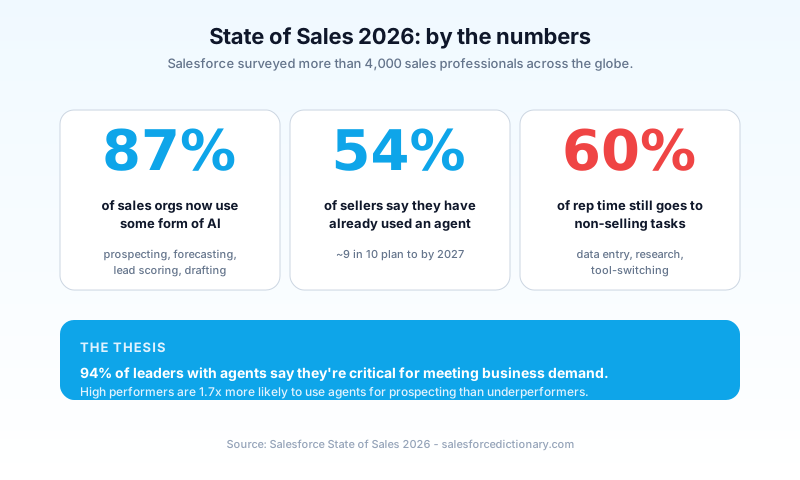
The report is based on a survey of more than 4,000 sales professionals. A few of the more useful data points buried below the headline:
- 94 percent of sales leaders who already deploy agents call them critical for hitting business demands. That is a strong leadership signal even allowing for survey bias.
- Sales reps still spend 60 percent of their time on non-selling tasks, mostly manual data entry, lead research, and tool-switching. The pitch for agents is squarely aimed at this number.
- High-performing sellers, defined as those with substantial year-over-year revenue growth, are 1.7 times more likely than underperformers to use agents specifically for prospecting.
- 84 percent of data and analytics leaders agree that AI output quality is bounded by data input quality, and 70 percent believe the most valuable insights are stuck in unstructured data. That doubles as a pitch for Data 360 and the unstructured-data ingestion work that has been shipping all year.
For Salesforce as a vendor, the report is positioned to seed the Q1 FY27 earnings call on May 27. Agent attach rate and Data 360 consumption are the two metrics analysts will press on, and this report puts both in front of them ahead of time.
Headless 360 and Agentforce Vibes 2.0 ship to Developer Edition
The third story is technically a TDX 2026 follow-up, but the actual rollout to Developer Edition orgs landed in the first week of May, and most developers only started exploring it on May 8 once the preview sandbox refresh freed up their attention. Every Developer Edition org now includes:
- The browser-based Agentforce Vibes IDE, a cloud-hosted VS Code environment.
- Agentforce Vibes 2.0 with full org awareness from the start and multi-model support including Claude Sonnet 4.5 (the new default), GPT-5, and Gemini.
- A Salesforce-hosted MCP server that exposes more than 60 MCP tools and 30 preconfigured coding skills against the live org.
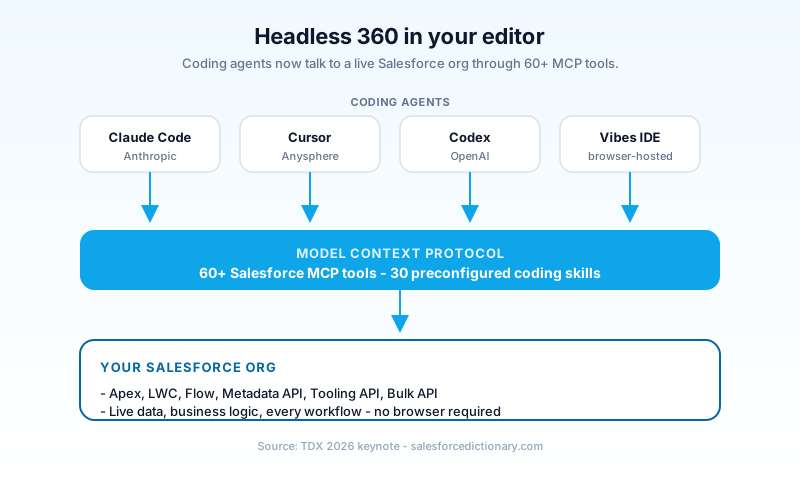
The framing matters. Salesforce is calling this Headless 360 because the platform's capabilities have been pulled away from the traditional browser UI. Coding agents like Claude Code, Cursor, Codex, and the new Vibes IDE can read your data, change your metadata, and run your business logic over MCP, with no need for a Salesforce window open in another tab. The pitch from the TDX keynote was that you can now build on Salesforce "any way you want," and the early developer feedback on social has been that this is a more honest claim than usual. The MCP tools cover Apex execution, LWC scaffolding, Flow management, the full Metadata API, the Tooling API, and Bulk API ingestion.
There is also a new Agentforce Experience Layer, a UI service that lets agents render rich interactive components like flight-status cards, decision tiles, and rebooking workflows natively inside Slack, Mobile, ChatGPT, Claude, Gemini, Microsoft Teams, or any client that supports MCP apps. It is an early preview, but the implication is that the agent's response surface is no longer the Salesforce chat panel.
What it all means for practitioners
Three things to do this week.
First, if you administer a sandbox that received the May 8-9 refresh, get a release-readiness pass on the calendar before May 16. The Flow-error troubleshooter is a major productivity gain, but it changes how stack traces are surfaced, and any custom Flow monitoring you have built may need to read different fields. Validate your Flow alerts. Test any integrations that hit the REST or GraphQL APIs against v62 to confirm conditional composite behavior. If you maintain a managed package, double-check whether you are bumping into the old 100-record Custom Metadata Type ceiling and consider repackaging.
Second, if you sell into sales leadership, the State of Sales 2026 report is now your single best opener. Three numbers to memorize: 87 percent AI penetration, 54 percent agent usage among individual sellers, and 60 percent of rep time still going to non-selling work. The first two are about social proof for buying agents; the third is the wedge.
Third, if you write code against Salesforce, spin up a fresh Developer Edition org this week and try Agentforce Vibes IDE. The cost of trying it is zero, the workflow is genuinely new, and the better you understand it before mid-2026, the more leverage you will have when your customers start asking for it. Spend a couple of hours pointing Claude Code or Cursor at the new MCP server and see how far you can get without ever opening Setup.
The Q1 FY27 earnings call is on May 27. Expect agent-attach numbers, Data 360 consumption, and Summer '26 readiness commentary to dominate that script. We will cover the call in the next roundup.
Share this article
Sources
- Salesforce Newsroom
- Salesforce Announces State of Sales Report for 2026
- Salesforce Announces Date of First Quarter Fiscal 2027 Earnings Release and Webcast
- Salesforce Summer '26 Release Date and Preview Information (Salesforce Ben)
- Headless 360 and Agentforce Vibes 2.0 Revealed at TDX 2026 (Salesforce Ben)
- Introducing Salesforce Headless 360. No Browser Required.
- Summer '26 Release Quick Summary (Automation Champion)
Related dictionary terms
Keep reading
Data Cloud Is Now Data 360: What Actually Changed (and Why It Matters)
Data Cloud became Data 360 in October 2025. Beyond the rename: Zero-Copy Federation, Tableau Semantics, the Lakehouse, and a new credit model. Here's the full picture.
What Is Salesforce Headless 360? The Complete 2026 Guide for Developers, Admins & Architects
Salesforce Headless 360 exposes Salesforce capabilities as APIs, MCP tools, and CLI commands so work can happen in agents, Slack, voice, and custom apps without relying on the browser UI.
What Is Agentforce 360? The Complete 2026 Guide for Salesforce Admins, Developers & Architects
Agentforce 360 is Salesforce's 2025 rebrand of its agentic-AI platform - built on the Atlas Reasoning Engine, Einstein Trust Layer, and Data 360. Here's the complete admin + dev + architect guide.